
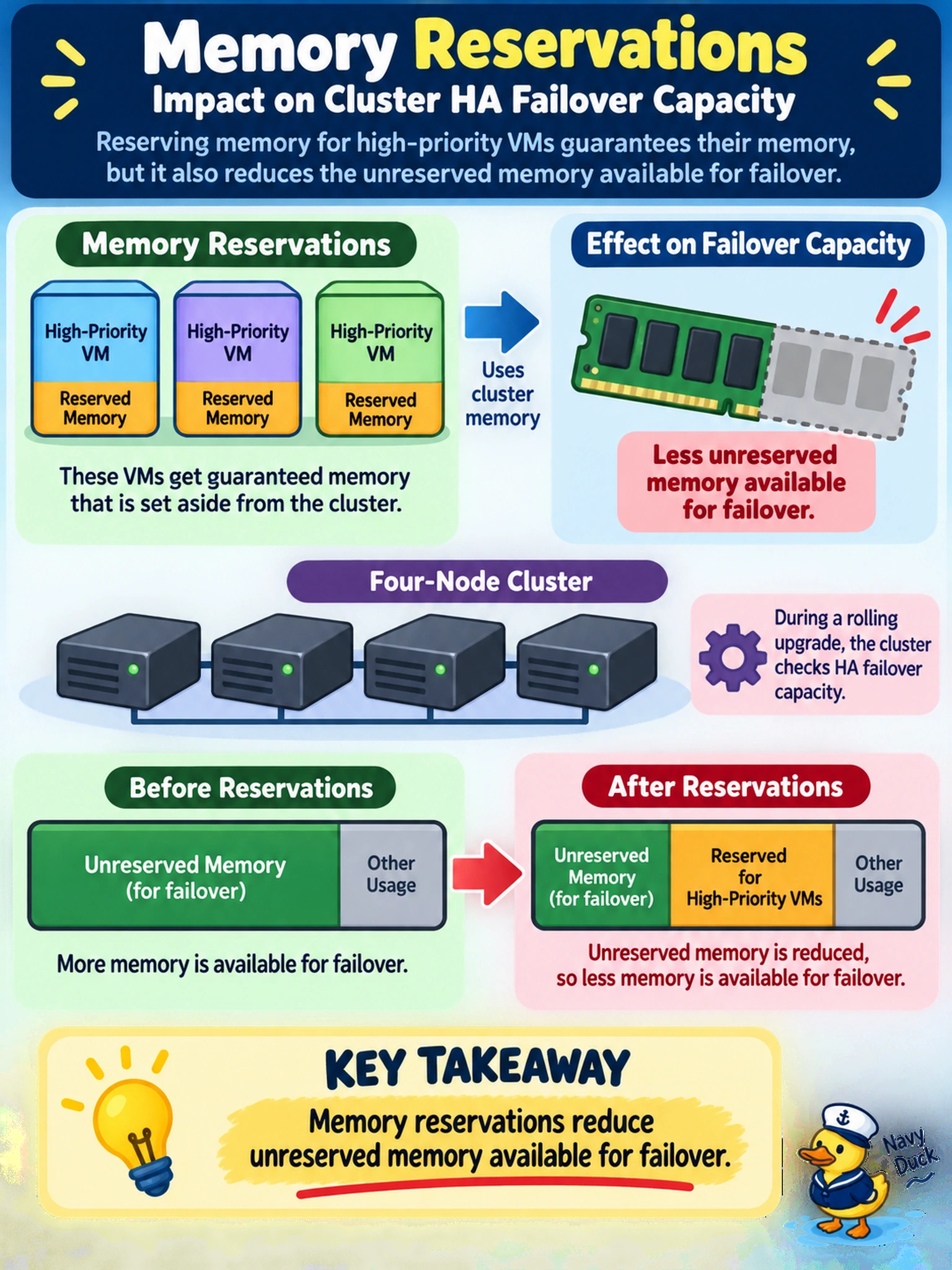
An administrator configures memory reservations for high-priority AHV VMs on a four-node cluster. Before a rolling upgrade, they review cluster HA failover capacity. What will these reservations most likely change?
Select an answer to reveal the explanation.
Short Explanation
Think about memory reservations like reserved seats at a concert: they look nice on paper, but they take up real room. Your HA math has to use the seats that are still open, not the ones already promised. High reservations shrink the failover pool, so a node failure can leave you short even when the cluster seems big.
Full Explanation
Memory reservations guarantee that a VM’s specified memory is held available on the host that runs it. Nutanix AHV treats that reserved memory as consumed for admission and placement, so it cannot be freely oversubscribed or used by other VMs. In an HA scenario, a node failure requires enough unreserved memory on surviving nodes to accept VMs that must restart. High reservations therefore reduce the failover headroom shown for the cluster, even if raw free memory appears adequate. The idea that reservations increase failover capacity is wrong because they do not create capacity; they only earmark capacity for a specific workload. The idea that HA cannot run until reservations are removed is too absolute: HA can still function when enough unreserved capacity remains, and reservations are not a global HA switch. The idea that reservations affect only CPU is wrong because memory reservations govern memory allocation and admission, not processor scheduling. Exam caveat: on the exam, distinguish reservations from limits and oversubscription: a reservation lowers oversubscription and can expose capacity problems during maintenance. Operational check: before a rolling upgrade, compare total reserved memory across all VMs with available memory on the remaining nodes and verify HA failover capacity in Prism.