
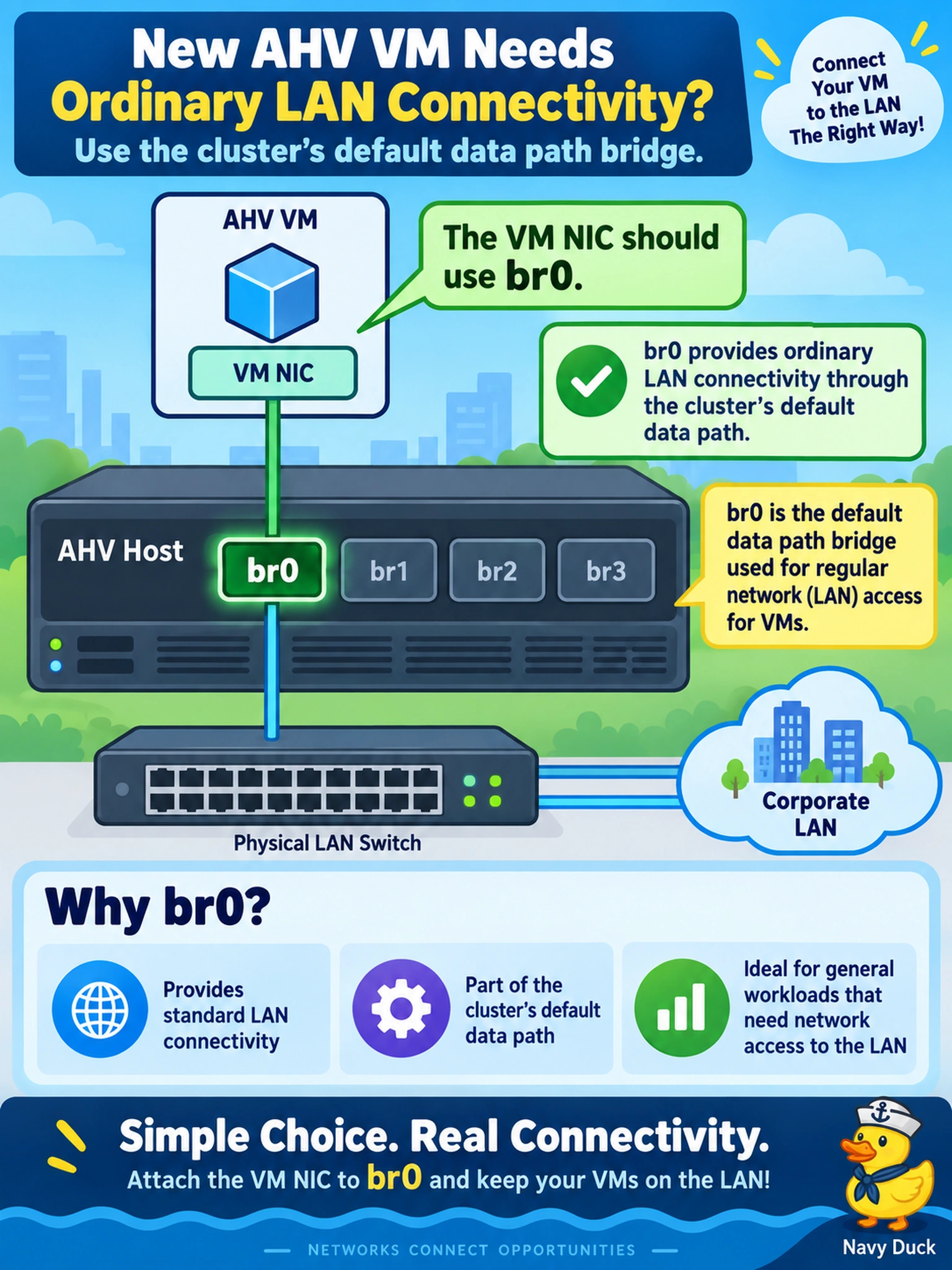
An engineer creates a new AHV VM that needs ordinary LAN connectivity through the cluster’s default data path. Which bridge should the VM NIC use?
Select an answer to reveal the explanation.
Short Explanation
Think of a bridge like the street your VM drives on. On AHV, the default data bridge for VM traffic is br0, not the control-plane bridges. If your VM can’t reach the LAN, check that it’s plugged into br0 first.
Full Explanation
AHV uses Linux bridges to connect virtual machine NICs to physical uplinks. The default bridge intended for ordinary VM data-plane traffic is br0, so a VM that should communicate over the normal LAN is attached through br0 and then inherits the VLAN or bond configuration applied to that bridge. Control or management bridges exist to carry infrastructure traffic, not to serve as the generic VM attachment point. A control bridge such as br-ctl is associated with the CVM/control path, so using it for an application VM would mix workload traffic with cluster control traffic and bypass the intended data-plane segmentation. A management bridge name implies access to host management or administrative traffic, which is not the default path for VM LAN connectivity and can expose or isolate workload traffic incorrectly. An LCM bridge name suggests lifecycle or update-related traffic, not routine VM networking; assigning a production VM there would be conceptually wrong because lifecycle operations are not the VM data plane. Exam caveat: the exam may describe the bridge function rather than the literal name, so recognize “default VM data bridge” as br0. Operational check: confirm the VM NIC is attached to br0 and that br0 is mapped to the correct physical NIC or bond and VLAN before troubleshooting guest connectivity.