
A Nutanix administrator is reviewing capacity efficiency on an AHV cluster using RF2 containers. Management proposes enabling EC-X instead of keeping full replication for selected workloads. Which statement best describes the trade-off?
Select an answer to reveal the explanation.
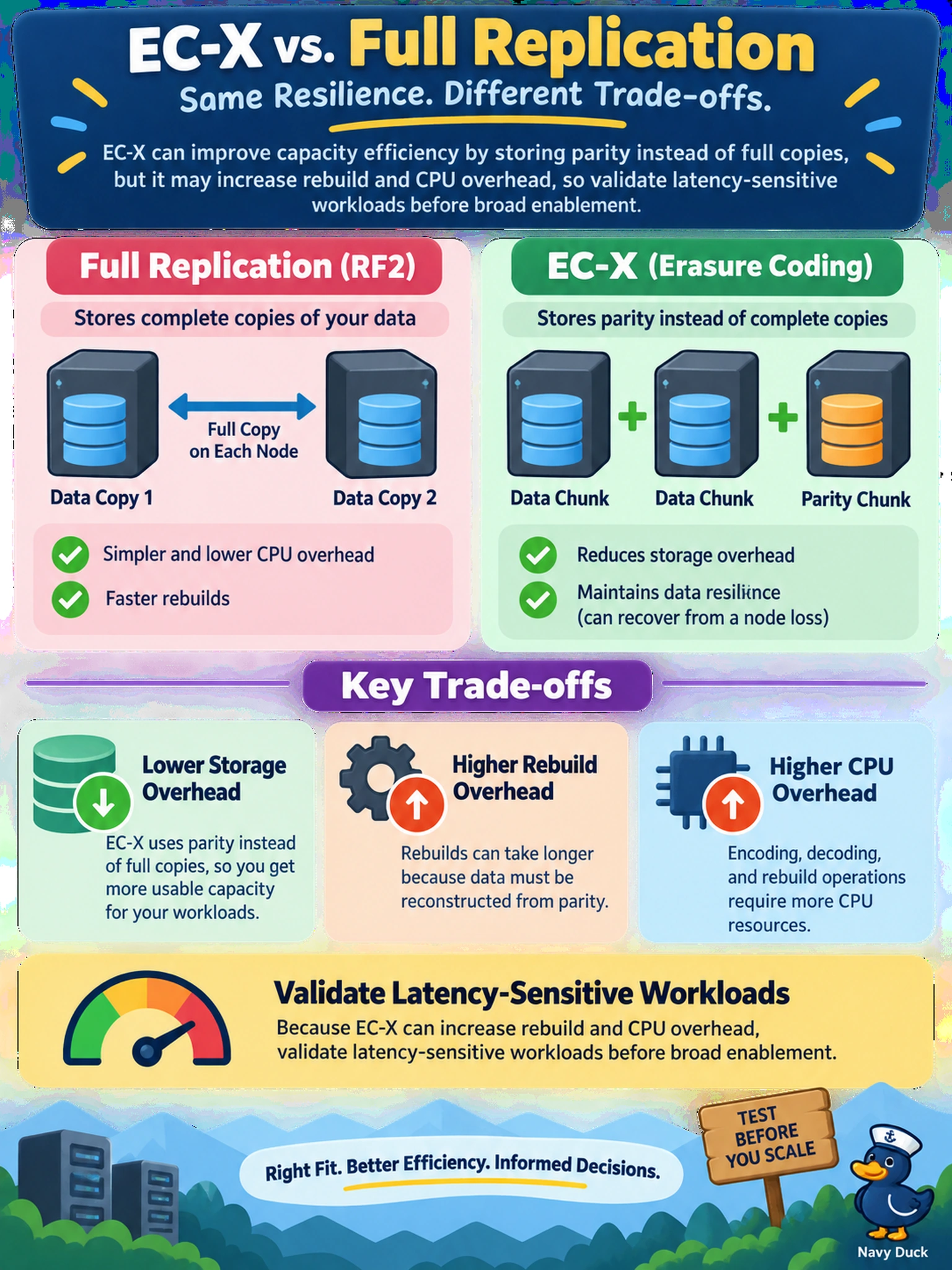
Short Explanation
Think of EC-X like trading a full photocopy for a puzzle piece and parity: you save disk space, but putting a broken piece back takes more math. If your VMs are latency-sensitive, check rebuild and CPU impact before rolling it out cluster-wide.
Full Explanation
EC-X changes how AOS stores redundant data. Instead of keeping complete replica copies for every block, it breaks data into stripes and adds parity information, so the effective capacity multiplier is lower than full replication. That is why it is proposed for capacity efficiency. The trade-off is that parity calculations and reconstruction can consume CPU and increase rebuild work, especially when multiple nodes or disks fail, and latency-sensitive workloads may notice the effect. A statement claiming EC-X eliminates replication and guarantees identical write latency is wrong because erasure coding still provides redundancy and changes the write path. A statement claiming it only improves capacity by reducing RF2 to RF1 is wrong because EC-X works with the container redundancy factor and changes how redundancy is stored, not by abandoning redundancy. A statement claiming capacity savings are independent of rebuild behavior is wrong because rebuild cost and CPU overhead are direct consequences of using parity-based protection. Exam caveat: EC-X is a capacity-efficiency feature, not a blanket performance optimization, and its benefit depends on container RF, workload profile, and cluster scale. Operational check: Review container RF and EC-X settings, then run NCC health checks and monitor CVM CPU, write latency, and rebuild activity on a representative workload before enabling it broadly.