
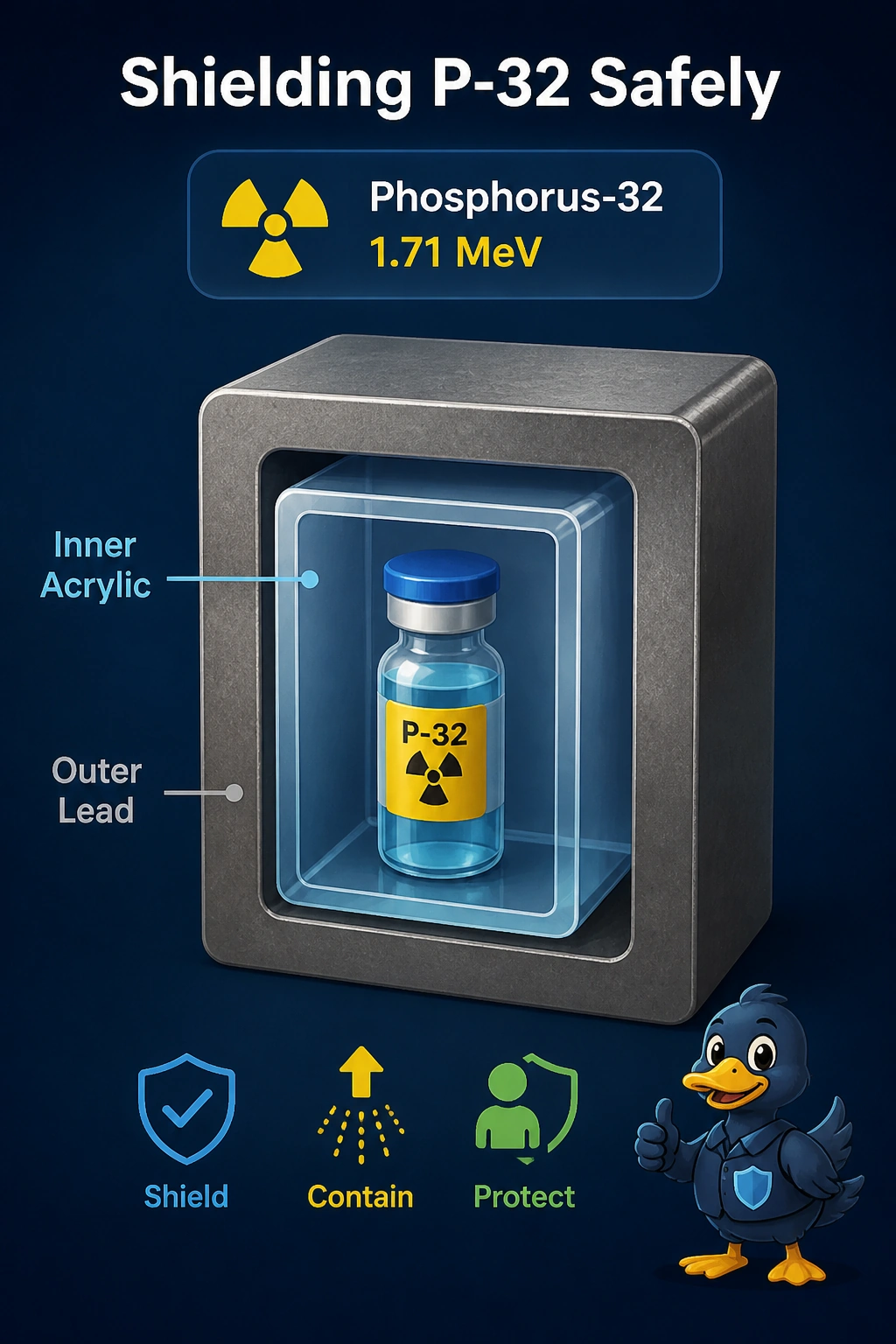
A laboratory needs to shield a high-activity Phosphorus-32 vial (a pure beta emitter with a 1.71 MeV maximum beta energy) to minimize total external dose to workers. Which shielding configuration best prevents secondary X-ray production?
Select an answer to reveal the explanation.
Short Explanation
High-energy beta particles slamming into heavy metal are like a sports car hitting a brick wall—they screech to a halt and throw off bremsstrahlung X-rays. To protect your workers, you want a low-atomic-number material like plastic on the inside to stop the betas gently first. Putting lead on the inside is the classic trap that creates a new X-ray hazard.
Full Explanation
When high-energy beta particles decelerate in matter, a fraction of their kinetic energy converts into bremsstrahlung X-rays, and the yield scales roughly with the atomic number (Z) of the absorber and the beta energy. Stopping Phosphorus-32 betas in a low-Z material such as acrylic, polycarbonate, or aluminum minimizes bremsstrahlung production; adding an outer high-Z layer only if residual photon attenuation is needed matches An inner acrylic shield with outer lead if needed. Using A thin inner lead liner surrounded by outer acrylic reverses the proper order, exposing the 1.71 MeV betas directly to high-Z lead (Z = 82) and maximizing secondary X-ray generation that acrylic cannot effectively attenuate. Using A single solid sheet of high-density tungsten (Z = 74) or A double layer of depleted uranium metal plates (Z = 92) places extremely high-Z absorbers directly in the beta beam, converting a pure beta hazard into a penetrating bremsstrahlung photon hazard. As a caveat, acrylic thickness must exceed the maximum beta range in plastic (about 7 to 8 mm for P-32) so betas do not penetrate into any outer lead layer. Operationally, survey the outside of the assembled shield with both a Geiger-Mueller pancake probe and a thin-window ion chamber to confirm both beta and bremsstrahlung dose rates are controlled.
Prefer to study offline? Printable PDF study book + test engine ($7.50, unofficial). These questions stay free here.