
Under NRC 10 CFR 20.1003, at what tissue depth is the Shallow-Dose Equivalent (SDE) evaluated for external exposure to the skin of the whole body or an extremity?
Select an answer to reveal the explanation.
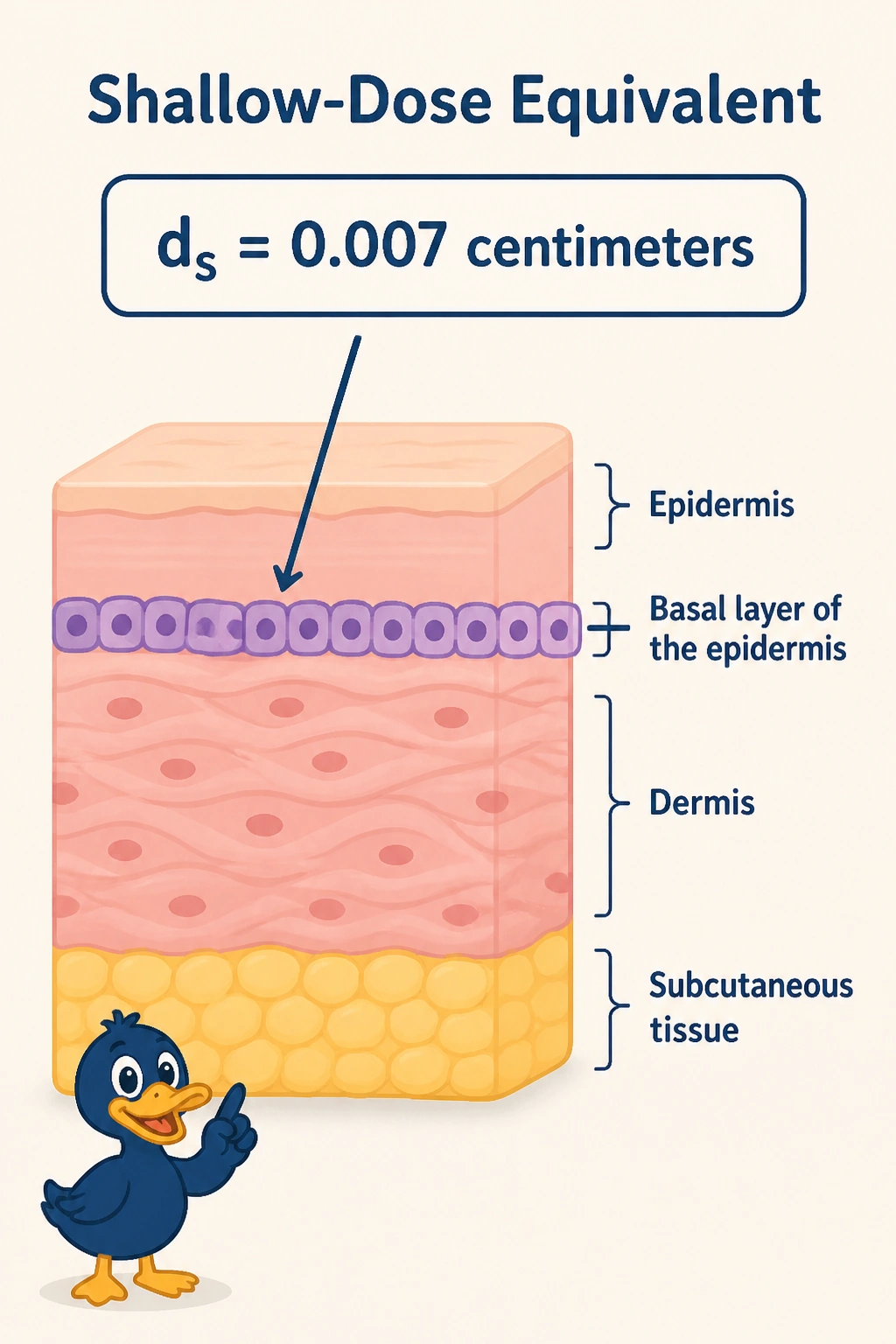
Short Explanation
Think of the skin's living basal cells sitting just beneath a paper-thin outer layer of dead cells. When you match dosimetry quantities to 10 CFR 20.1003 depths, the trap is mixing up the superficial 0.007 cm skin depth with the deeper eye-lens or whole-body depths.
Full Explanation
Under NRC 10 CFR 20.1003, Shallow-Dose Equivalent (SDE) applies to the external exposure of the skin of the whole body or the skin of an extremity and is defined as the dose equivalent at a tissue depth of 0.007 centimeters, corresponding to the basal layer of the epidermis (7 milligrams per square centimeter). Weakly penetrating radiations such as beta particles and low-energy X-rays deposit most of their energy near this shallow depth. 0.3 centimeters, corresponding to the average depth of the lens of the eye is incorrect because 0.3 cm (300 mg/cm²) is the regulatory evaluation depth for Lens Dose Equivalent (LDE), not SDE. 1.0 centimeter, corresponding to the standard depth for deep-dose evaluation fails because 1.0 cm (1,000 mg/cm²) defines the Deep-Dose Equivalent (DDE) for penetrating whole-body radiation. 5.0 centimeters, corresponding to the midline of the adult human torso is wrong because 10 CFR 20.1003 does not define any external dosimetry quantity at 5.0 cm. As a caveat, SDE is averaged over the contiguous 10 square centimeters of skin receiving the highest exposure. Verify that passive dosimeter badges used in beta fields include a thin open-window element matching roughly 7 mg/cm² filtration.
Prefer to study offline? Printable PDF study book + test engine ($7.50, unofficial). These questions stay free here.