
When 100 keV electrons strike a tungsten target inside an industrial X-ray tube, what happens to the vast majority (roughly 99 percent) of the electrons' kinetic energy?
Select an answer to reveal the explanation.
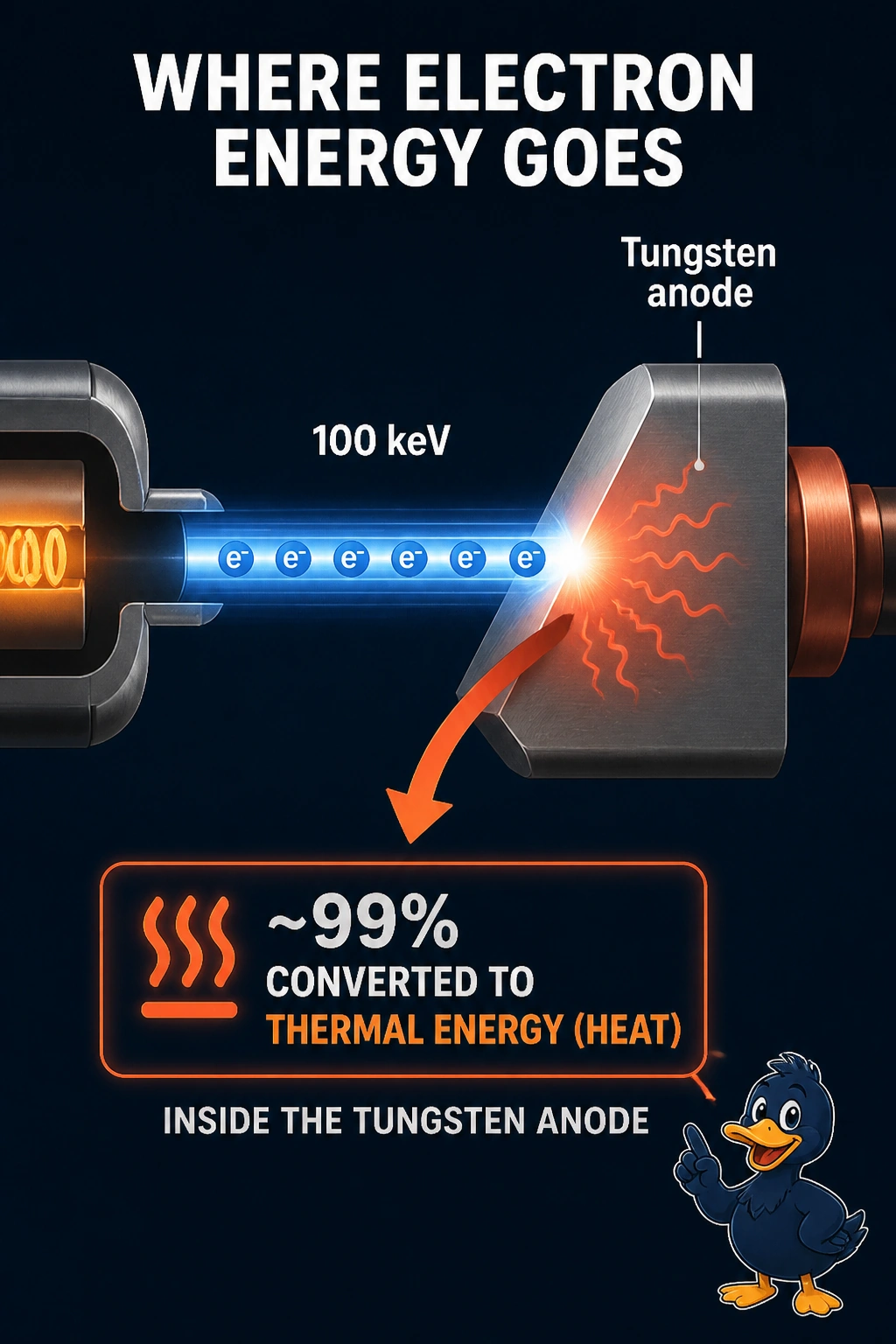
Short Explanation
An X-ray tube is actually a remarkably inefficient heater that happens to make a few X-rays on the side. At 100 keV, about 99 percent of your electron beam energy turns into thermal energy in the tungsten anode rather than useful photons. The trap is assuming bremsstrahlung or characteristic X-rays take most of the energy, when radiative yield is around 1 percent.
Full Explanation
When accelerated electrons enter a high-Z target at 100 keV, they undergo thousands of small-angle Coulomb interactions with outer-shell atomic electrons, transferring kinetic energy into lattice vibrations. Selecting It is converted into thermal energy (heat) inside the tungsten anode is correct because roughly 99 percent of the incident electron energy dissipates as heat, which is why X-ray tubes require high-melting-point tungsten targets and active cooling. Selecting It is emitted as continuous bremsstrahlung X-ray photons overstates radiative efficiency; at 100 keV in tungsten, bremsstrahlung accounts for only about 1 percent of total energy loss. Selecting It is emitted as discrete K-shell characteristic X-ray lines is also wrong because characteristic emission is an even smaller fraction of the output and requires exceeding the 69.5 keV K-edge of tungsten. Selecting It ejects photoneutrons from the tungsten target nuclei is physically impossible at 100 keV because photonuclear threshold energies are several MeV. As an exam caveat, radiative bremsstrahlung efficiency rises with both electron energy and target atomic number, though heat still dominates at industrial radiography voltages. As an operational check, monitor anode heat-unit ratings and cooling intervals during prolonged exposures to prevent target melting or cracking.
Prefer to study offline? Printable PDF study book + test engine ($7.50, unofficial). These questions stay free here.