
When an alpha or beta particle ionizes dry air, roughly 34 eV of kinetic energy is expended on average to form one ion pair, even though the first ionization potential of nitrogen and oxygen is only 14 to 15 eV. Where does the remaining energy go?
Select an answer to reveal the explanation.
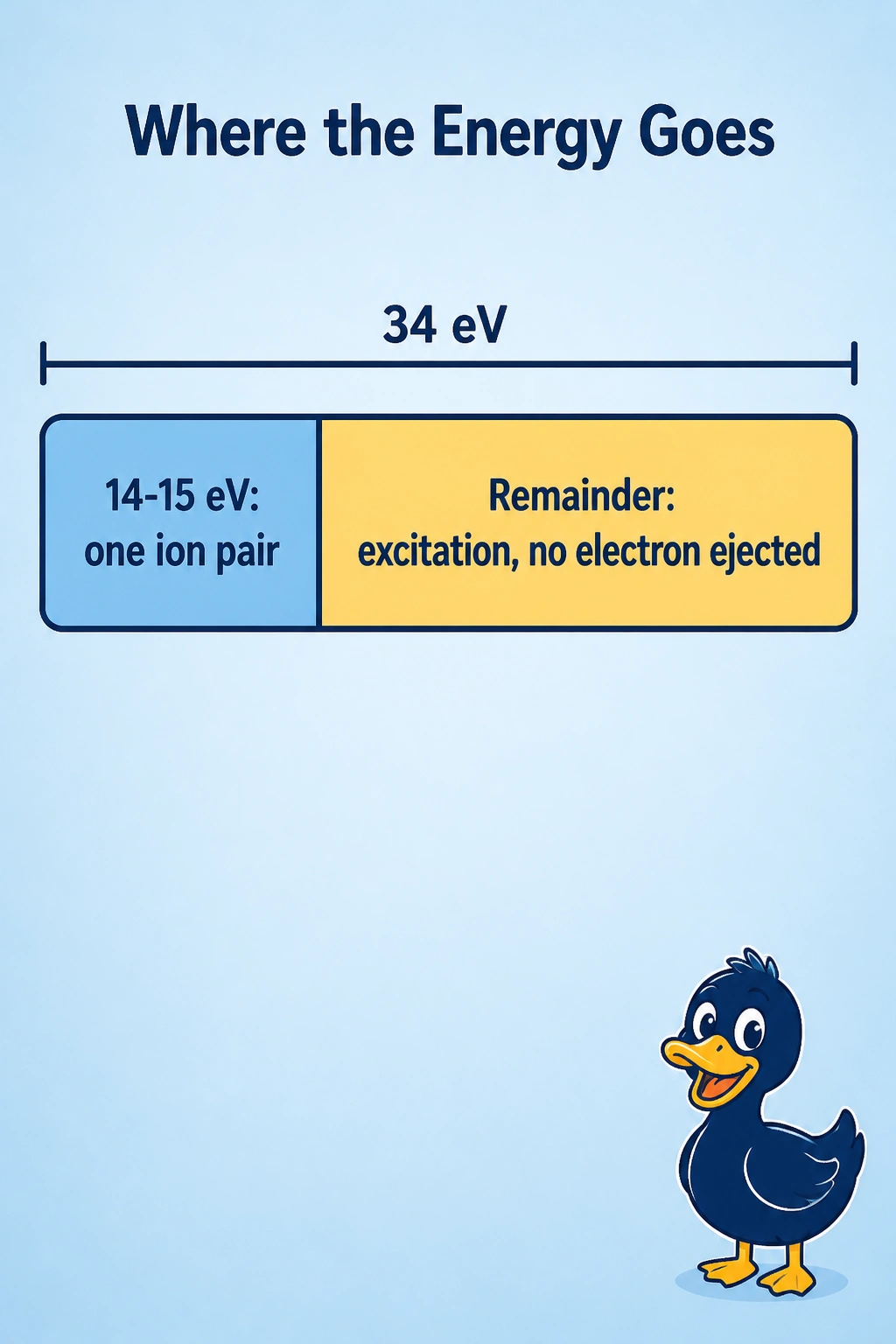
Short Explanation
Think of a charged particle moving through air like a bowling ball clipping pins without knocking every single one down—plenty of energy goes into shaking atoms rather than ionizing them. Because nitrogen and oxygen only need about 14 to 15 eV to lose an electron, you might wonder why the average W-value in air is roughly 34 eV. The trap is assuming every collision strips an electron, when in reality over half the energy goes into non-ionizing excitations.
Full Explanation
When alpha or beta particles traverse air, they lose energy through countless small coulombic interactions with orbital electrons. Although the first ionization potential of nitrogen and oxygen molecules is roughly 14 to 15 eV, the average energy required to produce one ion pair in dry air—the W-value—is approximately 34 eV. The difference is consumed by Atomic and molecular excitation events that do not eject an electron, raising orbital electrons to higher energy states that subsequently relax by emitting low-energy photons or transferring heat. Nuclear recoil and gamma photon emission during coulombic scattering does not account for this energy gap because heavy nuclei absorb negligible kinetic energy from light electrons and low-energy alpha interactions. Complete conversion into bremsstrahlung X-rays within the gas volume is incorrect because radiative losses are minimal in low-atomic-number gases like air, especially for heavy charged particles. Capture of the incident charged particle by an oxygen or nitrogen nucleus is rare at typical decay energies and cannot explain the steady average energy loss per ion pair. Note that the W-value varies slightly between gas mixtures, such as P-10 proportional gas versus air, so always verify the fill gas specification. In practice, confirm that ionization chamber calibration factors match the gas type and ambient pressure when converting current to exposure rate.
Prefer to study offline? Printable PDF study book + test engine ($7.50, unofficial). These questions stay free here.