
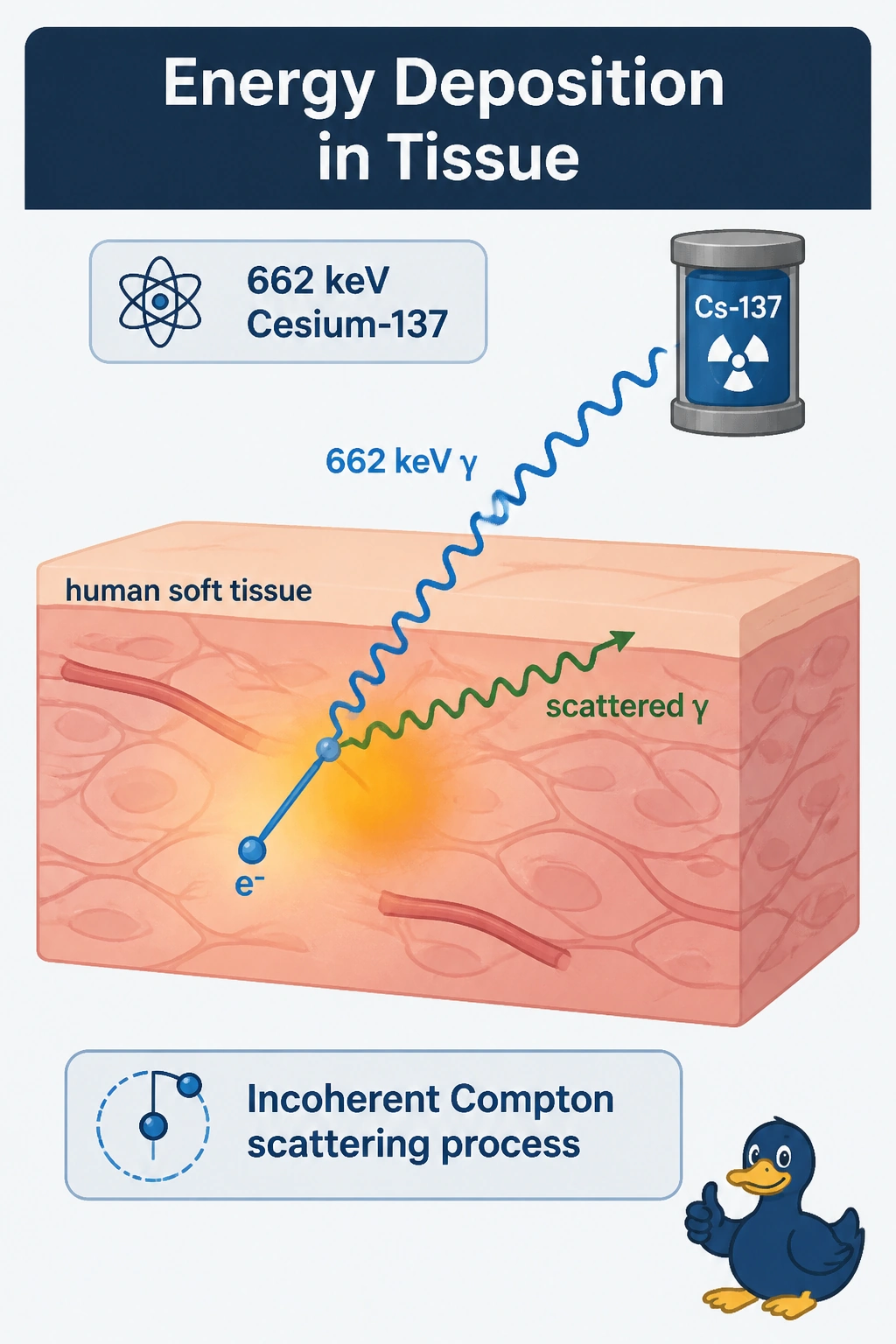
When 662 keV gamma rays from Cesium-137 interact with human soft tissue, which photon interaction mechanism accounts for the vast majority of energy deposition?
Select an answer to reveal the explanation.
Short Explanation
In low-atomic-number tissue, 662 keV gamma rays pack too much punch for photoelectric absorption and not enough energy for pair production. That leaves your photons playing billiards with outer-shell electrons. Watch out for the trap of picking pair production—it cannot even happen below 1.022 MeV!
Full Explanation
In soft tissue (low effective atomic number, roughly Z_eff around 7.4), the Incoherent Compton scattering process dominates photon interactions across the intermediate energy range from roughly 30 keV up to several MeV. At 662 keV, an incoming photon collides with a loosely bound outer-shell electron, transferring part of its energy to the recoil electron and continuing at a reduced energy and altered angle. Photoelectric absorption effect dominates at lower photon energies (below roughly 30 keV in soft tissue) and in high-Z materials like lead, because its probability scales roughly with Z^4 / E^3. Electron-positron pair production is physically impossible at 662 keV because the photon energy must exceed the 1.022 MeV threshold required to create the rest masses of an electron and a positron. Coherent Rayleigh scattering is an elastic interaction that changes photon direction without ionizing the atom or depositing energy, and it is significant only at low photon energies. As a caveat, scattered Compton photons retain substantial energy and can exit the body or shield, contributing to worker dose around patients or open sources. Operationally, health physicists account for Compton scatter by placing portable shields close to the source and verifying room scatter levels with an ion chamber.
Prefer to study offline? Printable PDF study book + test engine ($7.50, unofficial). These questions stay free here.