
A technician accidentally enters an unshielded irradiator bay for several seconds before exiting as the area alarm sounds, raising concern about a significant acute external gamma exposure. Which immediate radiological investigation step is essential for accurate dose reconstruction?
Select an answer to reveal the explanation.
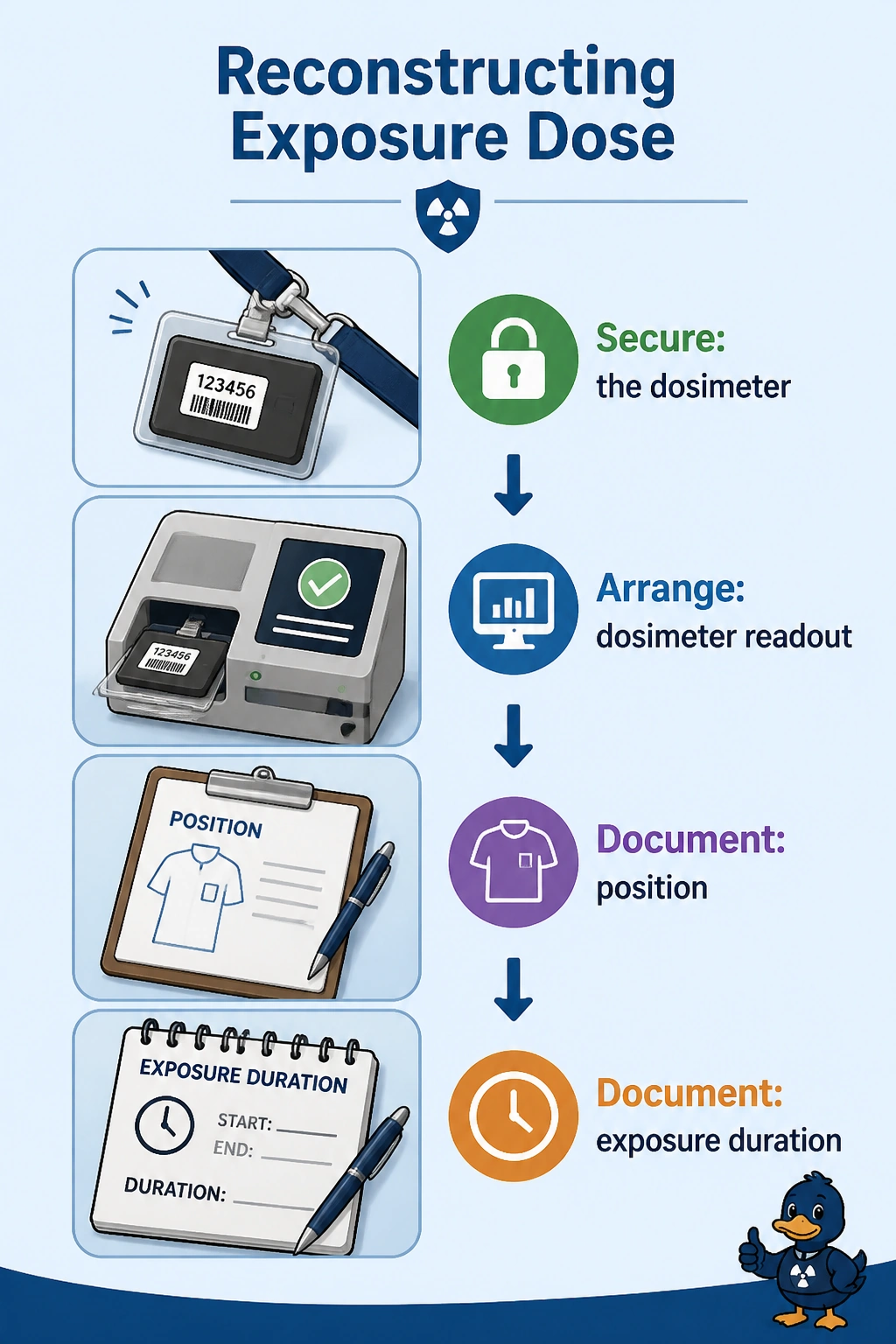
Short Explanation
After an unexpected high-dose entry, you should preserve the evidence so health physics can reconstruct what your body experienced. Dosimeter readout and a record of your position and exposure duration are essential; resetting it or waiting for routine processing can erase critical timeline clues.
Full Explanation
When a significant external exposure is suspected, accurate dose reconstruction depends on preserving physical evidence and timeline details. Secure the dosimeter for readout and document the worker’s position and exposure duration so health physics, the Radiation Safety Officer, and the medical team can assess whole-body and localized doses promptly. Zeroing the electronic dosimeter so the worker can resume normal duties can destroy alarm and dose history needed for the investigation and risks additional exposure. Potassium iodide does not block gamma absorption: it protects the thyroid from uptake of radioactive iodine, not from an external gamma field. Discarding clothing and waiting for the next quarterly dosimetry cycle delays urgent medical assessment and may discard evidence of activation or contamination. One caveat is that if an acute whole-body dose exceeds regulatory investigation thresholds, early blood counts for lymphocyte depletion and cytogenetic analysis may be warranted alongside dosimetry. As a practical check, interview the worker promptly to record source geometry, shielding, and exact time in the bay before memories fade.
Prefer to study offline? Printable PDF study book + test engine ($7.50, unofficial). These questions stay free here.