
A nuclear facility discharges treated batch and continuous process water through an outfall pipe whose flow rate and radionuclide concentration vary throughout the week. Which effluent sampling method provides the most accurate measure of total weekly activity released?
Select an answer to reveal the explanation.
Short Explanation
Taking one snapshot of a changing river misses every surge and lull that happens the rest of the week. To capture true total effluent activity, you need a sample that scales with flow, and the trap is relying on a single grab sample or non-radiological water parameters.
Full Explanation
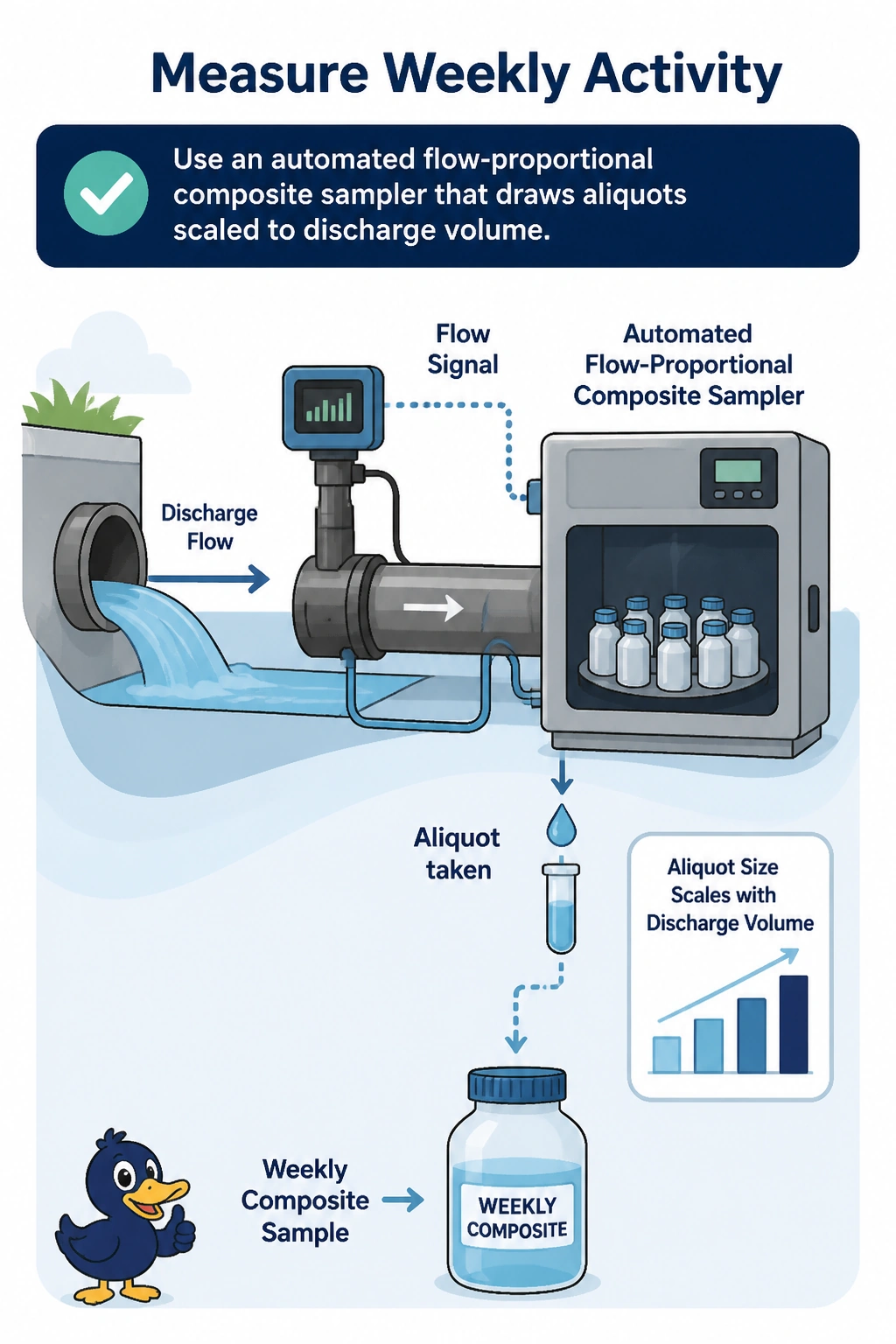
The most accurate way to quantify variable liquid releases is Using an automated flow-proportional composite sampler that draws aliquots scaled to discharge volume. Because both concentration and volumetric flow fluctuate over time, drawing sample increments proportional to discharge flow ensures the composite bottle represents the true volume-weighted average concentration across the entire week. Collecting a single grab sample at mid-week when facility operations are at peak capacity can severely bias the estimate high or low because it ignores off-peak batches and dilution changes. Placing passive thermoluminescent dosimeters submerged directly inside the outfall pipe is ineffective because TLDs measure integrated external photon or beta dose rather than specific radionuclide concentrations in water, and alpha or low-energy beta emitters would go undetected. Likewise, Measuring the water temperature and electrical conductivity continuously at the discharge point to estimate activity fails because conductivity and temperature reflect dissolved salts and thermal load, not trace radioactive isotopes. As a caveat, composite samples must be preserved properly so radionuclides do not plate out onto container walls before analysis. Verify flow-meter calibration and check sample-line tubing for fouling or blockage during weekly effluent collection.
Prefer to study offline? Printable PDF study book + test engine ($7.50, unofficial). These questions stay free here.