
A gamma spectroscopy laboratory needs to separate two closely spaced gamma photopeaks from a mixed fission-product sample. Why does a high-purity germanium (HPGe) detector provide much sharper energy resolution than a sodium iodide NaI(Tl) scintillation detector?
Select an answer to reveal the explanation.
Short Explanation
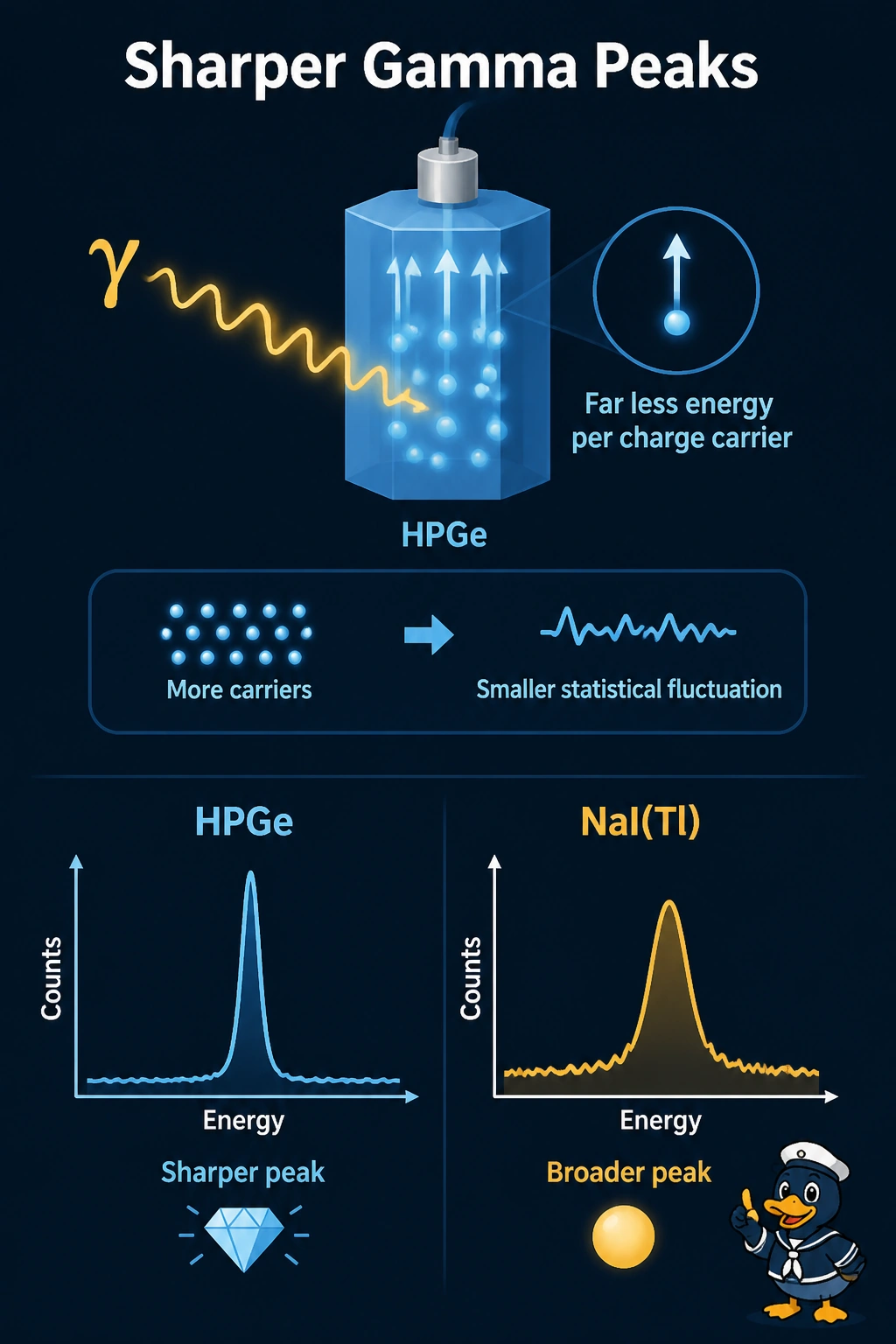
If you want to tell two nearly identical gamma energies apart, you need a detector that creates a crowd of information carriers for every photon. The trap is assuming NaI(Tl) loses on resolution because of atomic number, when NaI(Tl) actually has higher Z and better efficiency. HPGe wins on resolution because creating an electron-hole pair takes only about 3 eV, giving vastly better counting statistics per keV.
Full Explanation
Energy resolution depends primarily on the number of primary information carriers produced per unit of deposited photon energy. In a semiconductor detector, HPGe requires far less energy per charge carrier, producing more carriers and smaller statistical fluctuation—about 3 eV per electron-hole pair versus hundreds of eV per photoelectron in a NaI(Tl) system. That large carrier yield shrinks relative statistical spread, producing sharp photopeaks. Claiming that HPGe crystals have a higher effective atomic number than sodium iodide, increasing photoelectric absorption is backwards, because iodine (Z = 53) gives NaI(Tl) higher effective Z and intrinsic efficiency than germanium (Z = 32). Stating that HPGe detectors operate at room temperature without liquid nitrogen cooling, reducing electronic noise is wrong because germanium's small band gap requires cryogenic cooling to suppress thermal leakage current. Finally, HPGe detectors use a built-in photomultiplier tube to amplify faint light flashes inside the crystal describes scintillators, whereas HPGe collects electron-hole pairs directly under bias. As a caveat, HPGe systems cost more and require cooling. Operationally, check cooler temperature or liquid nitrogen level and verify peak FWHM with a calibration source before counting.
Prefer to study offline? Printable PDF study book + test engine ($7.50, unofficial). These questions stay free here.