
A radiation protection technologist uses a sodium iodide NaI(Tl) scintillation detector coupled to a multichannel analyzer to identify an unknown gamma-emitting isotope. Which component converts the faint light flashes from the crystal into a measurable, proportional electrical pulse?
Select an answer to reveal the explanation.
Short Explanation
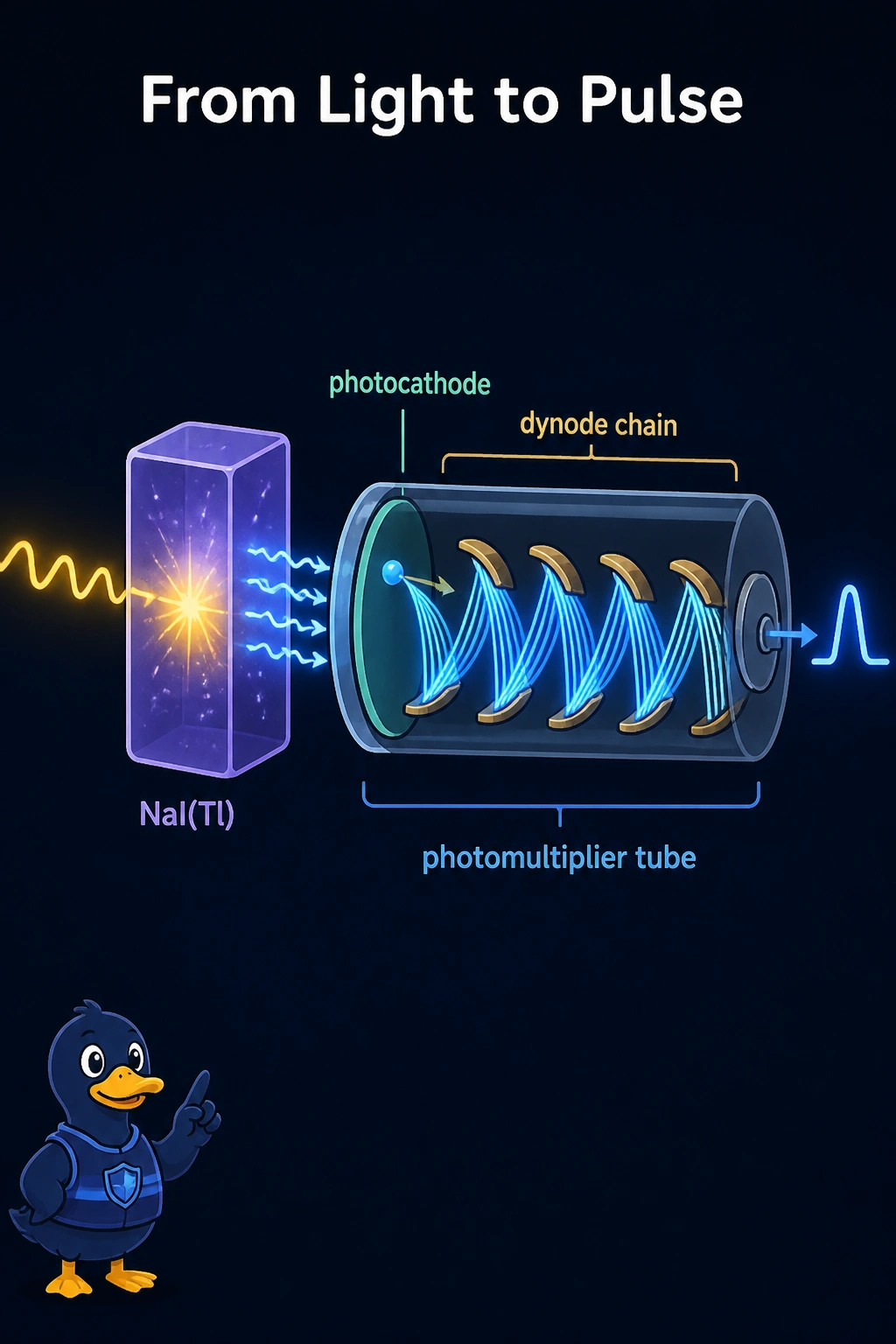
Think of a NaI(Tl) crystal as a tiny flashlight that blinks brighter for higher-energy gammas, and you need a sensitive amplifier to turn those faint blinks into a clear electrical signal. The trap is mixing up gas-filled or semiconductor parts with scintillation hardware, so keep your focus on how light becomes current.
Full Explanation
In a sodium iodide NaI(Tl) scintillation spectrometer, gamma photons deposit energy in the crystal and produce faint visible light flashes whose intensity is proportional to the absorbed photon energy. A photomultiplier tube with a photocathode and dynode chain sits optically coupled to the crystal; the photocathode converts those light photons into photoelectrons via the photoelectric effect, and successive dynodes multiply that electron cascade by orders of magnitude while preserving pulse-height proportionality for the multichannel analyzer. A thin mylar entrance window coated with conductive aluminum is used on gas-flow proportional or pancake GM probes to admit alpha and beta particles while blocking ambient light, not to convert scintillation light into pulses. A central anode wire operating in the Geiger-Mueller region creates a uniform gas avalanche that destroys energy proportionality and belongs to a gas-filled GM tube rather than a scintillator. A solid-state depletion layer biased with reverse voltage is the active sensing volume of a semiconductor detector such as high-purity germanium, where electron-hole pairs form directly without an intermediate light stage. Note that NaI(Tl) crystals are hygroscopic and light-sensitive, so even a pinhole in the aluminum housing can admit moisture or room light and ruin resolution. As an operational check, verify the photopeak channel position and full-width-at-half-maximum resolution using a known Cesium-137 check source before analyzing unknown spectra.
Prefer to study offline? Printable PDF study book + test engine ($7.50, unofficial). These questions stay free here.