
What is the primary purpose of adding a small amount of halogen or organic quench gas to the argon fill gas inside a Geiger-Mueller (GM) tube?
Select an answer to reveal the explanation.
Short Explanation
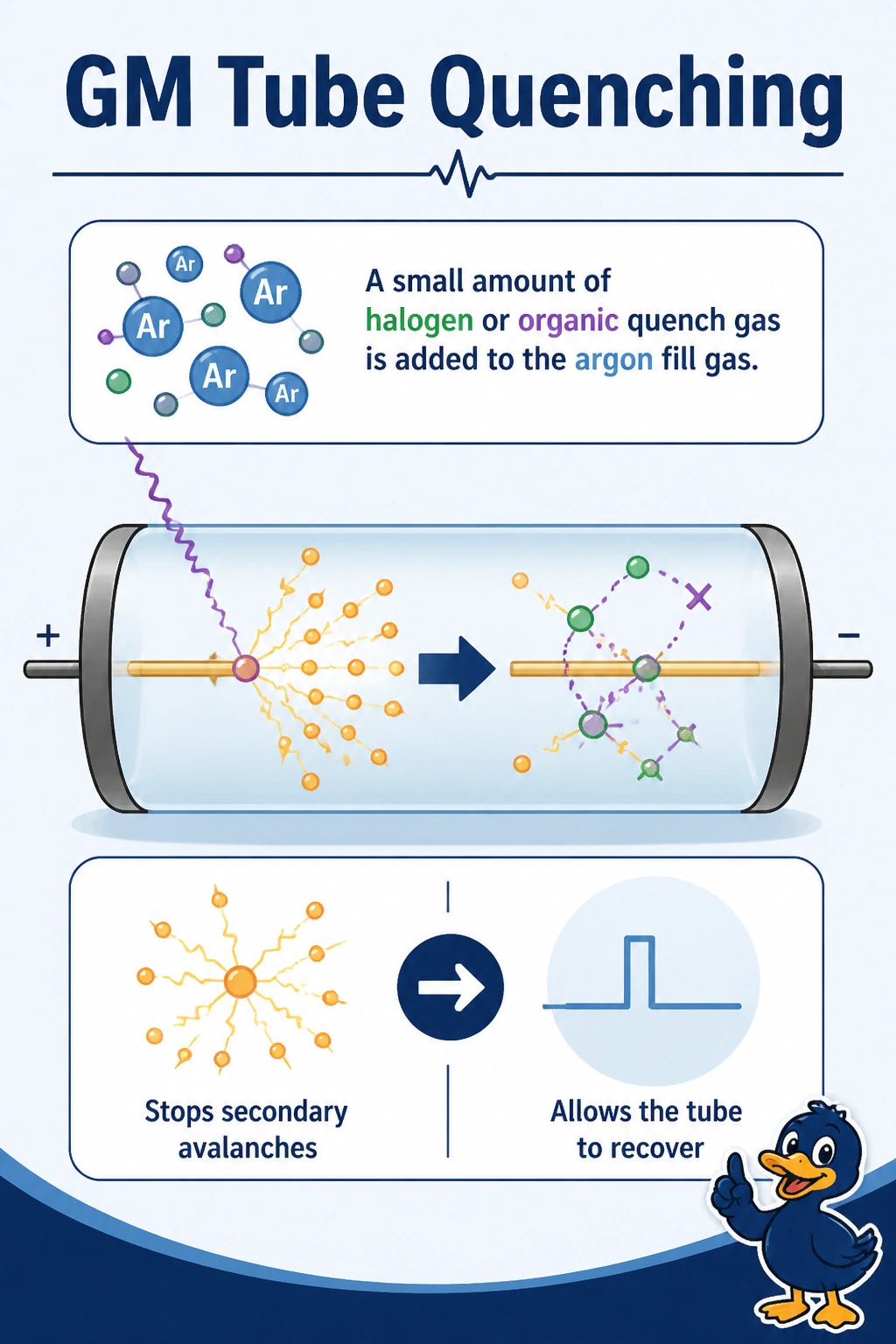
Without a quench gas, one lonely photon would send a GM tube into an endless domino chain of self-triggering sparks. On the exam, remember that quench gas shuts down the party after one pulse so your meter can reset for the next radiation event.
Full Explanation
To stop secondary avalanches and allow the tube to recover is correct because positive argon ions drifting to the cathode can otherwise eject new electrons on impact; the quench gas transfers charge to lower-ionization-potential molecules that dissociate or emit harmless energy instead of triggering a fresh Townsend avalanche. To convert the GM tube into an energy-resolving spectrometer is false because every GM discharge saturates the entire anode wire regardless of initial particle energy, so pulse height carries no energy information. To thermalize fast neutrons so they trigger gas avalanches is wrong because thermalizing fast neutrons requires a thick external hydrogenous moderator around a neutron-sensitive detector, not trace quench gas inside a GM tube. To raise the operating voltage needed for gas multiplication is incorrect because quench gas is added to stabilize recovery and extend plateau performance rather than to push operating voltage higher. As an exam caveat, organic quench gases like ethanol are gradually consumed during each pulse and give the tube a finite count lifetime, whereas halogen quench gases recombine and last much longer. Operationally, check the GM plateau curve periodically with a check source; a shrinking or steeply sloping plateau signals quench-gas depletion.
Prefer to study offline? Printable PDF study book + test engine ($7.50, unofficial). These questions stay free here.