
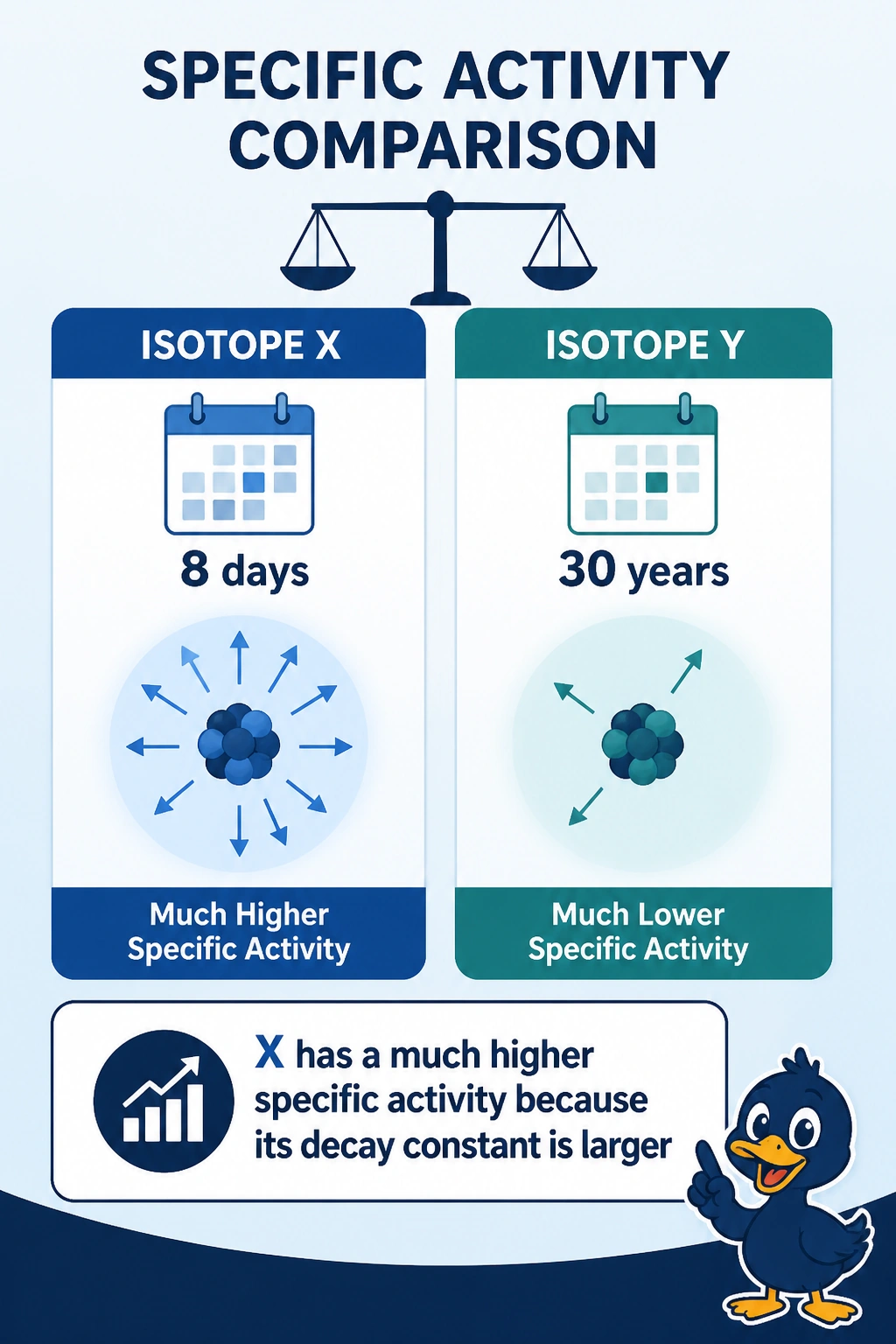
A radiochemist compares two pure, carrier-free radionuclides that have nearly identical atomic weights: Isotope X has a half-life of 8 days, while Isotope Y has a half-life of 30 years. How do their specific activities (activity per gram) compare?
Select an answer to reveal the explanation.
Short Explanation
Specific activity measures how fast a gram of atoms is decaying, so the short-lived sprint runner packs far more curies per gram than the 30-year marathoner. The trap is assuming equal mass means equal activity, when your decay rate is inversely proportional to half-life.
Full Explanation
Isotope X has a much higher specific activity because its decay constant is larger: specific activity equals the decay constant multiplied by Avogadro's number divided by atomic weight, so for two nuclides of similar mass, the shorter half-life yields a proportionally larger decay constant and far more disintegrations per second per gram. Isotope Y has a higher specific activity because its nuclei decay much more slowly reverses the inverse relationship between half-life and activity; slower decay produces fewer disintegrations per unit time per gram. Both isotopes have the same specific activity because their atomic weights are nearly equal ignores that equal numbers of atoms still decay at vastly different rates set by their decay constants. Specific activity depends only on photon energy and not on half-life or mass confuses radiation energy per decay with the rate of nuclear transformations per unit mass. One caveat is that non-carrier-free samples contain stable carrier atoms of the same element, which dilutes the observed specific activity below the theoretical carrier-free value. As an operational check when preparing high-activity sources, calculate theoretical specific activity using the isotope's exact half-life and atomic mass before ordering or diluting.
Prefer to study offline? Printable PDF study book + test engine ($7.50, unofficial). These questions stay free here.