
A technician collects wet smear wipes from a damp pump housing in an area with potential alpha and low-energy beta contamination. Why should the smears be dried before placing them in a gas-flow proportional counter?
Select an answer to reveal the explanation.
Short Explanation
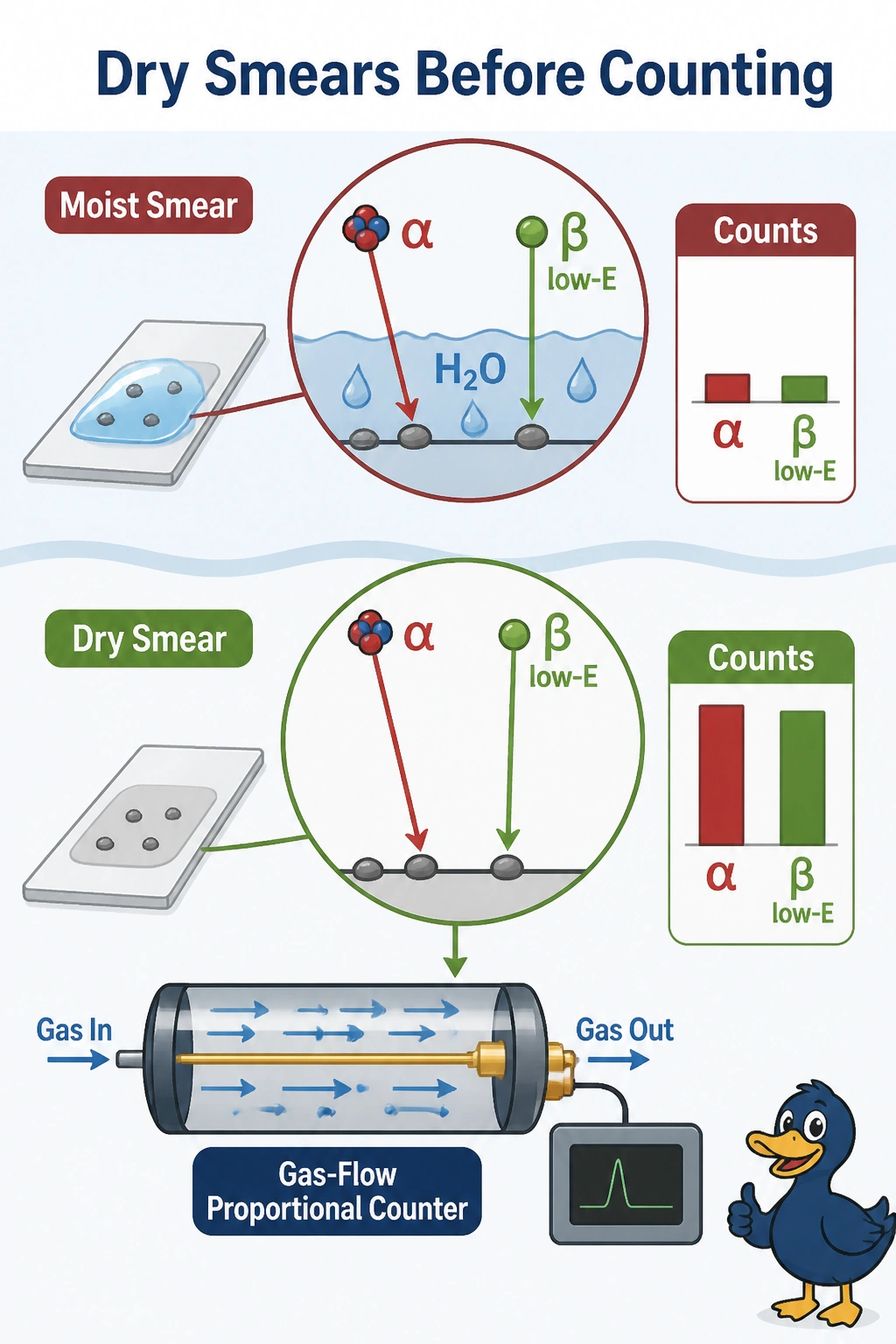
Alpha and low-energy beta particles have almost no penetrating power, so even a thin film of water on your smear paper acts like a brick wall. The trap is rushing wet wipes straight into the counter to save time, which hides real contamination through self-absorption.
Full Explanation
Alpha particles and low-energy beta particles lose all of their kinetic energy over micrometer distances in condensed matter. If a smear filter remains wet, Moisture causes self-absorption that masks alpha and beta counts because the liquid film traps the emitted particles before they can enter the detector's sensitive volume, leading to a dangerously low reading. The claim that Moisture vapor will permanently poison the P-10 counting gas cylinder is wrong because the regulated gas flows outward through the detector and exhausts, rather than flowing backward into the supply cylinder. Selecting Water increases alpha backscatter and causes a false high reading reverses the physics, as water attenuates short-range charged particles rather than amplifying them. Finally, Drying volatilizes fixed contamination so it can be counted is incorrect because smears only sample removable contamination, and volatilizing a radionuclide would lose activity rather than aid detection. As a caveat, avoid overheating wet smears with a high-temperature lamp if volatile radionuclides such as radioiodine or tritium might be present. Before counting smears from damp surfaces, air-dry or gently warm them under controlled ventilation and inspect the planchet for moisture.
Prefer to study offline? Printable PDF study book + test engine ($7.50, unofficial). These questions stay free here.