
Why must a handheld pancake Geiger-Mueller frisking station at a Contamination Area exit be positioned in a low-background radiation area?
Select an answer to reveal the explanation.
Short Explanation
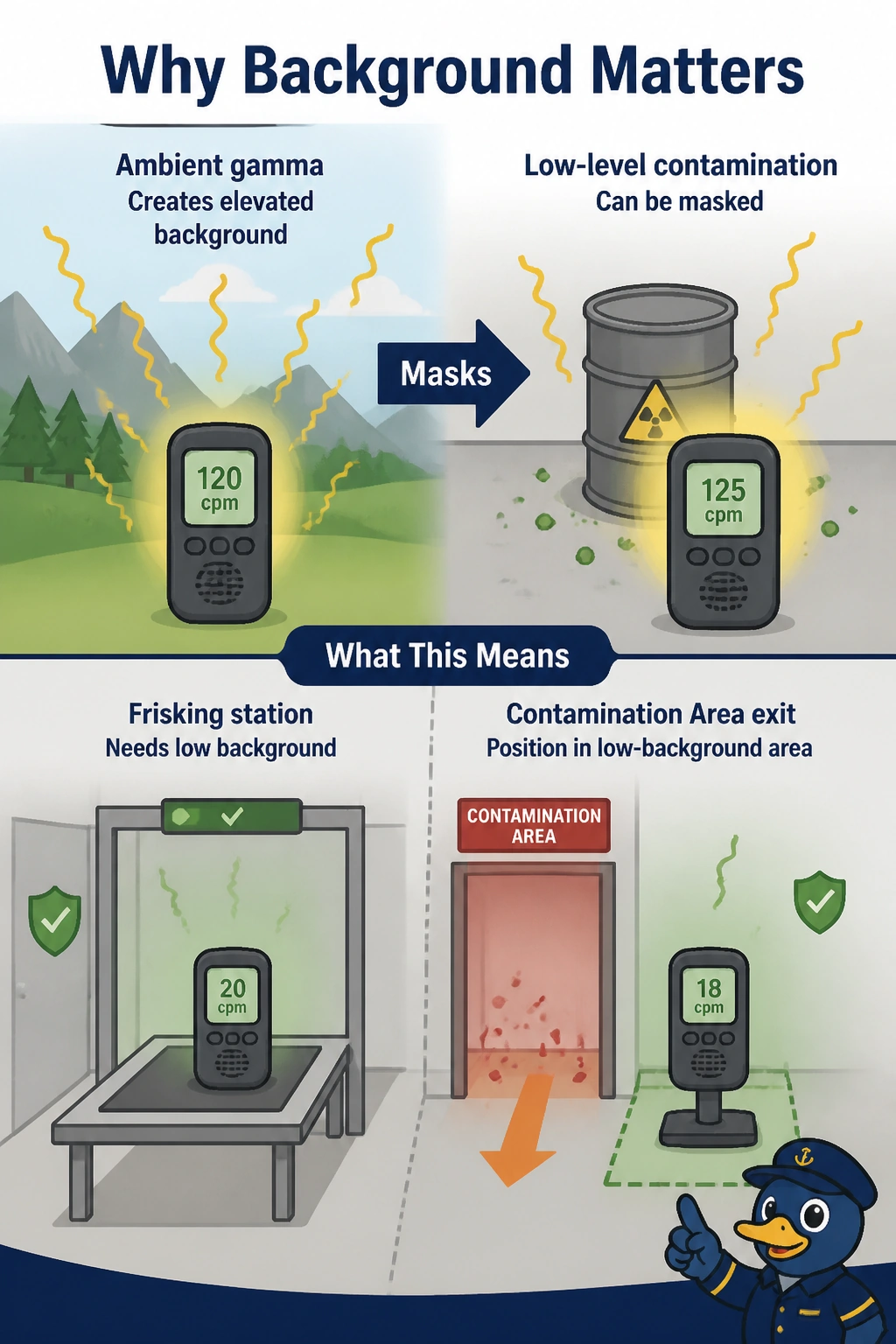
Frisking at a step-off pad is like listening for a whisper in a crowded room—if the background noise is too loud, you will miss the signal. The trap is blaming humidity, drafts, or lights when the real culprit is ambient gamma radiation drowning out your meter.
Full Explanation
Placing a contamination frisker in a low-background area ensures that Elevated ambient gamma background masks low-level contamination does not occur during personnel exit surveys. A Geiger-Mueller probe counts both background photons and radiation from surface contamination; when the ambient gamma field rises, the minimum detectable activity (MDA) increases sharply, allowing small spots of skin or clothing contamination to go unnoticed. High ambient humidity causes beta particles to scatter back into the probe is incorrect because air moisture does not significantly backscatter beta particles into a detector, though extreme condensation can cause high-voltage arcing. Ventilation drafts strip alpha particles from the detector window is physically wrong because alpha particles travel at thousands of kilometers per second and are unaffected by room airflow. Overhead fluorescent lighting saturates the pancake GM quench gas is also false because standard GM probes have opaque housings that block visible light. As a caveat, even in a low-background zone, nearby radioactive waste bags or shielded sources can temporarily spike the reading. For an operational check, measure and record the ambient background count rate at the frisking station before each shift and relocate the station if background rises above facility limits.
Prefer to study offline? Printable PDF study book + test engine ($7.50, unofficial). These questions stay free here.