
A PCT finds an adult visitor collapsed in a hospital hallway, unresponsive and not breathing normally with no pulse felt, alone with an AED nearby and no known trauma. Which first-aid and BLS sequence should the PCT initiate per AHA guidelines for this adult?
Select an answer to reveal the explanation.
Short Explanation
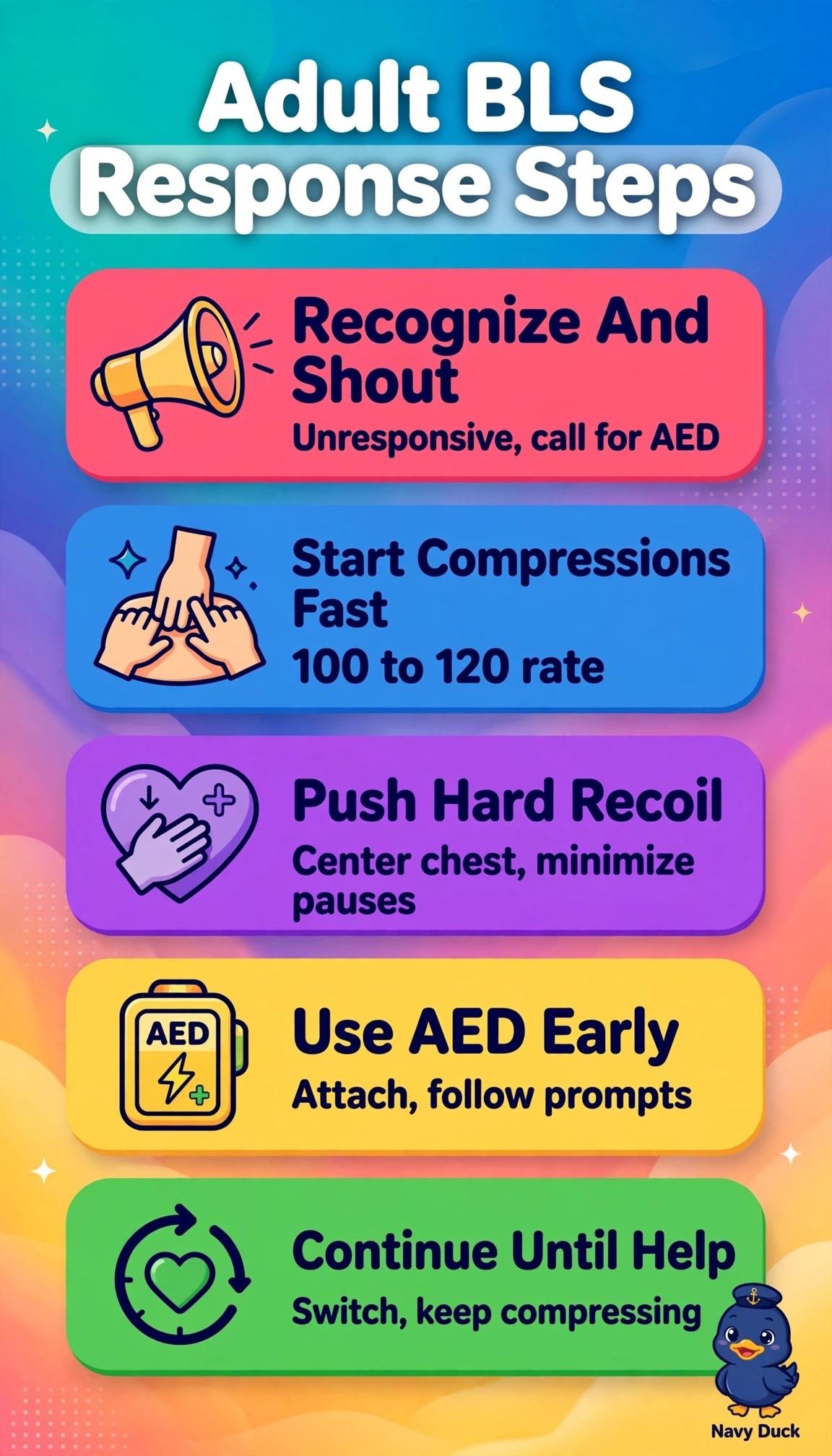
You save brain when compressions start fast and hardly pause. BLS is like pumping a stubborn well — compressions at the right rate keep blood moving to heart and brain.
Full Explanation
Proper adult BLS for unresponsive, pulseless apnea or agonal breathing with no trauma requires immediate emergency activation with AED retrieval and prompt high-quality compressions at 100 to 120 per minute with minimal interruptions to sustain coronary and cerebral perfusion until rhythm analysis and advanced care, making early defibrillation the decisive link for shockable rhythms, which the correct sequence provides. The alternative using 30 to 2 CPR while leaving the nearby AED unused until the code team arrives fails on early defibrillation, because effective compressions alone cannot replace timely analysis and shock when an AED is immediately available, and delaying retrieval reduces survival. The alternative placing the visitor in the recovery position to protect the airway while monitoring breathing fails on arrest recognition, because that position is reserved for unresponsive patients with normal breathing and a present pulse, and its use here withholds compressions and defibrillation. The alternative providing continuous rescue breathing without compressions fails on circulation versus ventilation, because isolated rescue breathing suits respiratory arrest with a pulse, whereas a pulseless patient needs compressions for forward flow. An exam caveat is to track adult versus pediatric criteria, pulse present versus absent, normal versus agonal breathing, and AED available versus delayed, since each detail changes ratio or priority. A practical check is to confirm unresponsiveness, assess breathing and carotid pulse within ten seconds, power on the AED with correct adult pads, use lower sternal hand placement with two to two point four inch depth, full recoil, and resume compressions immediately after any prompt.