
A pickle-crock visitor desk wants a talking digital face, not clip search. Which Domain 4 assembly fits?
Select an answer to reveal the explanation.
Short Explanation
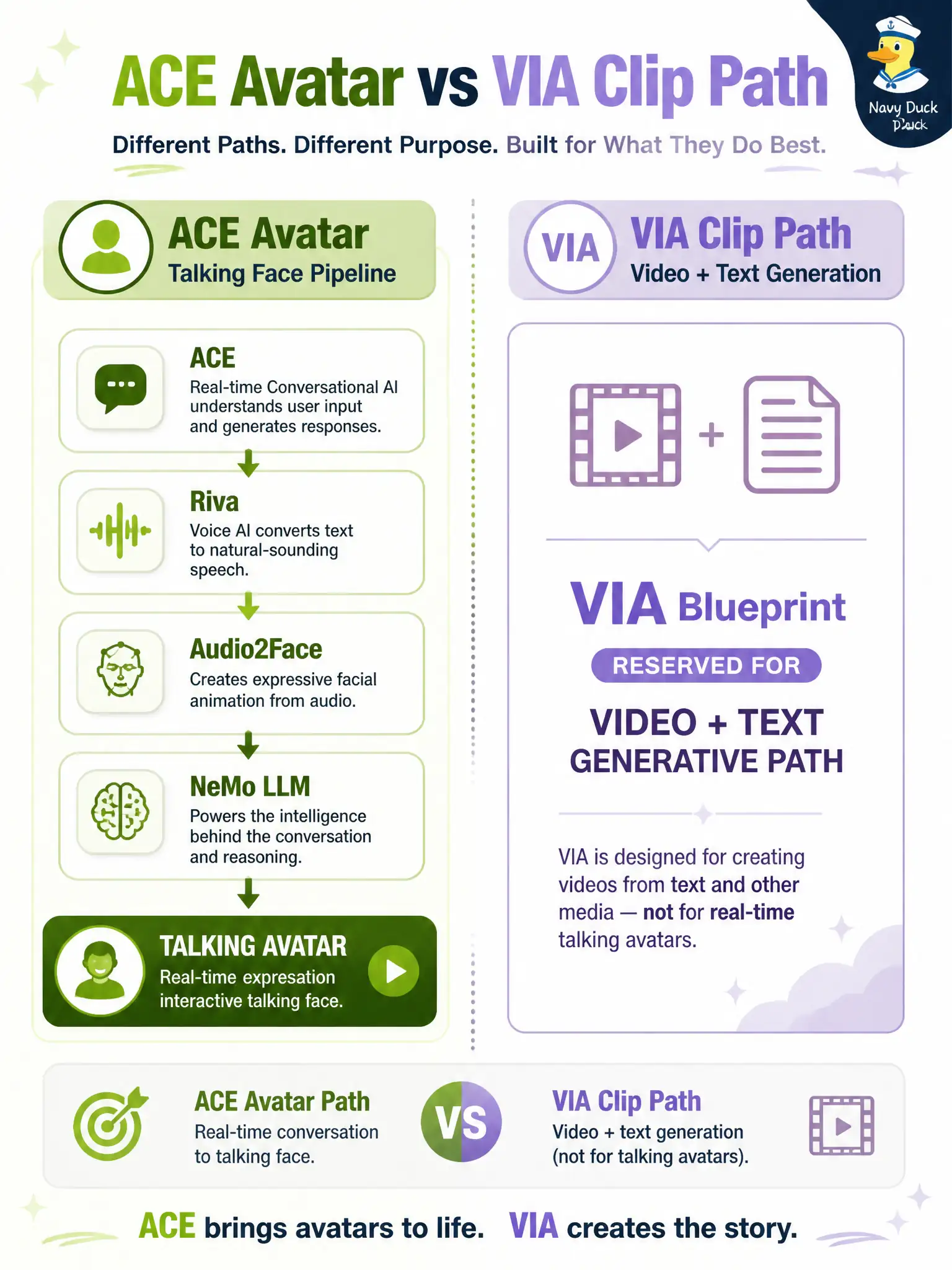
A talking face is a different stage than clip Q&A. Use the ACE path with Riva and Audio2Face—do not force a VIA Blueprint onto an avatar job.
Full Explanation
A visitor desk that wants a talking digital face, not clip search, should assemble ACE with Riva, Audio2Face, and a NeMo LLM for the avatar desk. That Domain 4 assembly fits the pickle-crock use case. Civic avatar experiences are a different stage than VIA clip Q&A and must not force the wrong Blueprint.
Forcing an NVIDIA AI Blueprint with VIA onto the speech-and-face job fails tool selection. Using CLIP noise-to-image alone as the talking avatar fails; stills are not talking faces. Scaling Riva with Helm only and skipping any face animation path fails the face requirement.
Exam caveat: talking face ⇒ ACE + Riva + Audio2Face + NeMo LLM; VIA is for video+text Q&A. Operational check: route civic avatar requests to ACE/Audio2Face assembly; keep VIA Blueprints for clip+question desks. Align this choice with the agency’s published multimodal runbook so civic operators can audit why the configuration was accepted. Document the VIA Blueprint customization (inputs, query shape, host) in the civic runbook and verify one clip-plus-question answer end-to-end before any scale discussion. Prefer explicit, reversible civic decisions over silent assumptions when multimodal data or software paths move toward production.