
A clarinet-reed loft wants neighboring benches to request a still from an English line. At associate Domain 4 depth, what should they add?
Select an answer to reveal the explanation.
Short Explanation
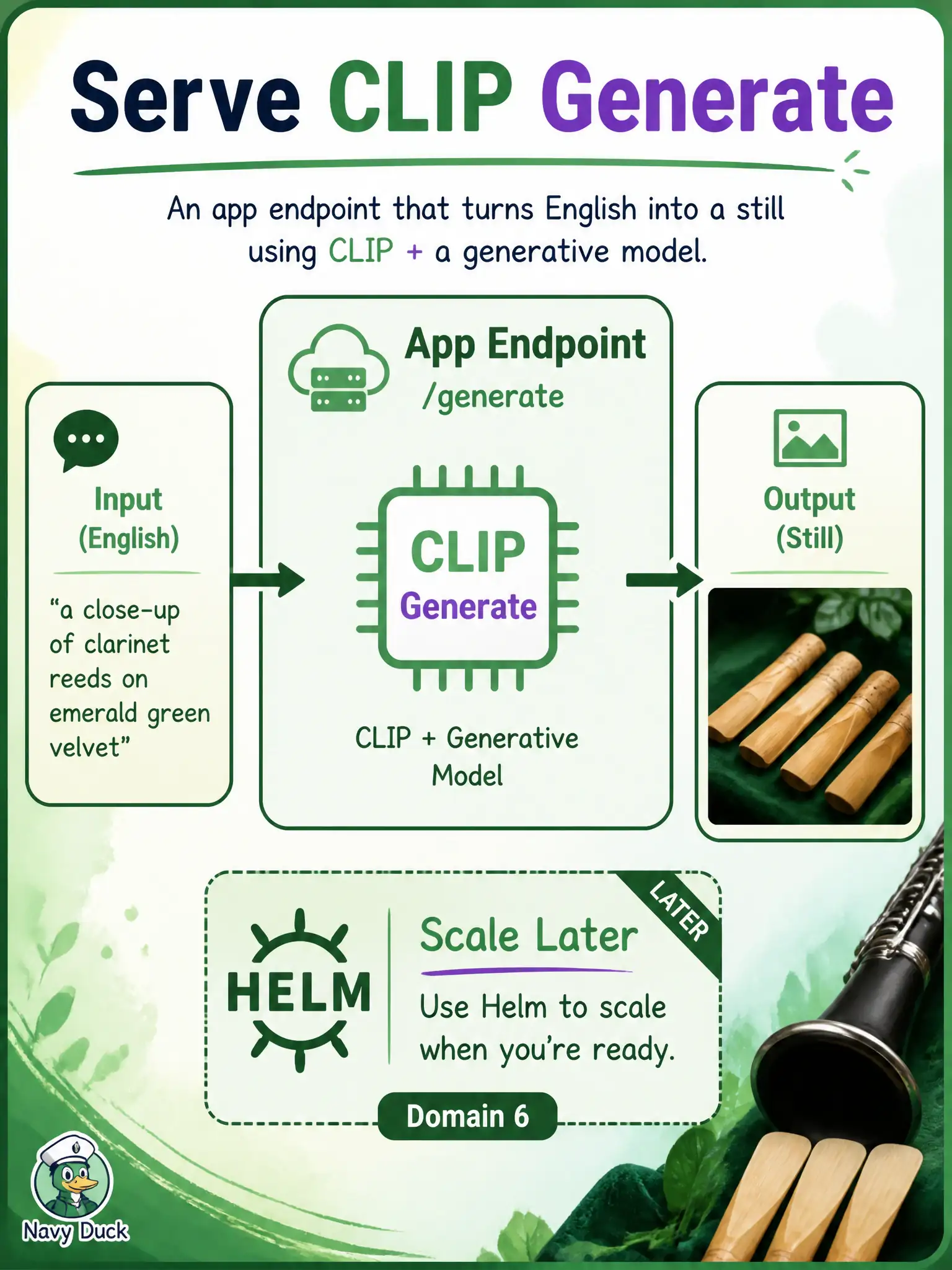
Give the neighbors a doorbell that rings the same CLIP path. A small served endpoint is enough; jumping to cluster charts or unnamed servers is the wrong depth.
Full Explanation
At associate Domain 4 depth, neighboring benches that request a still from an English line need a simple project endpoint that runs the official CLIP generate path. That addition is correct for the clarinet-reed loft. Civic shared generate access starts as a small served endpoint on the named path—not as premature cluster charts or unnamed servers.
A Domain 6 Helm chart that scales before any generate function exists fails sequencing. An unofficial third-party image server that never names CLIP fails the official path. A Domain 3 corpus rebuild required on every remote request fails by treating inference as collection.
Exam caveat: associate remote still requests = simple endpoint on CLIP generate. Operational check: expose a civic HTTP/function endpoint that runs CLIP generate; defer Helm scale to Domain 6 and refuse unnamed image servers. Align this choice with the agency’s published multimodal runbook so civic operators can audit why the configuration was accepted. Document the VIA Blueprint customization (inputs, query shape, host) in the civic runbook and verify one clip-plus-question answer end-to-end before any scale discussion. Prefer explicit, reversible civic decisions over silent assumptions when multimodal data or software paths move toward production.