
A high-resolution lace-scan project hears that some generators work in a compressed stage and then decode to pixels. How should the associate use that two-stage idea in a quality experiment?
Select an answer to reveal the explanation.
Short Explanation
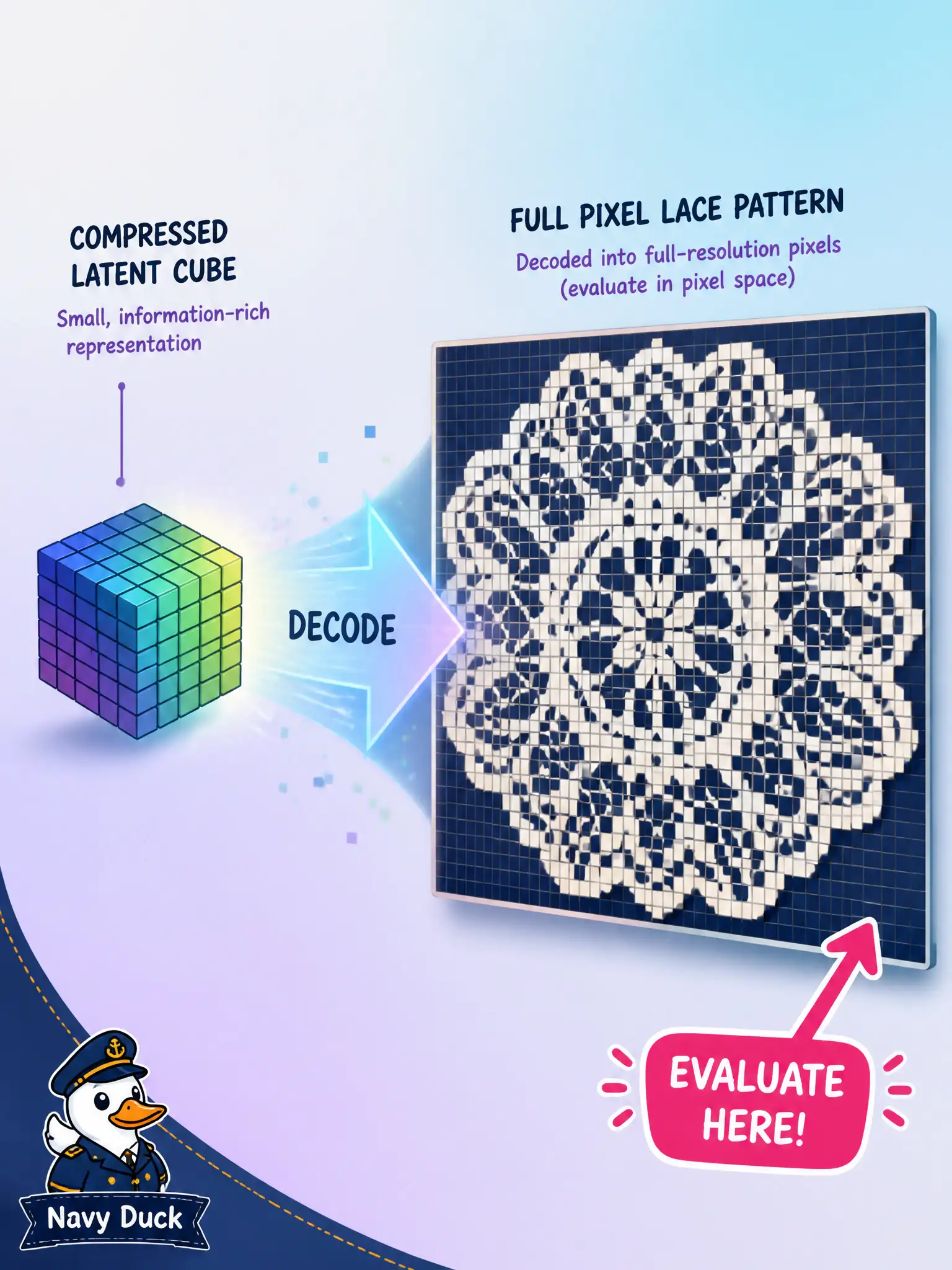
Think of a zip file that must be unzipped before you judge the photo. Even if synthesis runs in a compressed stage, the quality check still lands on the decoded pixels.
Full Explanation
A high-resolution lace-scan project that hears some generators work in a compressed stage and then decode to pixels should explain that a latent path still ends in a pixel image you evaluate for quality. Civic lace archives care about the final still conservators and the public see; compressed intermediates are a synthesis convenience, not an excuse to skip pixel evaluation. Keeping the quality check on decoded images protects public claims about lace clarity and pattern fidelity.
Naming a consumer photo app and treating the brand as the exam answer fails by substituting vendor trivia for the latent-then-decode concept. Scoring only the compressed latent and never looking at the decoded picture fails by omitting the civic deliverable—the visible lace image. Skipping evaluation because latent stages cannot produce images fails against the fact that the official path decodes to pixels for human and metric judgment.
Exam caveat: latent diffusion still yields a pixel image for associate quality evaluation; do not stop scoring at the compressed stage. Operational check: run the two-stage path end-to-end, decode to pixels, and score lace clarity and pattern fidelity on the decoded image—not on latent tensors alone—before accepting the generator for archive cards.