
A night-market voice stall files complaints that mix speech-to-text with a stall photo. Staff can try a pretrained classifier with no local labels, paste six examples into the instruction, or attach a small adapter on the text side. How should those options be treated?
Select an answer to reveal the explanation.
Short Explanation
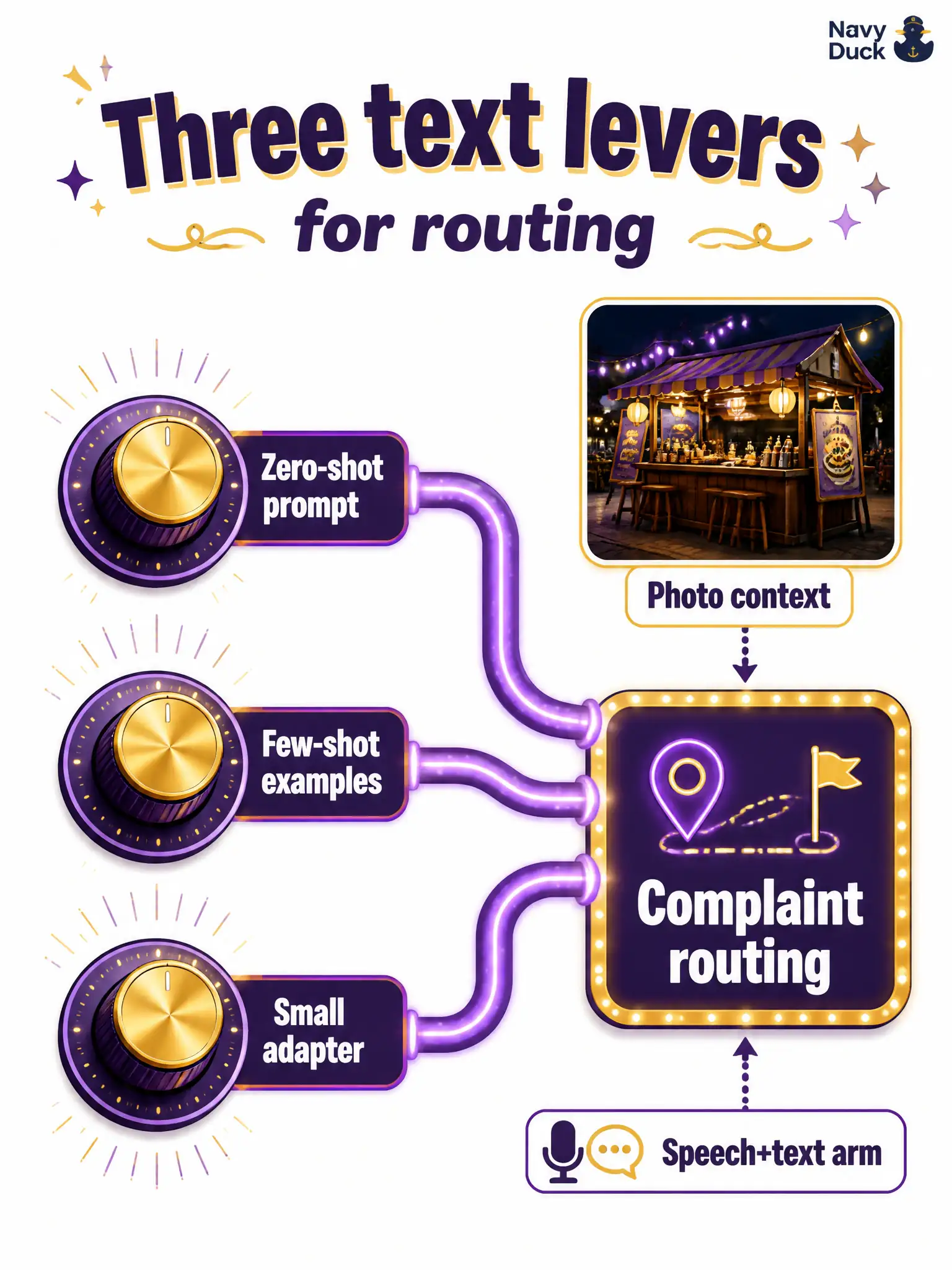
Zero-shot, six sticky examples, or a tiny add-on module are three different dials on the same routing job. Try them as experiments — not as a product bake-off that ignores the stall photo pairing.
Full Explanation
A night-market voice stall that files speech-to-text complaints with a stall photo can try a pretrained classifier with no local labels, paste six examples into the instruction, or attach a small text adapter. Those options should be treated as three experiments—prompt-only, few in-context labels, and a small text adapter—on a speech+photo routing task. Civic market offices need graded language-arm trials so complaint routing improves without pretending the levers are one mandatory rollout or a vision retrain.
Treating them as a single mandatory production rollout with no comparison fails by erasing experimental contrast taxpayers need before committing. Claiming only full from-scratch training on photos is allowed fails by forcing a vision campaign when the levers under discussion are text-arm. Calling them interchangeable names for regenerating stall images fails by conflating language routing experiments with image synthesis.
Exam caveat: zero-shot, few-shot, and adapter are comparable language-arm intensities on a multimodal routing job—not production mandates and not diffusion aliases. Operational check: hold the photo pairing fixed, run the three text levers on the same complaint set, and compare routing accuracy before any stall-wide rollout.