
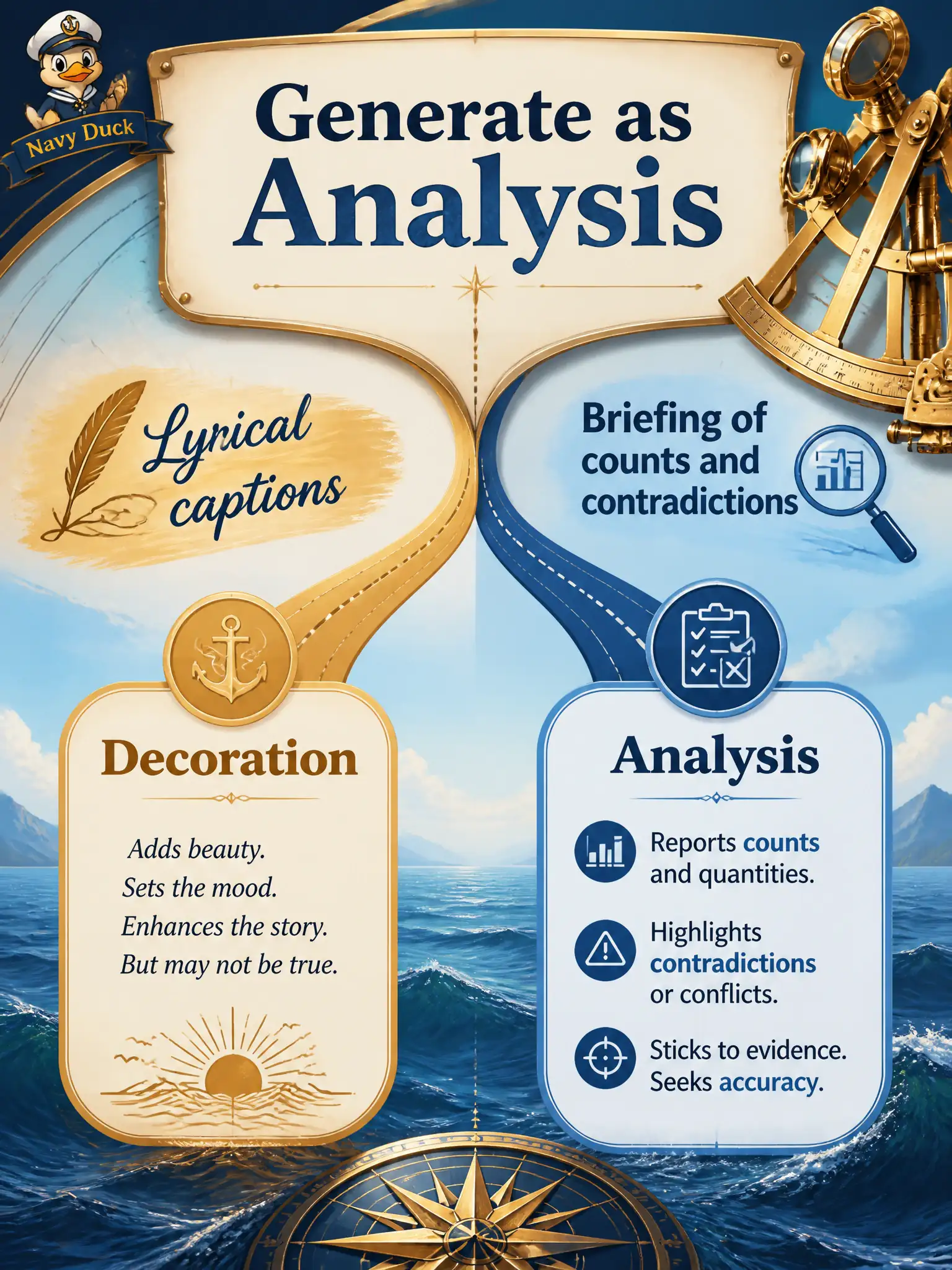
A sextant loft wants a one-page briefing of what the paired notes actually contain. One intern asks the transformer to invent lyrical captions; another asks it to report counts and contradictions. Which request matches generate-as-analysis?
Select an answer to reveal the explanation.
Short Explanation
A museum label that counts what is in the drawer is analysis; a poem that invents treasures is decoration. Ask for the briefing of counts and contradictions.
Full Explanation
A sextant loft one-page briefing should report what the paired notes actually contain: counts and contradictions in the existing text. Using the transformer to generate that factual briefing is Domain 5 text analysis for stewardship—not lyrical decoration or architecture design.
Inventing lyrical captions to decorate the catalog fails because decorative invention is not analysis of the loft’s real notes. Replacing every note with a Domain 1 image-generation prompt fails by converting analysis into generation experiments. Asking the model to design a new CLIP architecture on the page fails because Domain 5 briefings summarize corpus text; they do not redesign encoders.
Exam caveat: analysis transformers report on the corpus; they should not replace notes with poetry or smuggle Domain 2 architecture work into a briefing page.
Operational check: prompt for counts, contradiction lists, and theme tallies only; cite note ids in the municipal loft briefing; forbid lyrical caption invention in the Domain 5 job ticket; peer-review the page against raw notes before leadership distribution. In municipal multimodal stewardship, record the chosen Domain 5 reading and the rejected distractors in the loft change log so future stewards understand which concept boundaries were enforced for citizen-facing archives. Re-check the same chart or extraction after the next collection or OCR pass to confirm the civic gap is closing rather than merely relabeled.