
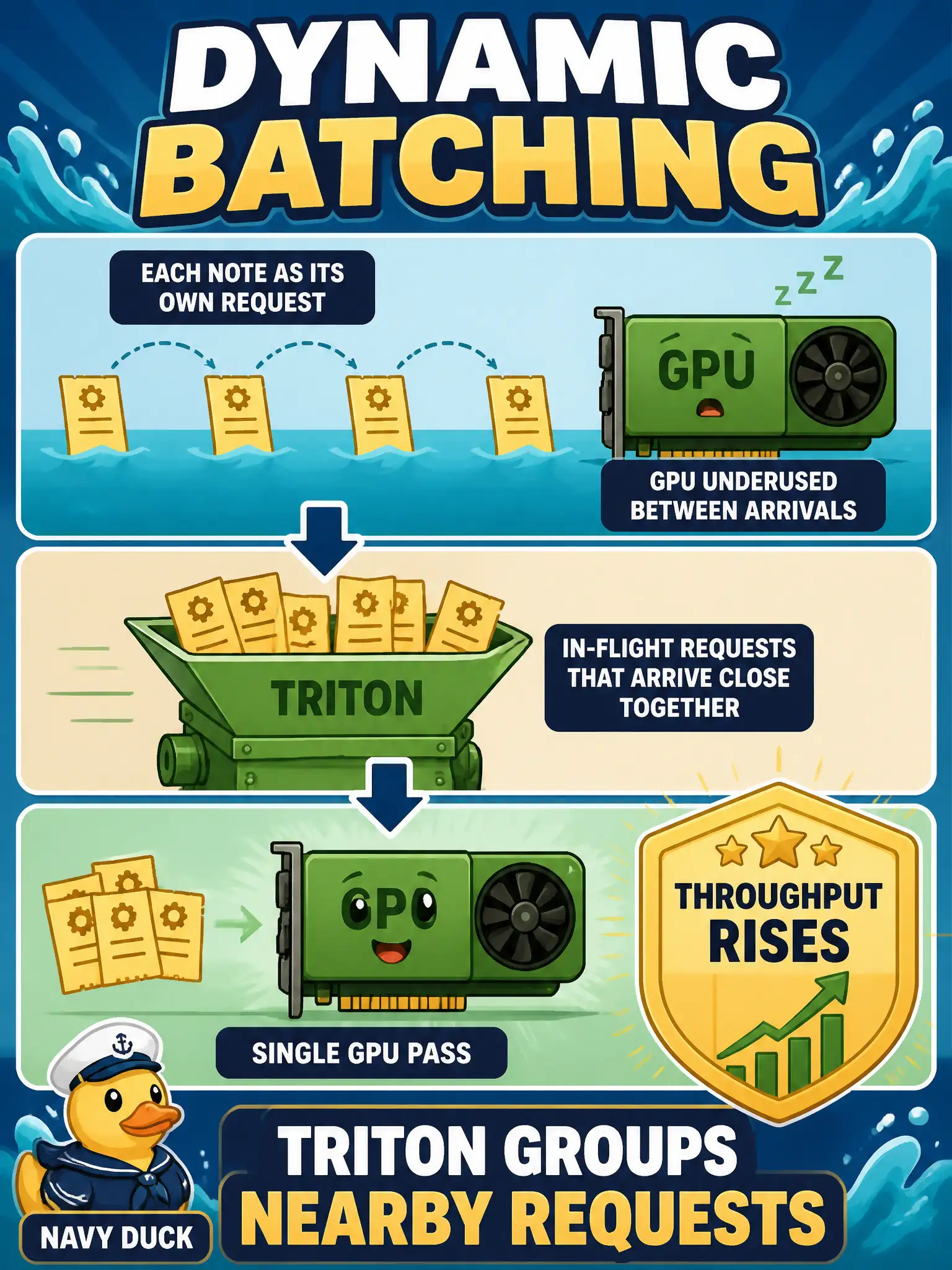
A municipal water-billing desk posts each meter note to Triton as its own request, and the GPU stays underused between arrivals. Which Triton feature lets nearby requests share one forward pass so throughput rises?
Select an answer to reveal the explanation.
Short Explanation
Each meter note as its own Triton request leaves the GPU idle between arrivals. Dynamic batching groups nearby in-flight calls into one forward pass so occupancy goes up. An NCCL mesh, a diffusion stack, or a dedicated GPU per note wastes that capacity.
Full Explanation
Dynamic batching is the associate Triton control that combines nearby in-flight requests so one forward pass serves several callers and GPU occupancy rises. It is a serving-config idea, not a scheduler thesis and not a kernel rewrite. NCCL collectives belong to Professional training parallelism, not this live-inference knob. A multimodal image stack or a one-GPU-per-note pin wastes capacity instead of raising throughput on the text model you already deployed.