
A civic-auditorium lost-and-found encodes item notes and wants to look at groups before anyone labels them. How should they explore that structure on the GPU?
Select an answer to reveal the explanation.
Short Explanation
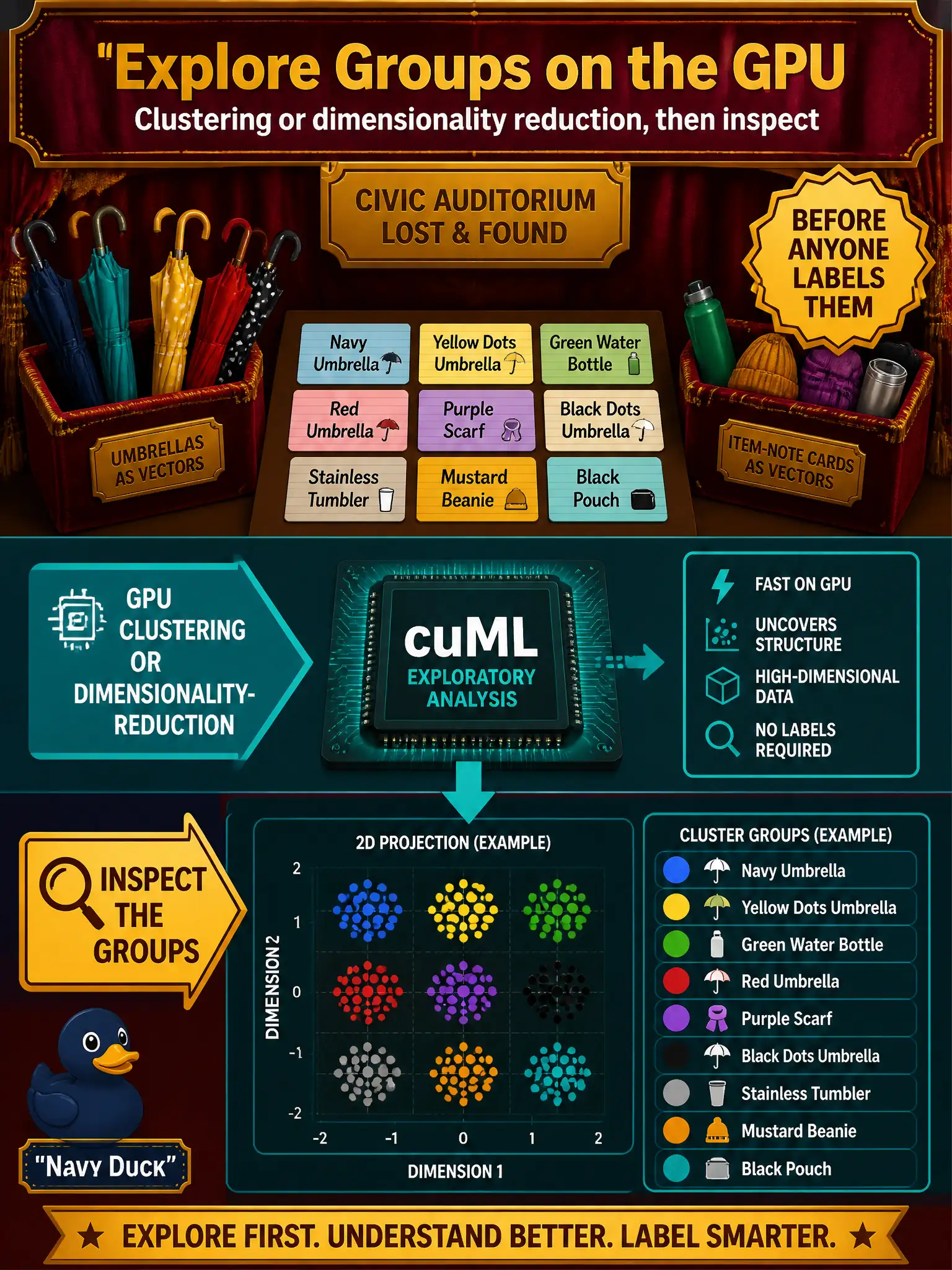
Unlabeled lost-and-found notes want a look at groups first. Run a GPU clustering or dimensionality-reduction step with cuML, then inspect the groups. That is exploratory analysis, not a bake-off, an embedding lecture, or a NIM labeling shortcut.
Full Explanation
Unsupervised GPU algorithms such as clustering or dimensionality reduction are a Domain 4 way to explore prepared data. cuML is the official estimator family for that look-before-you-label pass. It is not an A/B bake-off, not an embedding definition, and not a serving shortcut. Inspect the groups after the GPU step.