
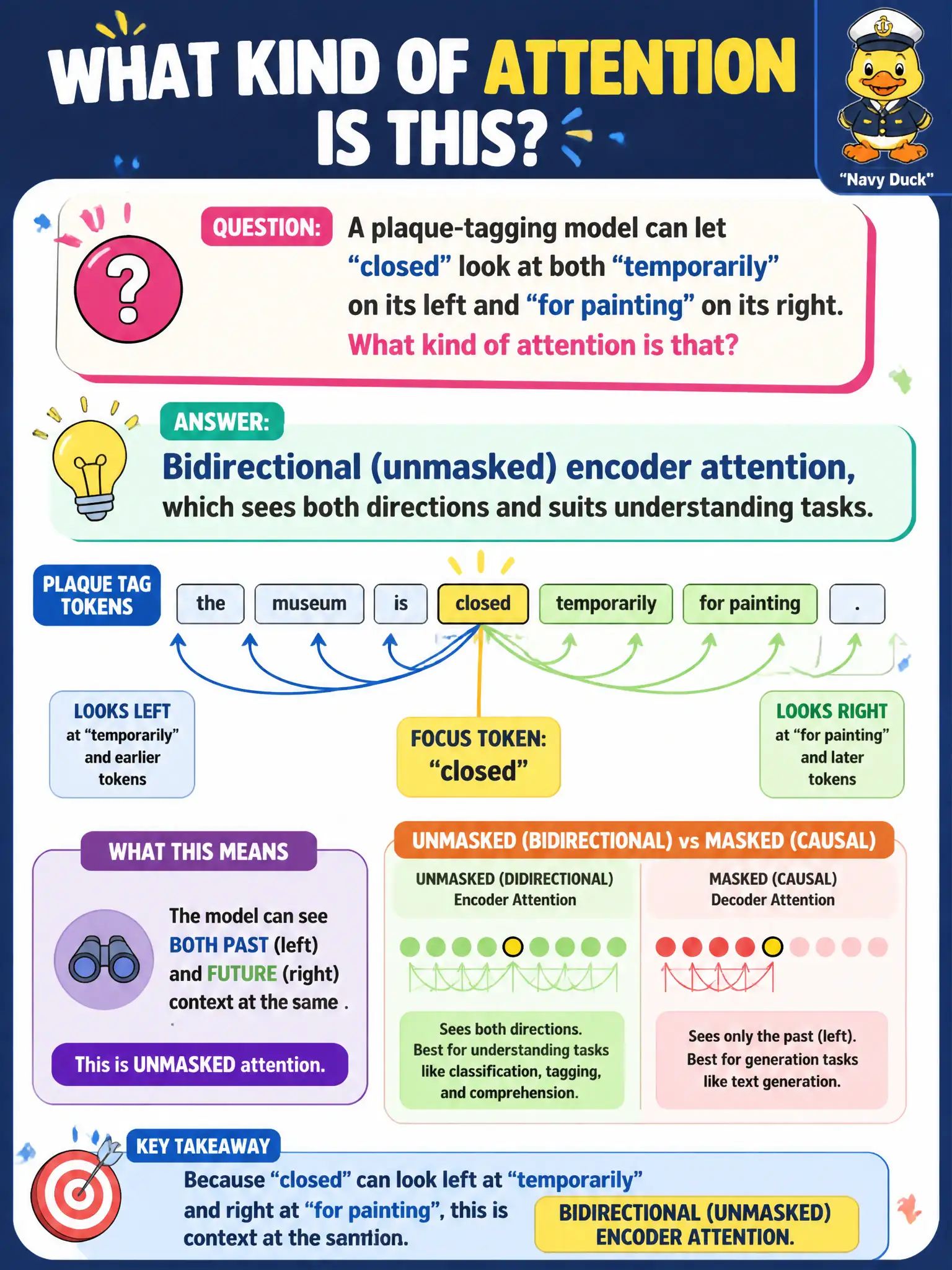
A plaque-tagging model can let “closed” look at both “temporarily” on its left and “for painting” on its right. What kind of attention is that?
Select an answer to reveal the explanation.
Short Explanation
When “closed” can see “temporarily” on the left and “for painting” on the right, that is bidirectional encoder attention. Understanding tasks want both sides. Causal masking would block the right, and neither a tree split nor a timeout is a direction of attention.
Full Explanation
Encoders use bidirectional attention so a token can use left and right context. That is why they suit labeling and other understanding tasks. Causal masking is the decoder rule that blocks the future.