
A 48-year-old woman with pneumonia meets moderate ARDS criteria with PaO2/FiO2 135 on PEEP 10 cm H2O and FiO2 0.70. She is receiving volume control at 6 mL/kg predicted body weight with plateau 27 cm H2O and is deeply sedated. Which lung-protective ARDS management strategy best improves oxygenation while limiting ventilator-induced lung injury?
Select an answer to reveal the explanation.
Short Explanation
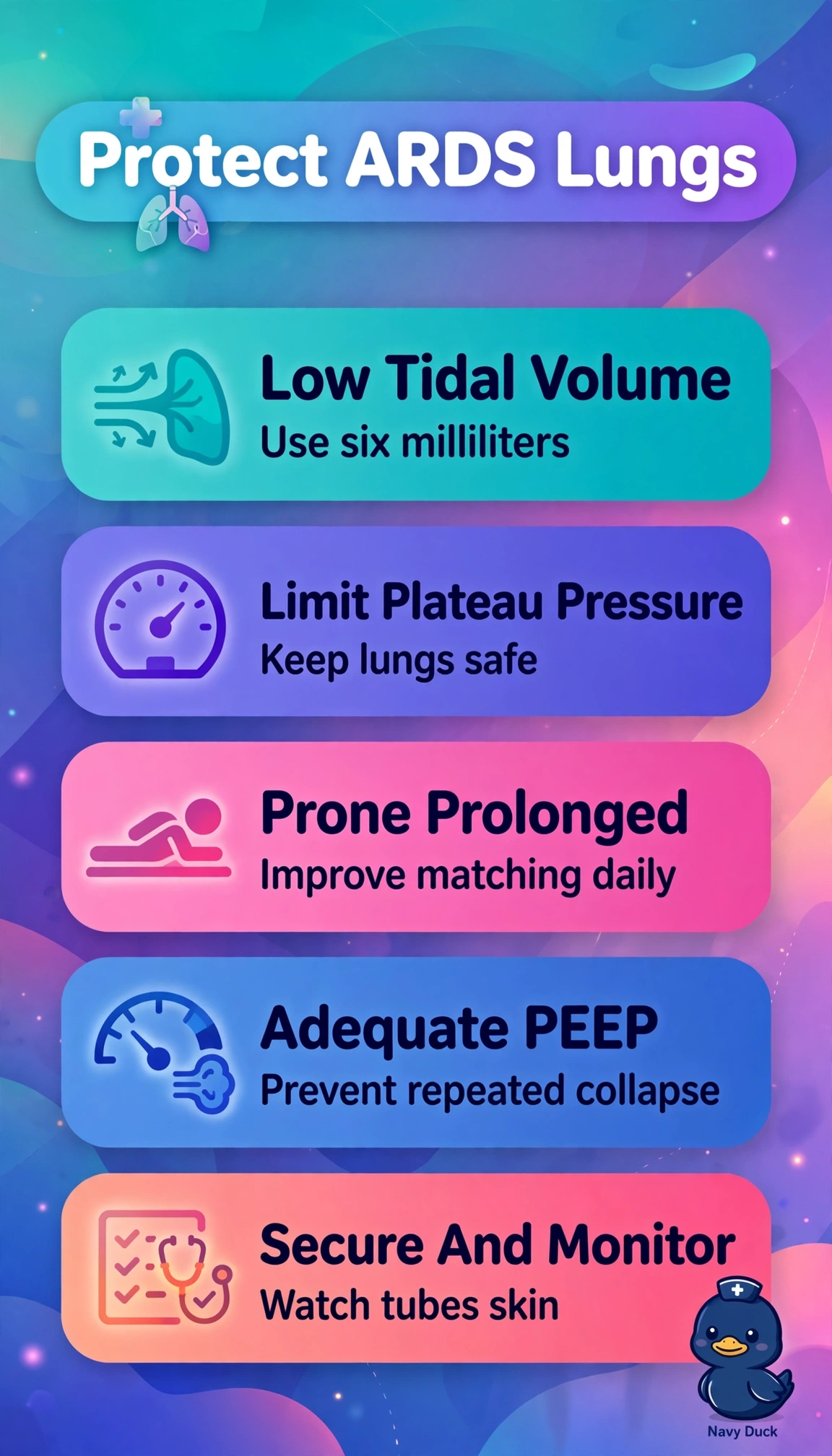
Her lungs are baby-small and angry, so gentle goes further. Low stretch plus prone evens out ventilation and blood flow, boosting your oxygenation safely. Flip her early and keep volumes low.
Full Explanation
This patient has moderate ARDS by Berlin criteria with PaO2/FiO2 135 on PEEP 10, already on guideline-concordant 6 mL/kg predicted body weight volume control with plateau 27 cm H2O and deep sedation, so maintaining low tidal volume with prolonged prone positioning 12-16 hours daily and neuromuscular blockade assessment best improves oxygenation while limiting ventilator-induced lung injury by recruiting dorsal lung, improving ventilation-perfusion matching, homogenizing transpulmonary pressure, and reducing overdistension without violating protective limits. Persisting supine with protocolized higher PEEP titration fails by omission of proning because higher PEEP may improve mechanics but does not replicate the mortality benefit shown when PaO2/FiO2 is below 150. Continuous 48-hour neuromuscular blockade without proning fails by substitution because paralysis may aid synchrony but routine prolonged infusion is now replaced by as-needed use tied to proning, adding weakness and hemodynamic risk without proven survival advantage. Early extracorporeal membrane oxygenation for moderate hypoxemia fails by escalation threshold because ECMO is rescue for severe refractory ARDS typically below 80 despite optimized proning, high PEEP, and low tidal volume. Exam caveat is to prioritize the 150 threshold over FiO2 alone to separate moderate disease requiring proning from mild or severe disease, and practical check is to verify predicted body weight dosing, plateau below 30, hemodynamic tolerance, no unstable spine or raised intracranial pressure, and secured airway, lines, skin, and eye care.