
A 54-year-old man with a BMI of 41 needs urgent intubation for hypercapnic failure. Bedside exam notes Mallampati class IV, thyromental distance under 6 cm, rigid cervical collar, full beard, and loud habitual snoring with witnessed apneas. Which difficult airway recognition conclusion best guides preparation for this intubation?
Select an answer to reveal the explanation.
Short Explanation
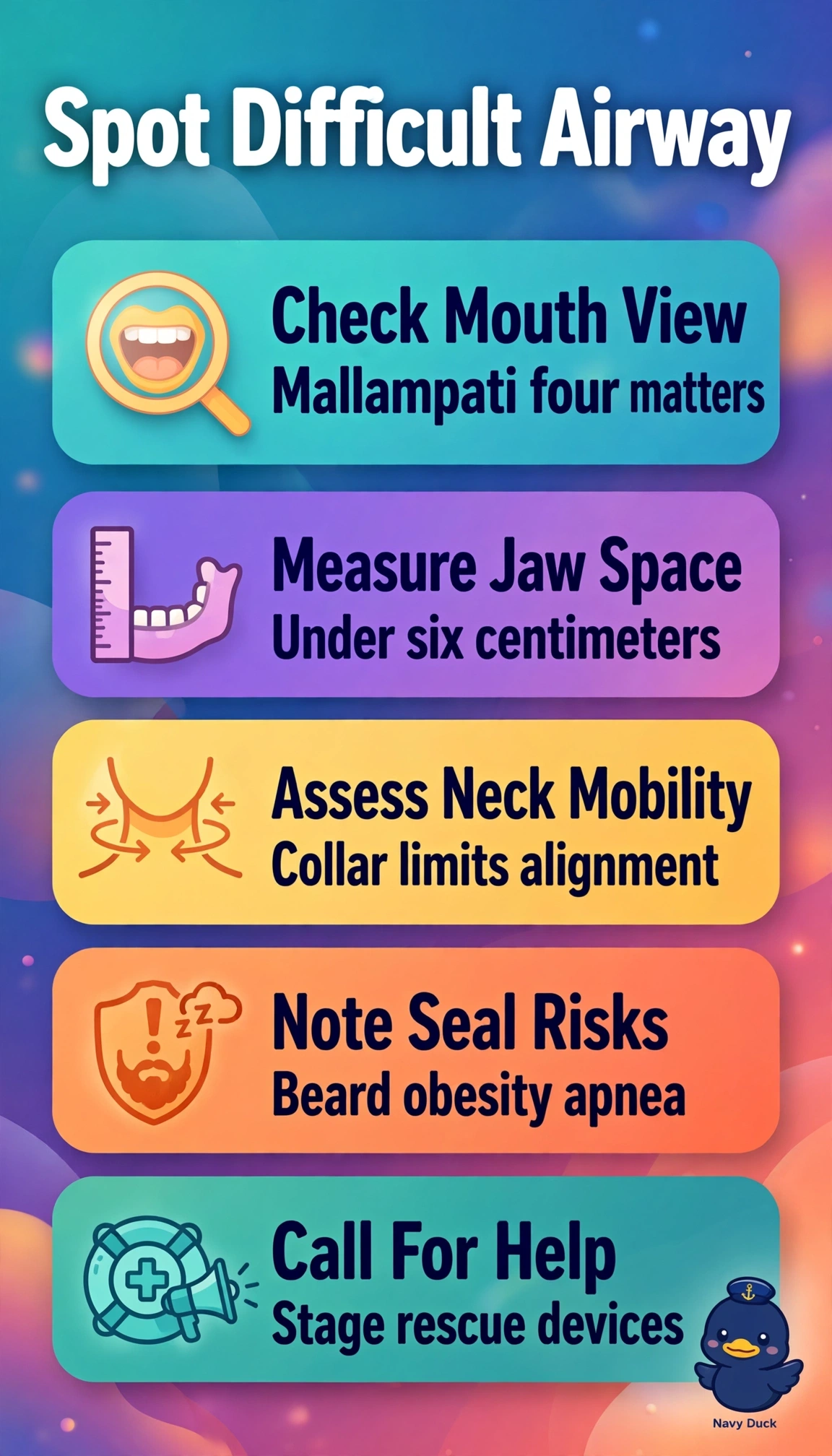
One red flag worries you, but five together shout at you. Clustering Mallampati, jaw space, neck, and beard findings upgrades this to a difficult airway. Call for backup and gear now.
Full Explanation
Multiple concordant predictors establish a difficult airway requiring help and difficult-airway equipment because Mallampati IV with thyromental distance under 6 cm predicts poor glottic exposure, rigid collar blocks opening and extension, beard with BMI 41 plus snoring and witnessed apneas predicts difficult mask ventilation and obstruction, and urgent hypercapnic failure adds limited apnea tolerance, aspiration risk and time pressure, demanding help, video laryngoscopy with bougie/stylet, supraglottic rescue, suction, ramped neutral-neck positioning, preoxygenation with apneic oxygenation and a failed-airway plan. The video laryngoscopy with neck extension strategy recognizes laryngoscopy difficulty but fails on cervical-spine protection because neutral stabilization is required and extension is contraindicated and usually impossible. The two-person mask ventilation strategy recognizes ventilation difficulty but fails on comprehensive planning because it covers ventilation only while Mallampati IV, short distance and immobile neck separately predict difficult intubation needing parallel rescue. The awake fiberoptic strategy recalls an elective classic but fails on urgency and respiratory drive because hypercapnic failure with obesity and apnea leaves minimal reserve and sedation risks hypoventilation, obstruction, aspiration and lost cooperation. Exam caveat is predictors are additive not alternative and the collar must not be removed or extended for view without clearance. Practical check is to announce difficult-airway status, confirm help and cart, test suction and rescue, maximize preoxygenation, ramp torso with neck neutral, and verify seal plus bougie and supraglottic backup.