
Your ICU blood gas analyzer, end-tidal CO2 monitor, bedside spirometer, ventilator, and pulse oximeter all drifted after a power outage before morning rounds. Which quality control process best verifies analyzers, pulmonary function equipment, ventilators, and monitors are safe to use?
Select an answer to reveal the explanation.
Short Explanation
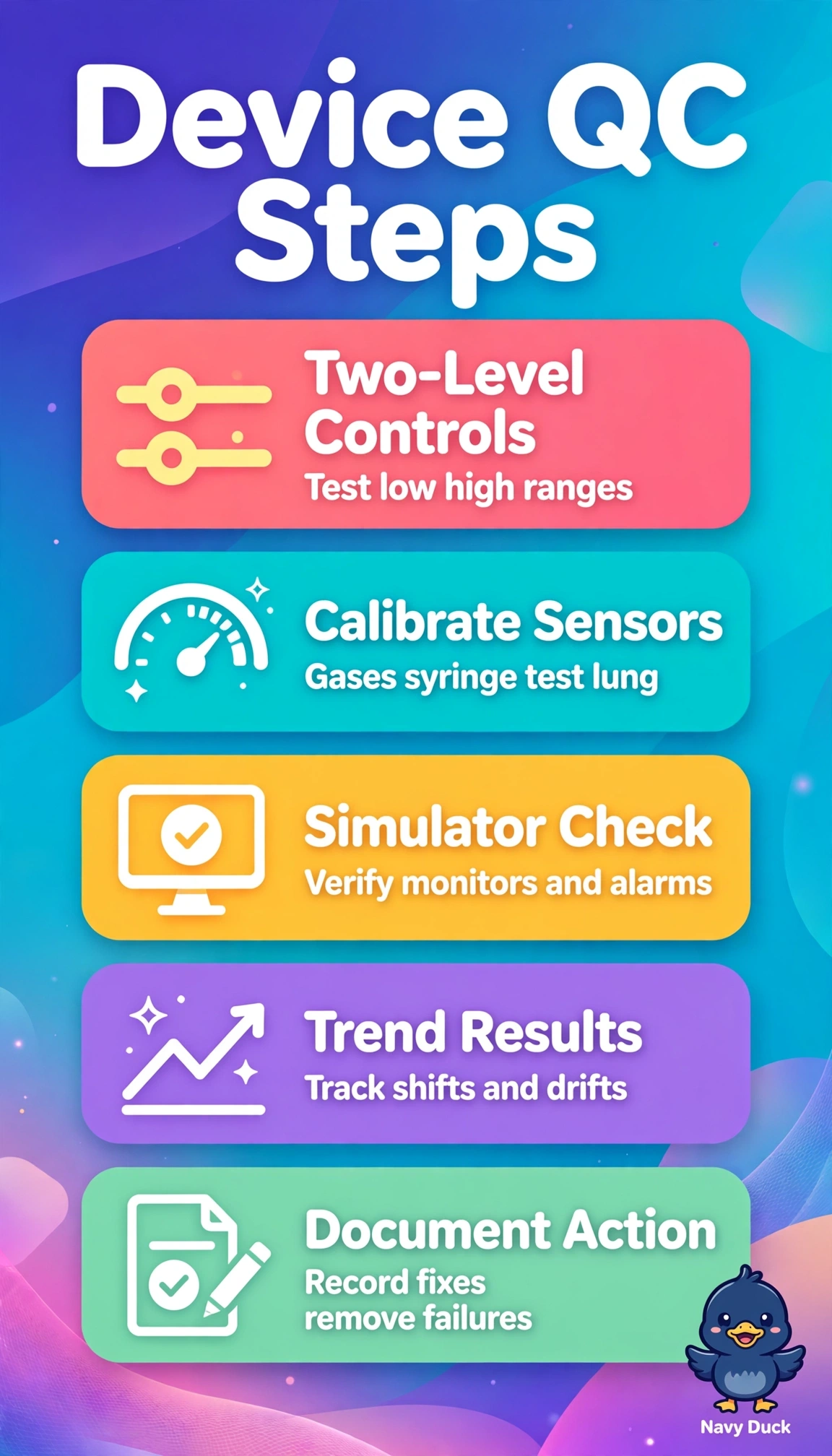
After that outage, you can't trust your screens until you've checked them like test-driving a car after repairs. You'll want to run two-level controls, calibrate your sensors, check with a simulator, and jot down what you fixed.
Full Explanation
Correct verification after outage drift must combine analytical control, calibration, independent functional testing, and documentation for every device class, which restores blood gas analyzers, spirometers, capnographs, oximeters, and ventilators to safe use before rounds. Two levels spanning low and high ranges reveal bias and nonlinearity, calibration returns electrodes, flow sensors, and pressure transducers to traceable accuracy, simulator verification proves monitors and ventilators sense and deliver correctly under known inputs without patient risk, and documented corrective action provides traceability and compliance. The one-level control approach fails by range because normal-value precision does not guarantee accuracy at critical extremes where ICU management changes. The healthy-volunteer test fails by traceability because uncontrolled physiology cannot replace a calibrated simulator delivering repeatable EtCO2, SpO2, flow, and pressure references. The analyzers-only calibration fails by scope because the stem states pulmonary equipment, ventilators, and monitors also drifted and remain unsafe until recalibrated. Exam caveat is to distinguish routine daily QC from post-event requalification of all affected classes, not the alarming analyzer alone. Practical check confirms controls and simulator outputs are within limits and log cause, actions, and sign-off.