
An acute care hospital repeatedly receives payer denials and lower quality ratings because inpatient sepsis and heart failure charts lack timely clinical specificity until weeks after discharge. Which quality review strategy most effectively addresses these gaps?
Select an answer to reveal the explanation.
Short Explanation
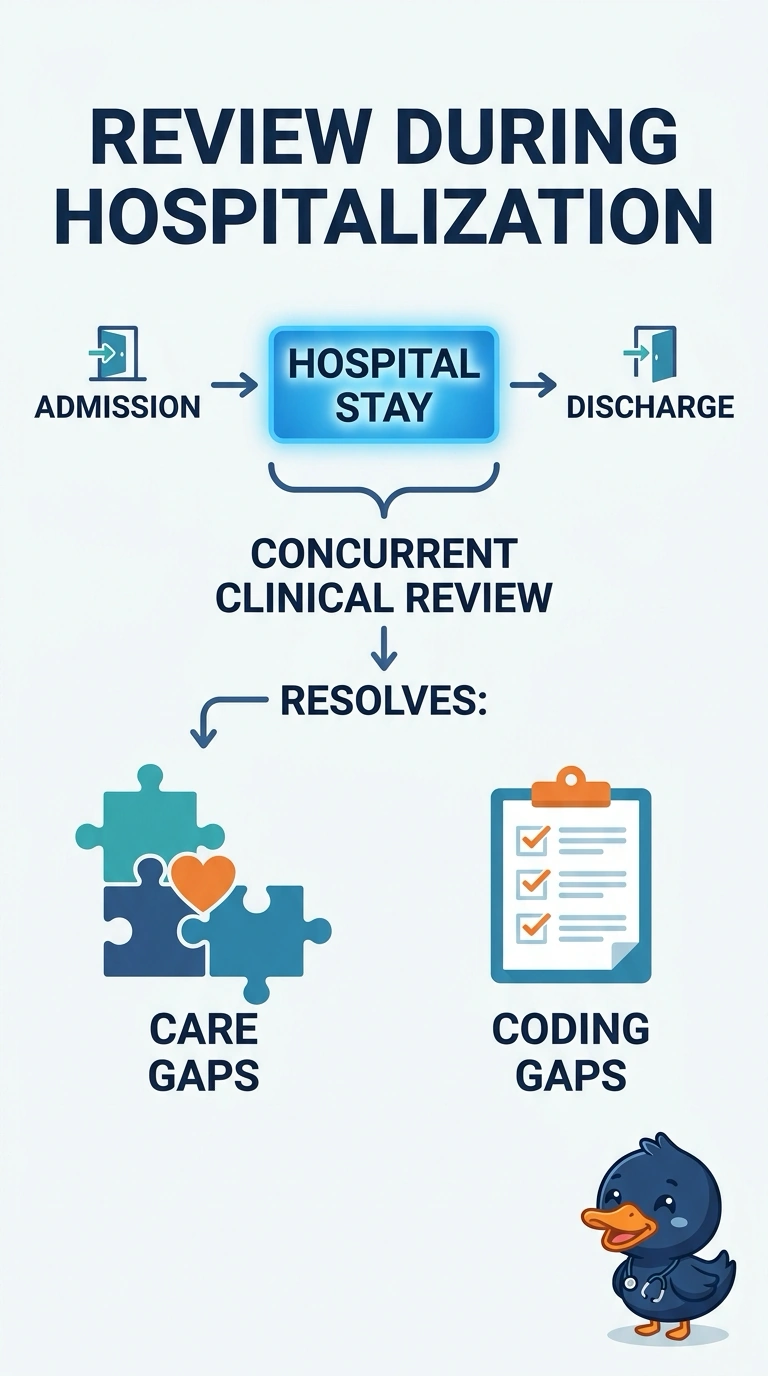
Waiting until weeks after discharge to fix missing clinical details is like trying to steer a ship after it has already docked. Concurrent review lets your team catch care and coding gaps while the patient is still in the bed and the clinical picture is fresh. Don't fall for the trap of relying on delayed retrospective audits or waiting for payer denials to surface problems.
Full Explanation
Timely, accurate clinical records support both safe active care and valid external quality reporting. "Using concurrent clinical review during hospitalization to resolve care and coding gaps" enables clinical documentation specialists and quality reviewers to query clinicians in real time while laboratory results, severity indicators, and treatment plans are fresh, improving both guideline adherence and risk-adjustment accuracy. "Conducting retrospective chart audits six months after discharge to issue clinician reminders" arrives far too late to influence the patient's care and relies on faded clinician memory for chart clarification. "Limiting chart reviews to cases that have already received a payer denial letter" adopts a reactive posture that forfeits revenue and leaves quality measure inaccuracies uncorrected. "Relying on automated billing software to validate clinical documentation after discharge" misses nuanced clinical judgment and cannot independently confirm whether documented diagnoses match bedside assessment. As a caveat, concurrent queries must remain non-leading and ethically neutral so clinicians document only clinically supported conditions. As an operational check, track the percentage of concurrent clinician queries answered before discharge and monitor the hospital's retrospective denial rate over consecutive quarters.
Prefer to study offline? Printable PDF study book + test engine ($7.50, unofficial). These questions stay free here.