
At a mid-sized community hospital, medical staff peer review committees track physician complications separately from the nursing-led hospital quality council, and neither group shares improvement priorities or trend data. Which governance step should the quality director recommend to leadership?
Select an answer to reveal the explanation.
Short Explanation
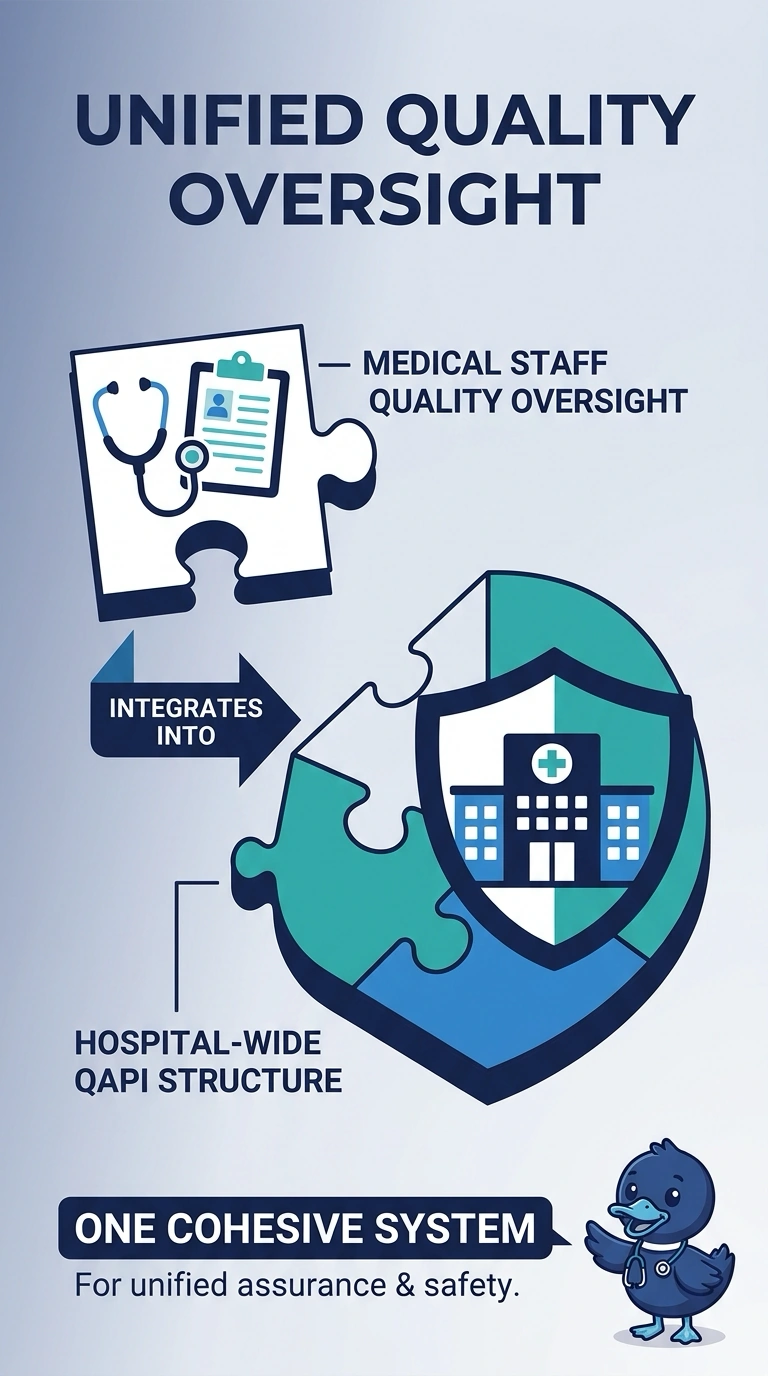
Running medical staff quality and hospital quality in separate lanes is like having two pilots fly the same plane without talking. The trap is mistaking peer-review confidentiality for a reason to keep clinical governance siloed. You build real accountability when medical staff oversight connects directly into hospital-wide QAPI.
Full Explanation
Recommending that leadership Integrate medical staff quality oversight into the hospital-wide QAPI structure aligns physician, nursing, and operational improvement efforts under a unified governance framework while still preserving peer-review protections. Under 42 CFR 482.21, QAPI must be hospital-wide, reflect the complexity of the hospital's organization and services, and involve all departments and services, and under 482.21(f) the medical staff, with the governing body and administrative officials, is accountable for that program rather than a separate silo. Trying to Move physician peer review under the nursing-led hospital quality council just swaps one silo for another and undermines medical staff self-governance. Publishing individual physician complication rates on the hospital's public website does not connect the two oversight structures and can place practitioner-specific results outside peer-review protections. Deciding to Keep both committees separate to preserve peer-review confidentiality confuses protection with isolation and perpetuates fragmented priorities and blocks interprofessional learning. Caveat: integration means sharing aggregated system trends and joint improvement charters while keeping practitioner-specific peer-review files restricted. Operational check: review bylaws and the QAPI plan annually to confirm reporting links and joint representation.
Prefer to study offline? Printable PDF study book + test engine ($7.50, unofficial). These questions stay free here.