
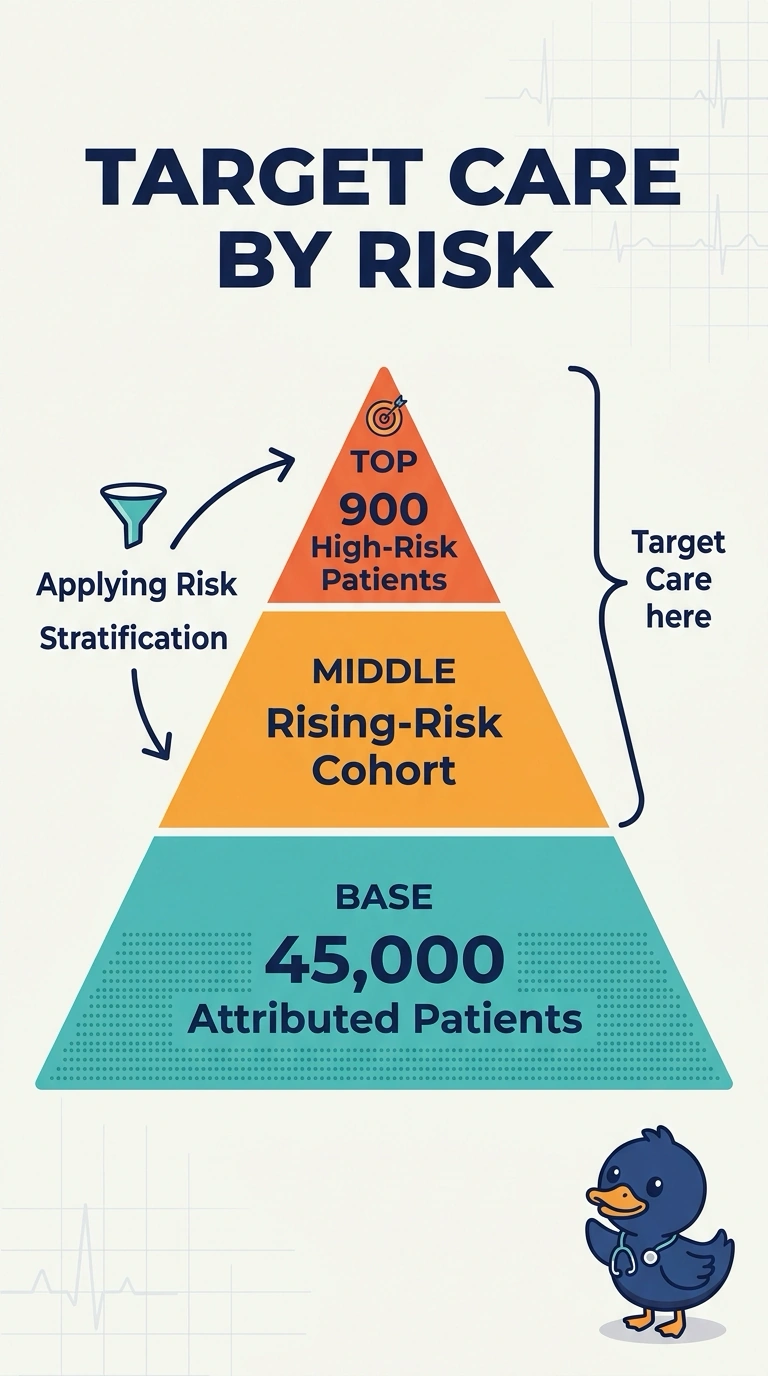
A primary care network manages 45,000 attributed patients under a value-based contract, but its nurse care managers only have capacity to enroll 900 patients in intensive care coordination. Which population health strategy best directs those limited resources to prevent avoidable hospitalizations?
Select an answer to reveal the explanation.
Short Explanation
Trying to give intensive care management to 45,000 patients with a handful of nurses is like trying to water an entire farm with one garden hose. The trap is enrolling whoever walks in first or focusing only on age. You maximize impact by stratifying the population to reach patients whose risk is climbing.
Full Explanation
Population health programs operate under fixed staffing budgets, so matching care-management intensity to clinical need is essential for preventing avoidable emergency visits and hospitalizations. Applying risk stratification to target rising-risk and high-risk cohorts combines utilization history, chronic disease burden, and social risk factors to focus nurse outreach on patients most likely to benefit from timely intervention. By contrast, Enrolling patients sequentially at routine clinic check-in fills scarce slots with whoever arrives first, often excluding homebound or disengaged high-risk patients. Prioritizing enrollment for patients over age eighty with a recent hospital admission uses a narrow age-plus-event filter that misses younger adults with poorly controlled diabetes, heart failure, or behavioral health needs. Similarly, Selecting patients with the highest annual primary care visit counts favors patients who are already engaged with outpatient care while overlooking those who avoid clinics and rely on emergency departments. One caveat is that risk models should incorporate social determinants of health alongside claims data so underserved patients with sparse claims are not overlooked. As an operational check, review care-manager caseloads quarterly to confirm that enrolled patients match current risk-tier criteria and graduate stabilized patients.
Prefer to study offline? Printable PDF study book + test engine ($7.50, unofficial). These questions stay free here.