
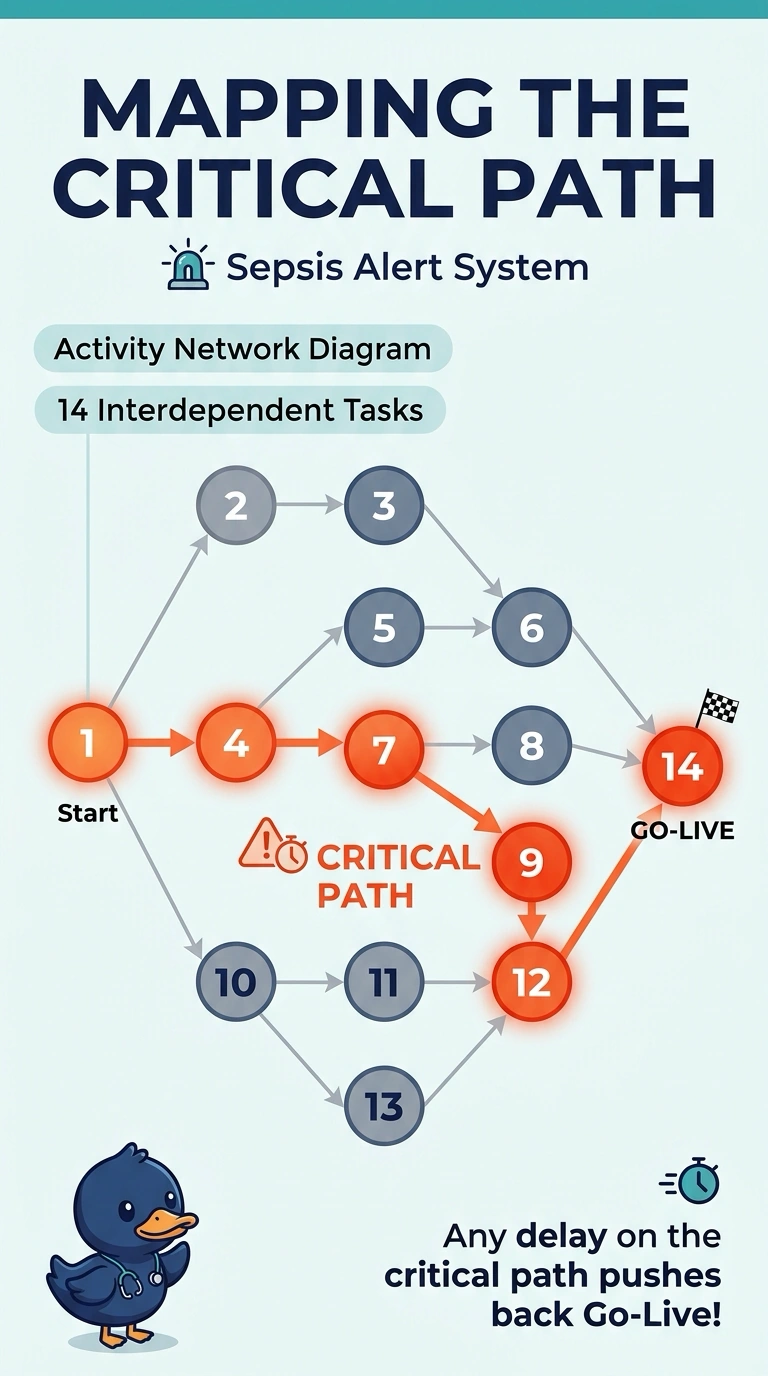
A multi-hospital quality team is coordinating 14 interdependent technical, training, and clinical workflow tasks to launch a new sepsis alert system and needs to determine which task delays would push back the entire go-live date. Which tool should the team use?
Select an answer to reveal the explanation.
Short Explanation
When a complex rollout has tasks waiting on other tasks, you need to know which bottleneck has zero wiggle room. The trap is grabbing a diagnostic or prioritization tool when what you really need is a schedule dependency map. Trace the longest chain of dependent steps so you know which delays will derail your launch date.
Full Explanation
Managing a complex, multi-step quality rollout requires understanding how sequential and parallel tasks depend on one another. Selecting "An activity network diagram mapping task dependencies and the critical path" lets the team identify the longest sequence of dependent activities—the critical path—where any delay directly postpones the go-live date, while also revealing tasks with slack time. Selecting "A Pareto chart ranking historical sepsis bundle failures by frequency" helps prioritize which clinical defects occur most often, not how implementation tasks depend on one another. Selecting "A scatter diagram plotting training completion against alert response time" tests whether two continuous variables correlate rather than scheduling project dependencies. Selecting "A fishbone diagram categorizing potential causes of delayed sepsis care" organizes root causes of a clinical problem rather than estimating project duration or schedule risk. As a caveat, the critical path can shift during implementation if a non-critical task slips enough to exceed its available float. As an operational check, review critical-path milestones weekly with task owners and reallocate support immediately whenever a zero-slack activity falls behind schedule.
Prefer to study offline? Printable PDF study book + test engine ($7.50, unofficial). These questions stay free here.