
An outpatient surgical center struggles with interconnected delays across pre-admission testing, room turnover, sterile processing, and discharge transport, and team members argue over which problem drives the others. Which quality tool best maps these mutual cause-and-effect links to identify primary drivers?
Select an answer to reveal the explanation.
Short Explanation
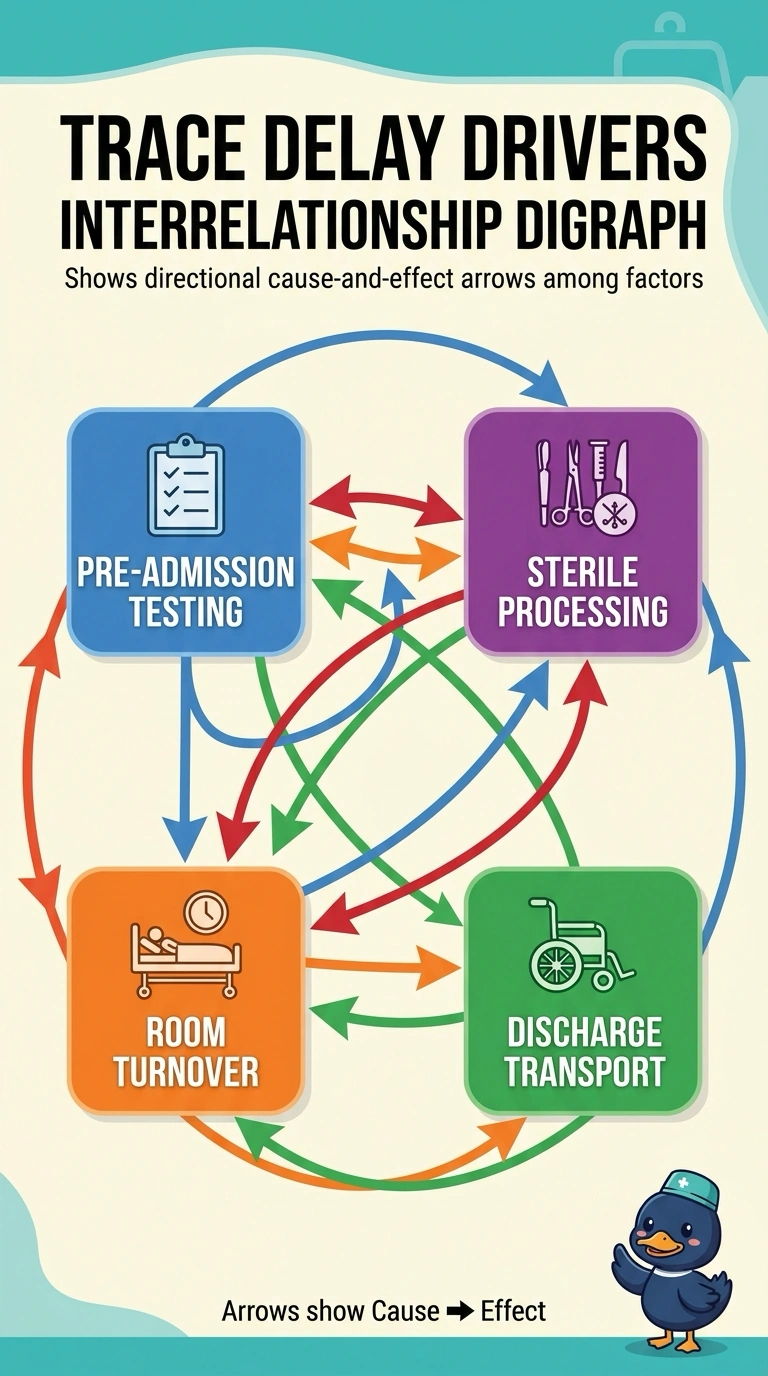
When every department insists someone else caused the bottleneck, your team needs a map of who pushes whom. An interrelationship digraph turns circular arguments into directional arrows so the true root driver stands out. The trap is picking a measurement chart when you first need to untangle how complex factors influence one another.
Full Explanation
An interrelationship digraph showing directional cause-and-effect arrows among factors lets a cross-functional team systematically examine each pair of issues and determine which one drives the other. Factors with the highest number of outgoing arrows emerge as primary root drivers, while factors with mostly incoming arrows represent downstream effects, giving the team a clear starting point. A control chart tracking monthly operating room utilization percentages monitors process stability over time, but it cannot explain how sterile processing or pre-admission testing interact. A histogram displaying the distribution of daily surgical case durations reveals spread and skewness for a single continuous variable without mapping multi-department relationships. A check sheet tallying the daily count of delayed first-case starts captures frequency data at one point in the schedule, yet it does not clarify causal dependencies across downstream departments. As a caveat, directional arrows drawn by a team reflect group consensus and should be verified with operational timestamps before launching major redesigns. For an operational check, validate the top driver identified on the digraph by measuring cycle times at that handoff over two weeks.
Prefer to study offline? Printable PDF study book + test engine ($7.50, unofficial). These questions stay free here.