
During a hospital-wide sepsis bundle improvement project, pharmacy, emergency nursing, and laboratory leaders repeatedly duplicate data pulls while assuming someone else will approve order-set edits. Which tool best resolves this role confusion?
Select an answer to reveal the explanation.
Short Explanation
Picture a relay race where four runners all grab the same baton while nobody crosses the finish line. The trap is reaching for a workflow map when your real bottleneck is unclear ownership, so make sure you assign who does the work and who signs off.
Full Explanation
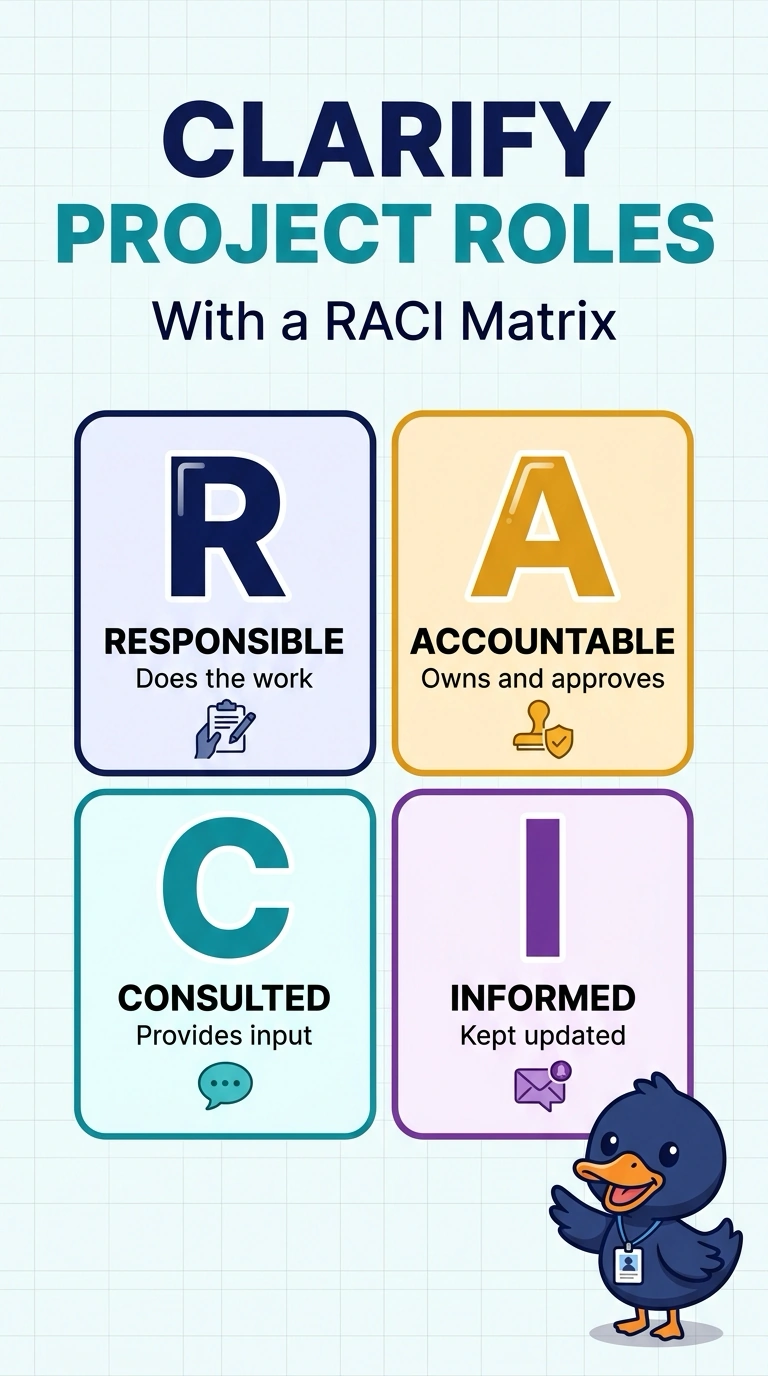
Cross-functional improvement projects stall when multiple departments share a clinical process without explicit decision rights. Using A RACI matrix assigning responsible and accountable task owners solves this governance gap by mapping every project deliverable against each role to specify who is Responsible for executing the task, who is Accountable for final approval, who must be Consulted beforehand, and who is Informed of updates. By contrast, A SIPOC diagram outlining high-level suppliers and process outputs defines process boundaries and inputs at project launch but does not clarify which team member approves order-set changes or pulls weekly metrics. A Pareto chart ranking the most frequent sepsis bundle delays helps prioritize which clinical defects to target first, yet it cannot prevent two departments from pulling the same report. Similarly, A spaghetti diagram mapping staff walking paths in the emergency bay exposes physical motion waste on the unit rather than administrative role overlap. As a caveat, assign only one Accountable owner per deliverable; listing multiple approvers recreates the exact ambiguity you are trying to eliminate. Operationally, review the completed matrix with all department sponsors at the next team huddle and confirm every recurring task has a single named owner.
Prefer to study offline? Printable PDF study book + test engine ($7.50, unofficial). These questions stay free here.