
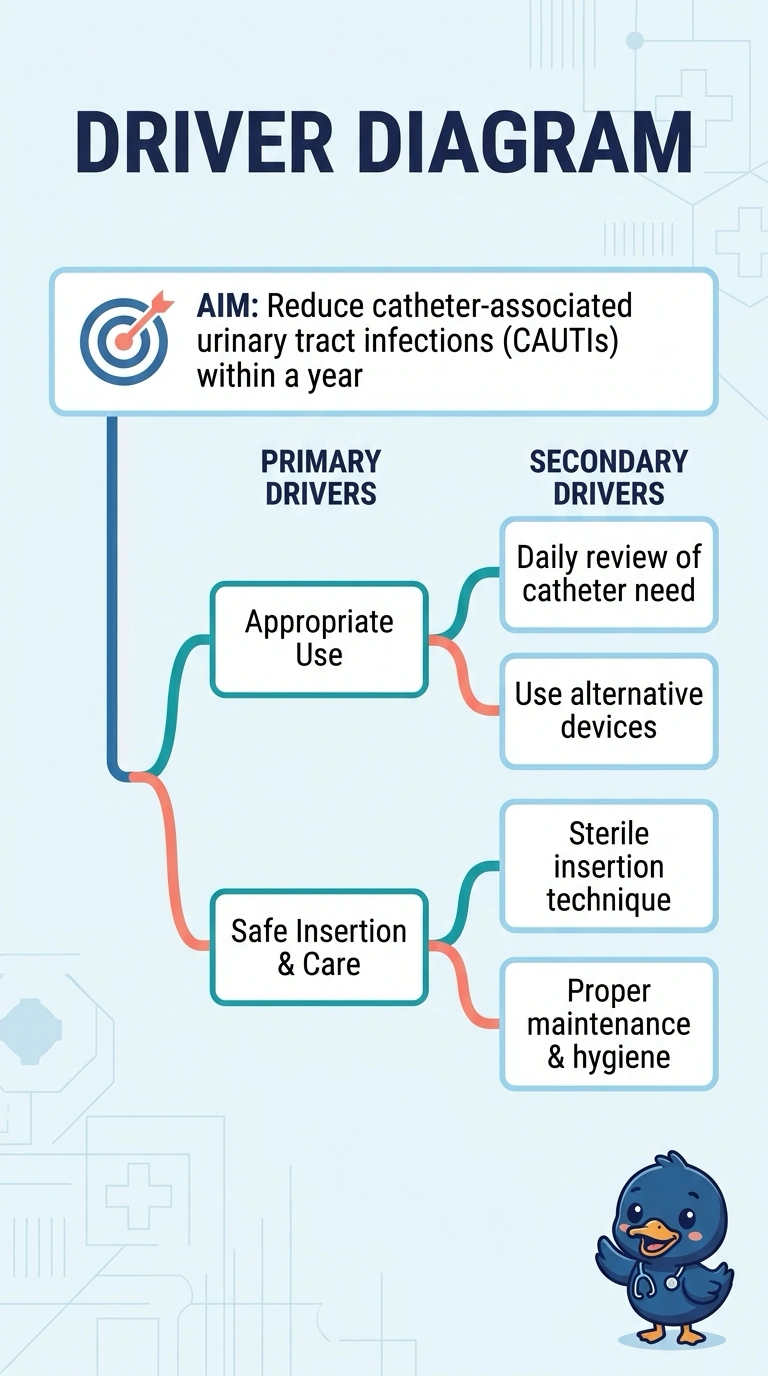
A hospital quality team sets a goal to cut inpatient catheter-associated urinary tract infections within a year and wants to map its measurable aim to high-level system factors and specific frontline interventions. Which quality tool best supports this structure?
Select an answer to reveal the explanation.
Short Explanation
Think of a driver diagram as your project's road map: it connects where you want to go on the left to the exact system levers you will pull on the right. The trap is grabbing a diagnostic or counting chart when you actually need to organize your theory of change. Use a tool built for planning interventions, not just summarizing past data.
Full Explanation
When an improvement team launches a multifaceted clinical initiative, it needs a visual theory of change that translates a broad aim into actionable tests. Selecting "A driver diagram linking the aim to primary and secondary drivers" works because it organizes the measurable goal on one side, the primary drivers in the middle, and the secondary drivers with specific change ideas linked to those drivers on the other. Choosing "A Pareto chart ranking historical infection counts by nursing unit" only identifies which units have the highest volume of infections and does not map out how system factors connect to interventions. Using "A spaghetti diagram tracing nurse walking paths in supply rooms" visualizes physical motion waste in a workspace rather than linking clinical drivers to an aim. Plotting "A scatter diagram plotting monthly catheter days against staffing hours" tests whether two continuous variables correlate, which answers a narrow analytical question rather than structuring an entire improvement program. A key caveat is that a driver diagram represents an initial hypothesis that must still be tested and refined through iterative cycles. As an operational check, review the diagram with bedside nurses and physicians to confirm every secondary driver links to at least one measurable process change.
Prefer to study offline? Printable PDF study book + test engine ($7.50, unofficial). These questions stay free here.