
A newly formed quality improvement team at a reference laboratory needs to align on the high-level boundaries, key inputs, and downstream recipients of its specimen accessioning workflow before building a detailed step-by-step flowchart. Which quality tool best establishes this shared high-level view?
Select an answer to reveal the explanation.
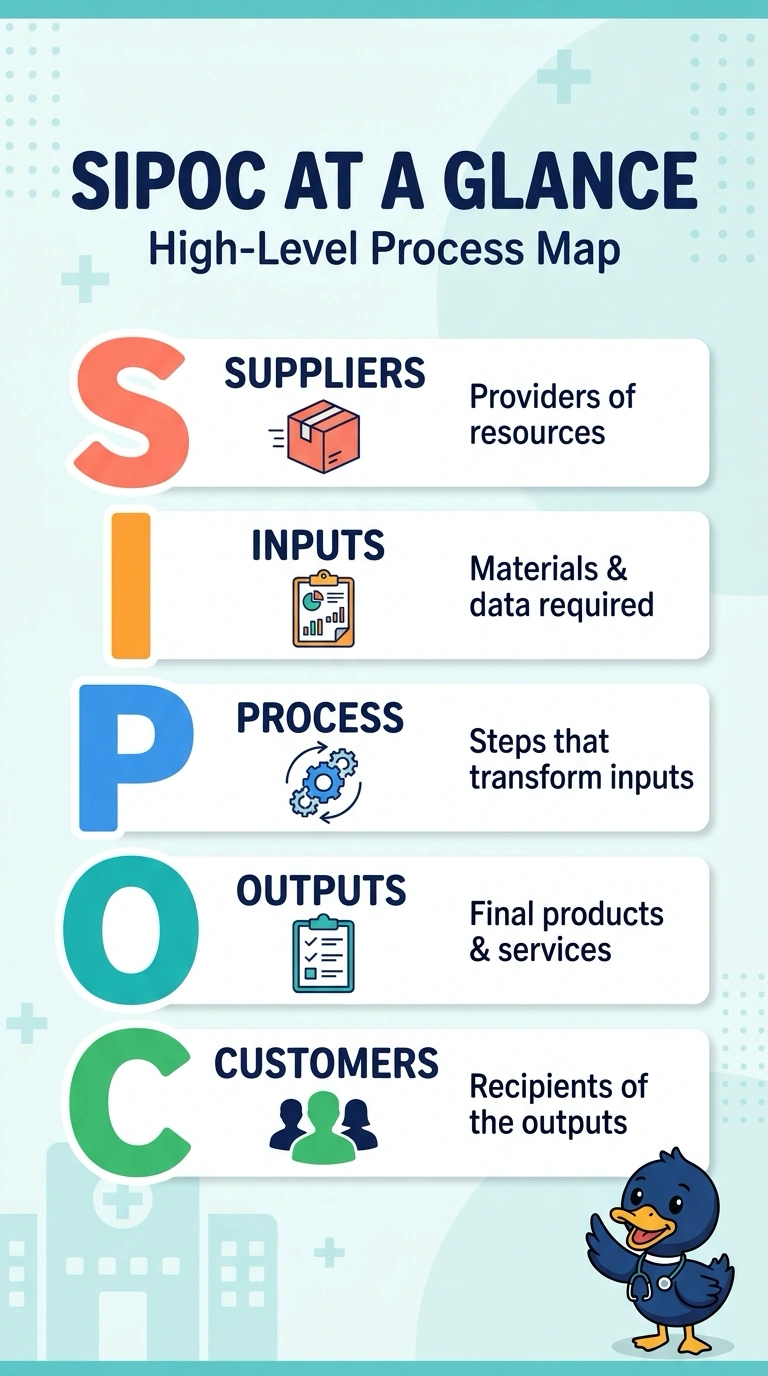
Short Explanation
Diving straight into a micro-level flowchart without agreeing on where the process starts and stops is like building a fence without surveying the property line. The trap is reaching for detailed statistical or risk tools before defining scope. You need a high-level boundary map first so everyone sees the same workflow.
Full Explanation
At the outset of a process improvement initiative, teams need a shared bird's-eye view of process boundaries before investing hours in detailed task mapping. Choosing A SIPOC diagram defining suppliers, inputs, process, outputs, and customers aligns laboratory, courier, and clinical stakeholders on who provides specimens, what enters accessioning, the major process steps, and who receives final results. By contrast, An X-bar and R control chart tracking daily specimen turnaround time variation is a statistical monitoring tool used during baseline measurement or ongoing control, not for scoping workflow boundaries. Selecting A Failure Mode and Effects Analysis scoring severity, occurrence, and detection evaluates specific failure points within an already-mapped process rather than establishing initial scope. Likewise, A scatter diagram plotting daily specimen volume against hourly staffing levels tests correlation between two continuous variables rather than defining process inputs and customers. One caveat is that a SIPOC diagram should stay at a high level—typically five to seven major steps—or it loses its value as a quick alignment tool. As an operational check, review the completed SIPOC with upstream clinic staff and downstream physicians to confirm start and end boundaries before drafting a detailed flowchart.
Prefer to study offline? Printable PDF study book + test engine ($7.50, unofficial). These questions stay free here.