
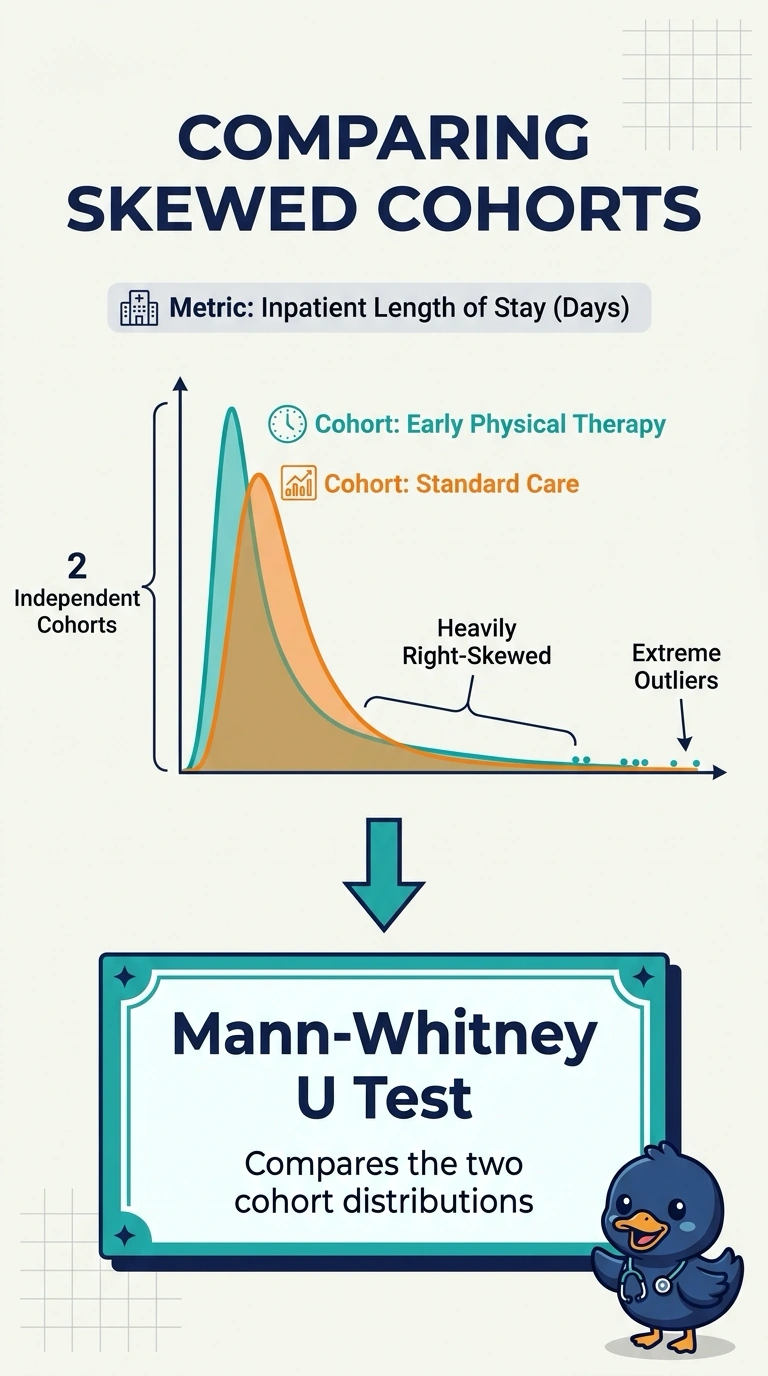
A quality analyst wants to compare inpatient length of stay in days between two independent patient cohorts—those receiving early physical therapy and those receiving standard care—and finds both distributions are heavily right-skewed with extreme outliers. Which statistical test is most appropriate?
Select an answer to reveal the explanation.
Short Explanation
When a few long hospital stays stretch your average out of shape, a standard t-test loses its footing. The trap is forcing skewed length-of-stay data into a parametric mean comparison when a rank-based test is built for the job.
Full Explanation
A Mann-Whitney U test comparing the two cohort distributions is a non-parametric rank-sum test that does not assume normality and resists distortion from extreme high-length-of-stay outliers. By ranking all observations across both independent groups, it accurately tests whether one cohort tends to have shorter stays than the other. An independent-samples t-test comparing the two cohort means fails here because heavy right-skewness and outliers inflate standard deviations and distort the mean, particularly in modest samples. A Pearson correlation coefficient measuring linear association evaluates the strength of a linear relationship between two continuous variables rather than comparing two distinct cohorts. A chi-square test of independence comparing categorical proportions applies to frequency counts across categories, which would require discarding continuous day-level precision by dichotomizing stays. As a caveat, the Mann-Whitney U test compares overall rank distributions rather than means, so report medians and interquartile ranges alongside the p-value. Operationally, inspect histograms or Q-Q plots before selecting parametric versus non-parametric tests.
Prefer to study offline? Printable PDF study book + test engine ($7.50, unofficial). These questions stay free here.