
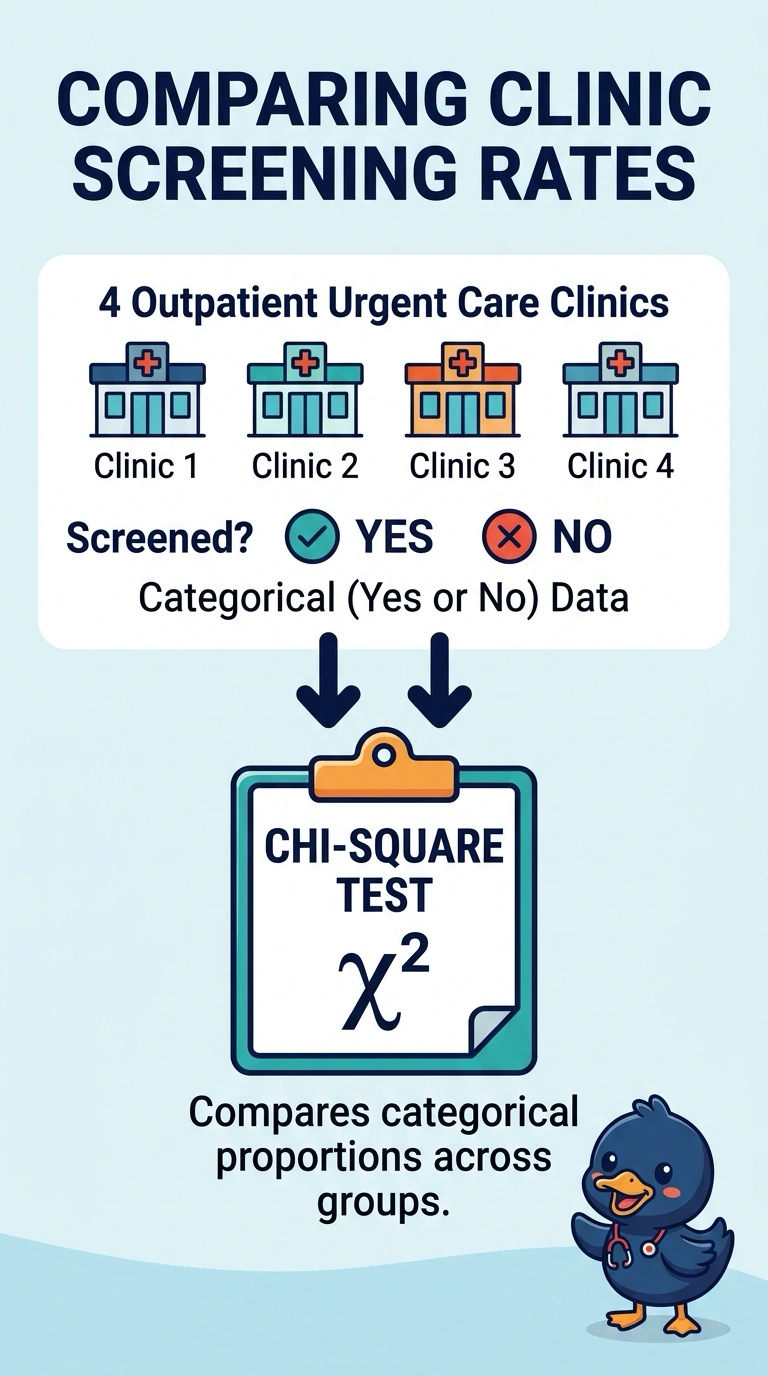
A quality analyst wants to determine whether the proportion of patient charts passing a binary yes-or-no sepsis screening audit differs significantly across four outpatient urgent care clinics. Which statistical test is most appropriate for this comparison?
Select an answer to reveal the explanation.
Short Explanation
Matching the wrong statistical test to your data is like trying to weigh apples with a thermometer. When your outcome is a yes-or-no category compared across independent clinics, you need a test built for counts and proportions. The trap is picking correlation or continuous mean tests when the outcome is categorical.
Full Explanation
A chi-square test comparing categorical proportions across groups is the standard statistical method for evaluating whether observed pass-versus-fail counts differ across two or more independent clinics beyond what random chance would produce. Because each chart audit yields a binary categorical outcome and the four urgent care clinics represent independent groups, comparing cell frequencies against expected counts directly answers the analyst's question. A Pearson correlation coefficient comparing two continuous lab turnaround variables measures the strength of a linear relationship between two continuous numeric variables rather than comparing pass/fail proportions across four categories. A paired t-test measuring before-and-after wait times on the same patients compares means of a continuous variable measured twice on matched subjects, which fits neither independent clinics nor binary outcomes. A linear regression model predicting continuous length of stay from age models a continuous numeric outcome rather than categorical audit compliance. Remember that a statistically significant chi-square result indicates that at least one clinic differs, not which specific pair differs or whether the gap is clinically meaningful. As an operational check, verify that expected cell counts meet minimum test assumptions and display each clinic's sample size alongside its compliance percentage.
Prefer to study offline? Printable PDF study book + test engine ($7.50, unofficial). These questions stay free here.