
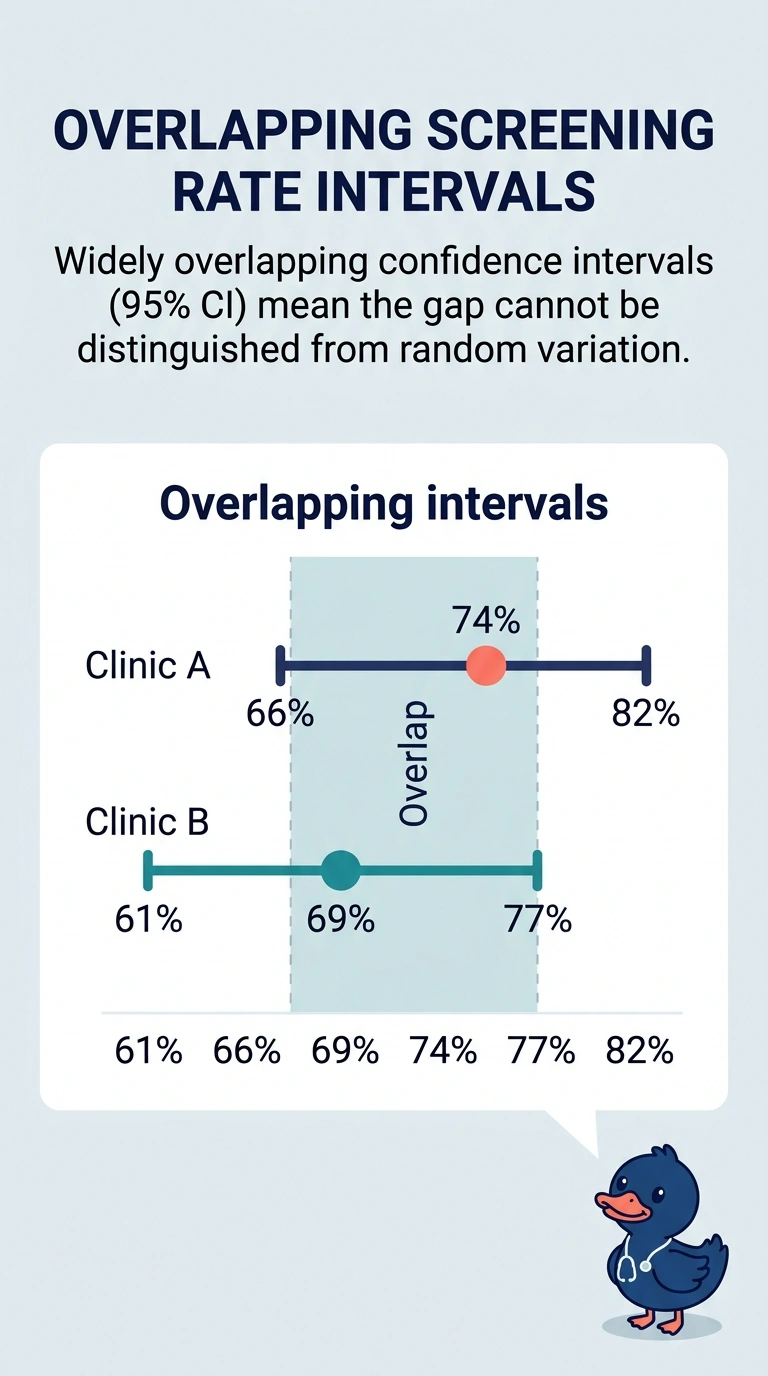
A regional health system compares quarterly colorectal cancer screening rates across four primary care clinics. Clinic A reports 74% (95% CI: 66% to 82%) and Clinic B reports 69% (95% CI: 61% to 77%), and an executive wants to publicly rank Clinic A as the top performer. How should the quality analyst advise leadership?
Select an answer to reveal the explanation.
Short Explanation
You’re right to pause before turning a five-point gap into a public ranking: the confidence intervals overlap like two neighbors’ lawns. When 95% confidence intervals overlap widely, you cannot reliably declare one clinic superior, so the gap cannot be distinguished from random variation.
Full Explanation
Explain that the widely overlapping confidence intervals mean the gap cannot be distinguished from random variation, preventing leaders from misinterpreting statistical noise as a meaningful performance difference. Clinic A’s interval (66% to 82%) and Clinic B’s interval (61% to 77%) share a broad range of plausible true values, so ranking one above the other risks rewarding or penalizing clinics for sample-size fluctuations. Publishing the numeric ranking immediately to promote transparency and motivate improvement undermines trust in analytics when clinicians recognize that a random swing next quarter could reverse the order. Removing the confidence intervals because executives prefer single percentages strips away essential precision context and encourages overreaction to small differences. Creating a weighted ranking score that adjusts for patient volume to account for clinic size distorts a proportion into a volume-driven count that favors larger clinics regardless of screening quality. As an exam caveat, even when intervals overlap slightly, a formal hypothesis test or pooled time-series review can clarify whether a persistent gap exists. As a practical check, display error bars or funnel plots alongside clinic rates in quarterly scorecards and review sample denominators before assigning tiers.
Prefer to study offline? Printable PDF study book + test engine ($7.50, unofficial). These questions stay free here.