
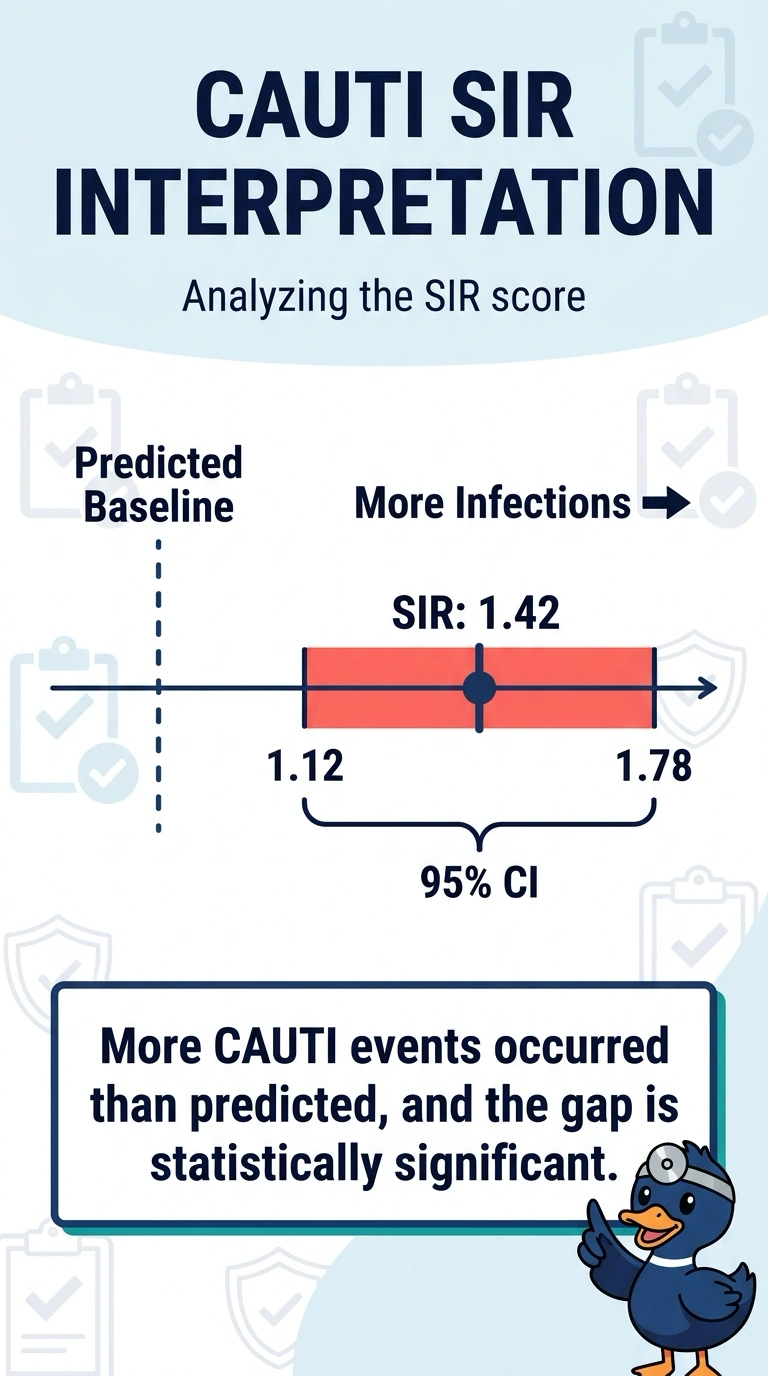
An acute care hospital reviews its quarterly CDC National Healthcare Safety Network (NHSN) report and sees a catheter-associated urinary tract infection (CAUTI) Standardized Infection Ratio (SIR) of 1.42, with a 95% confidence interval of 1.12 to 1.78. How should the quality analyst interpret this result?
Select an answer to reveal the explanation.
Short Explanation
A Standardized Infection Ratio works like a par score in golf—1.0 means you matched what the risk model predicted for your patient mix. The trap is misreading the ratio as a raw percentage or ignoring the confidence interval when judging significance. Because your SIR of 1.42 sits well above 1.0 and the confidence interval does not include 1.0, your hospital had significantly more infections than predicted.
Full Explanation
In CDC NHSN surveillance, an SIR divides observed infections by predicted infections adjusted for facility and patient-care location risk factors, so an SIR of 1.42 with a confidence interval of 1.12 to 1.78 means More CAUTI events occurred than predicted, and the gap is statistically significant. Because 1.0 represents parity with the national baseline, a ratio of 1.42 indicates 42% more infections than predicted, and the 95% confidence interval lying entirely above 1.0 confirms the excess is unlikely due to chance. Choosing The hospital had 42% fewer CAUTI events than predicted by the national baseline reverses the direction of the ratio, which would correspond to an SIR of 0.58 rather than 1.42. Choosing The infection rate reflects normal random variation because the ratio stays under two misstates the statistical threshold, because significance for an SIR depends on whether the confidence interval crosses 1.0, not 2.0. Choosing Exactly 1.42% of all catheterized patients developed a urinary tract infection confuses a risk-adjusted ratio with a crude infection proportion. As a caveat, an elevated SIR can also reflect surveillance definition changes or improved case-finding rather than clinical deterioration alone. For an operational check, stratify the unit-level SIRs and audit urinary catheter days and culture practices on the highest-contributing units.
Prefer to study offline? Printable PDF study book + test engine ($7.50, unofficial). These questions stay free here.