
A 400-bed hospital wants to audit pain reassessment documentation across 12 inpatient units, but two small specialty units account for only 5% of total discharges and would be missed by a simple random sample. Which sampling method ensures proportional representation across every unit?
Select an answer to reveal the explanation.
Short Explanation
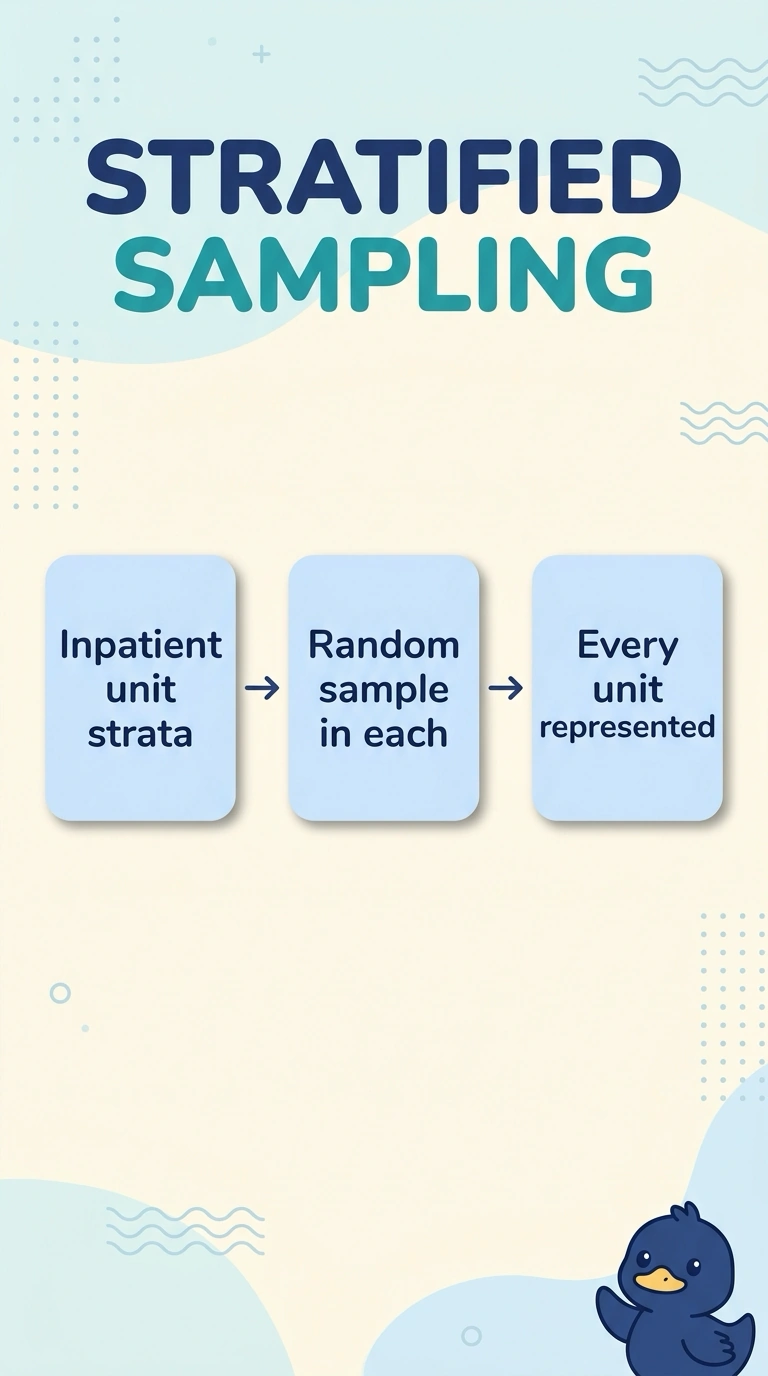
If you pull a simple random sample across a big hospital, your smallest specialty units can vanish into statistical noise. The trap is grabbing convenient charts or picking only large units, which leaves blind spots where safety gaps hide. Divide the population into unit-level strata first, then sample randomly within each one so every unit is fairly represented.
Full Explanation
When a quality team needs accurate inferences across subgroups of unequal size, the sampling design must guarantee that smaller units are not drowned out by high-volume departments. Applying "Stratified random sampling divided by individual inpatient unit" groups the population into distinct unit strata and draws random records from each stratum, ensuring every clinical area is represented for comparison. Using "Convenience sampling of the first charts available on the medical floor" introduces selection bias and excludes other units entirely. Relying on "Judgmental sampling of charts flagged by unit managers as exemplary" skews results toward favorable documentation rather than reflecting true routine practice. Selecting "Cluster sampling that selects only two large surgical units for review" leaves the remaining ten units—including the small specialty areas—completely unmeasured. A caveat is that if strata have very small sample sizes, unit-level percentages will have wide confidence intervals and should be interpreted cautiously or pooled over time. As an operational check, document the exact inclusion criteria, stratum counts, and random selection seed in the data collection plan before chart abstraction begins.
Prefer to study offline? Printable PDF study book + test engine ($7.50, unofficial). These questions stay free here.