
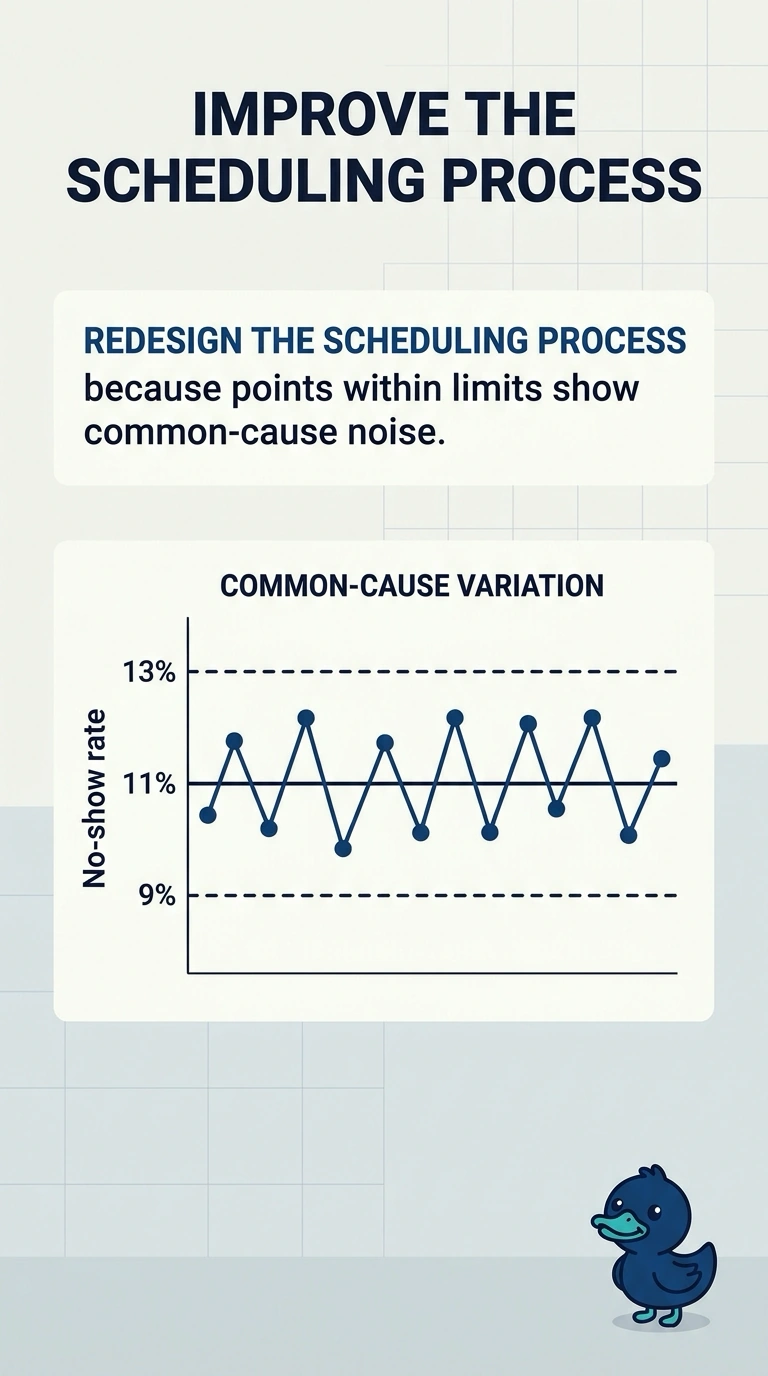
An outpatient clinic tracks its monthly appointment no-show rate on a statistical process control chart. Over the past year, rates have fluctuated between 9% and 13% around an 11% centerline, with all points inside the control limits and no runs or trends. A clinic manager wants to investigate every month that rises above 11%. What should the quality analyst advise?
Select an answer to reveal the explanation.
Short Explanation
Think of a thermostat oscillating naturally within a two-degree band—chasing every minor swing only wears out the equipment. The trap is treating normal variation as a special crisis, which leads your team into costly tampering instead of fixing the underlying system.
Full Explanation
When all points on a statistical process control chart fall within the upper and lower control limits without special-cause patterns, the process is statistically stable and exhibits only common-cause variation. Therefore, the analyst should advise leadership to Redesign the scheduling process because points within limits show common-cause noise. Meaningful improvement in a stable process requires changing the system itself—such as revising reminder workflows or intake scheduling—rather than reacting to routine month-to-month swings. Choosing to Conduct an immediate root cause analysis whenever a monthly rate rises above the centerline is Deming's classic tampering mistake, wasting staff effort on random noise. Choosing to Narrow the control limits by recalculating them from the most recent three months only is wrong because valid limits require stable baseline data, and a short window narrows limits and triggers false alarms. Choosing to Switch to a two-point bar comparison so month-to-month changes are easier to spot abandons time-series context and amplifies overreaction to single-period changes. Caveat: confirm that no special-cause rules, such as a shift or trend, are hidden before classifying the process as stable. As an operational check, review the full control chart alongside staff to verify baseline stability before chartering a scheduling redesign.
Prefer to study offline? Printable PDF study book + test engine ($7.50, unofficial). These questions stay free here.