
You commission a 10-kWh wall battery paired with a hybrid inverter in a garage with limited ventilation, where the manual specifies torque, firmware, charge limits, and PPE for arc and chemical hazards. Inspection requires listed settings and labeled disconnects. Which commissioning approach follows manufacturer programming and safety instructions?
Select an answer to reveal the explanation.
Short Explanation
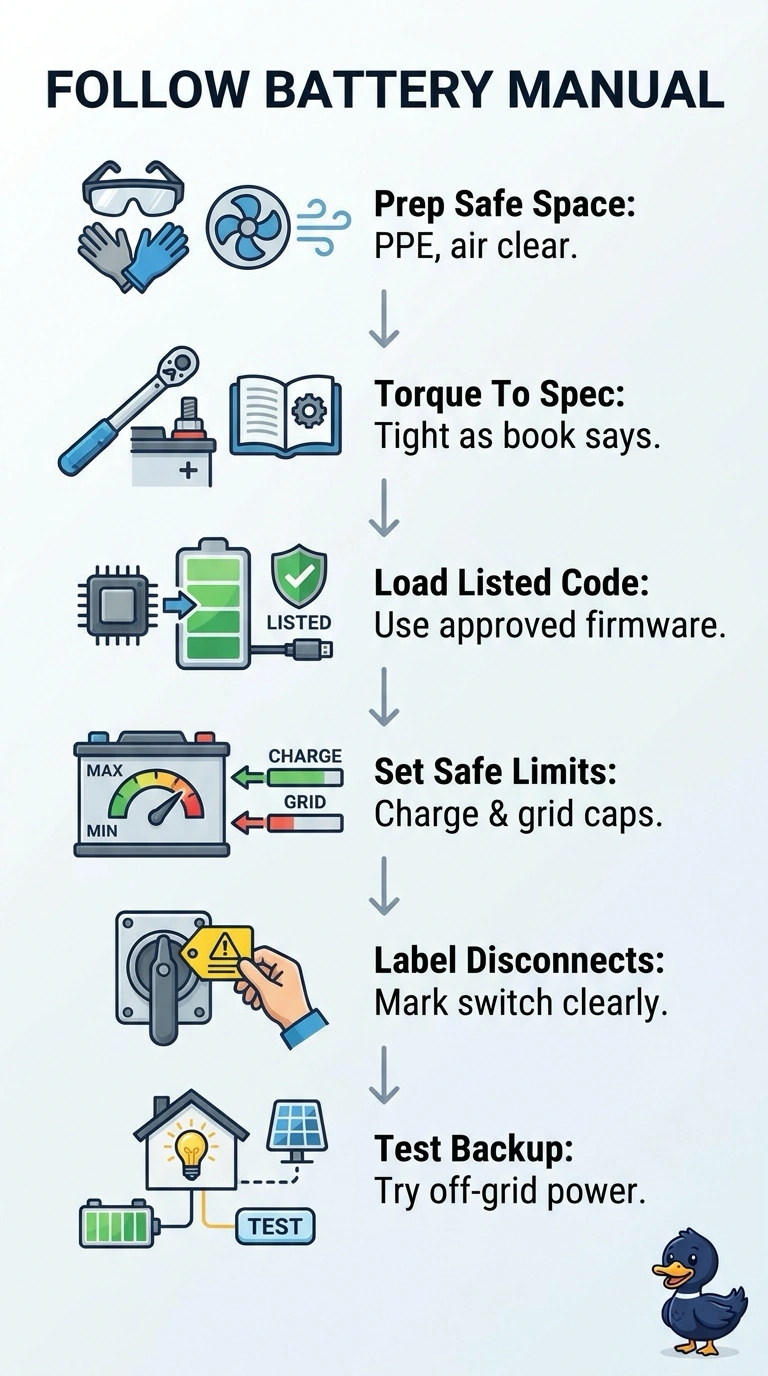
You’re commissioning a powerful battery in a tight space, so follow the manufacturer’s instructions in sequence and protect yourself from the specified hazards. This manual-first startup includes the listed firmware, charge limits, labeled disconnects, and a backup test.
Full Explanation
The approach that stages PPE and ventilation, applies the manual’s torque, loads the listed firmware, sets charge limits, labels disconnects, and then tests backup follows the manufacturer’s programming and safety instructions and the inspection requirements. Documenting backup readiness is useful, but it does not show that backup operation was actually tested; commissioning requires that functional check. Recording disconnect locations can support documentation, but it cannot replace physical labels that identify isolation points during operation and service. Loading the latest approved firmware may seem reasonable, but that version is not necessarily the one listed for this equipment and may affect behavior or compatibility. Exam caveat: “latest” or “approved” does not override a model-specific manual; resolve any discrepancy with the manufacturer rather than assuming versions are interchangeable. Practical check: before energizing, compare the firmware identifier and programmed charge limits with the manual, verify torque records and visible disconnect labels, and confirm that required PPE and ventilation controls are in place.