
After a skilled nursing facility transitions to Medicare Part A Patient Driven Payment Model (PDPM) billing, a rehabilitation director asks whether increasing daily therapy minutes for stable orthopedic residents will raise per-diem reimbursement. How should the administrator respond?
Select an answer to reveal the explanation.
Short Explanation
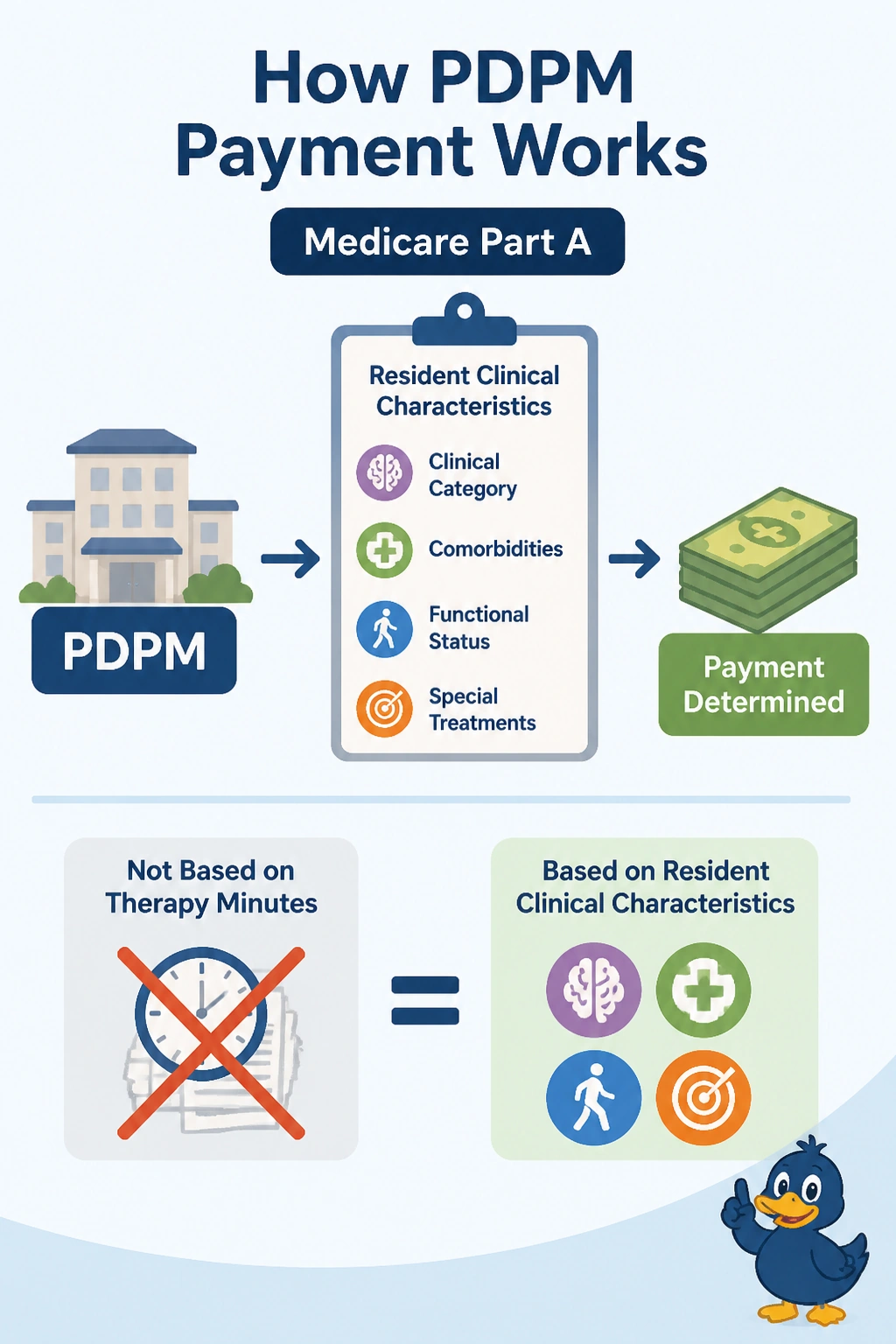
Think of PDPM like paying a mechanic for the complexity of the engine repair rather than how many hours they keep the car in the bay. The trap is holding onto the old RUG-IV mindset where more therapy minutes meant a bigger check. Under PDPM, your Medicare Part A payment is driven by resident clinical characteristics and comorbidities, not therapy volume.
Full Explanation
Under the Medicare Part A Patient Driven Payment Model (PDPM), CMS eliminated therapy-minute thresholds as the primary driver of skilled nursing reimbursement so that clinical need—not service volume—guides care delivery. Consequently, Payment depends on resident clinical characteristics rather than therapy minute volume, using five case-mix-adjusted components (physical therapy, occupational therapy, speech-language pathology, nursing, and non-therapy ancillary) derived from MDS 3.0 diagnoses, functional scores, and comorbidities. The belief that Higher weekly therapy minutes automatically shift residents into higher reimbursement tiers reflects the superseded RUG-IV payment system and risks unnecessary utilization scrutiny. Conversely, Per-diem rates are fixed uniformly across all residents regardless of clinical acuity is false because PDPM adjusts per-diem payments substantially based on each resident's specific clinical profile and variable per-diem schedules over the stay. Similarly, Reimbursement increases only when group therapy exceeds individual treatment sessions is wrong; CMS actually caps combined concurrent and group therapy per discipline at 25 percent of total therapy minutes. As a caveat, facilities must still deliver clinically appropriate therapy intensity because under-delivery can trigger medical review and quality-of-care citations. For an operational check, audit recent MDS admission assessments to confirm ICD-10 primary diagnoses and comorbidities are accurately coded before billing.
Prefer to study offline? Printable PDF study book + test engine ($7.50, unofficial). These questions stay free here.