
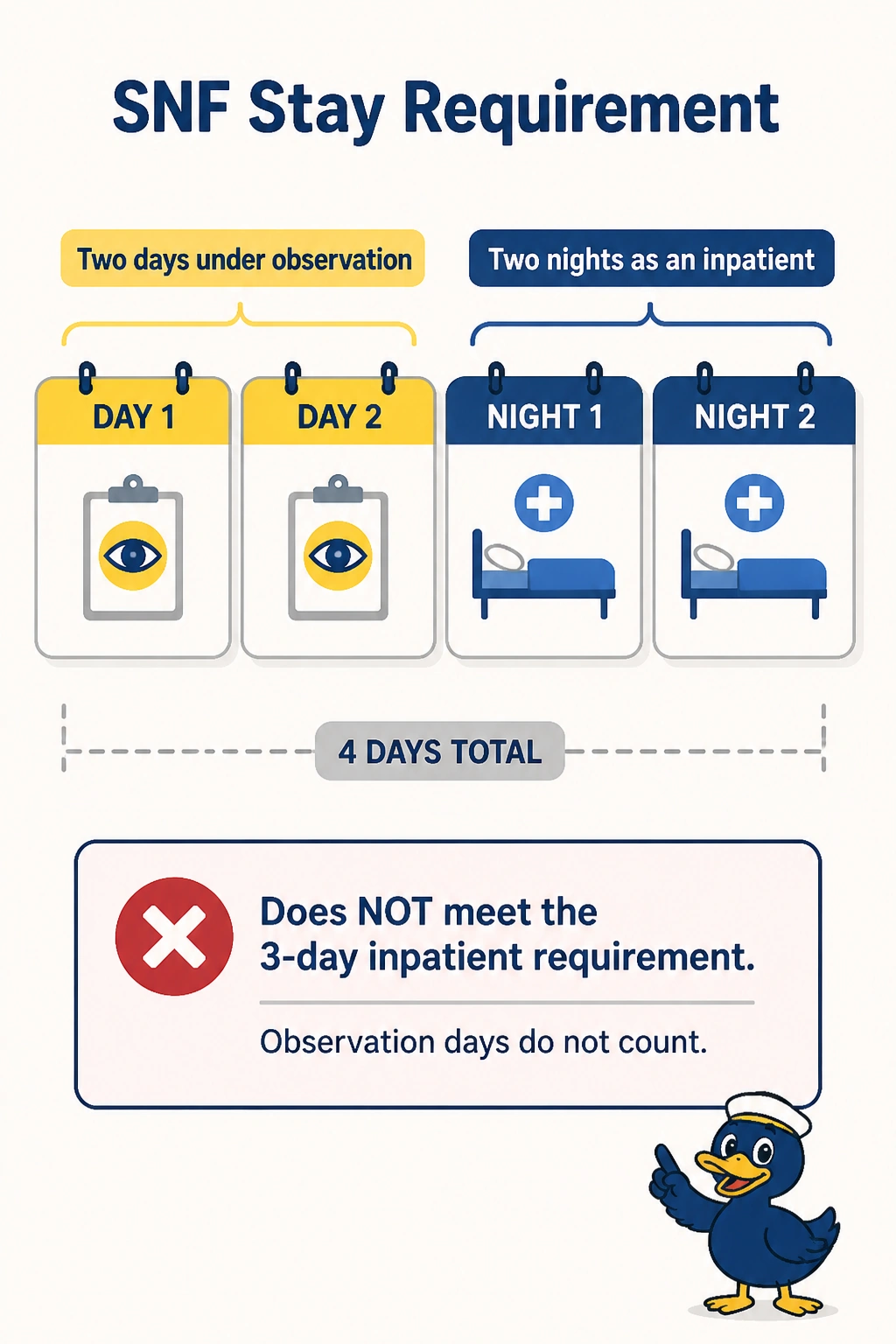
A traditional Medicare beneficiary spends two days in a hospital emergency department under observation status and is then admitted as an inpatient for two nights before transferring to a skilled nursing facility for rehabilitation. How does this hospital stay affect traditional Medicare Part A SNF coverage?
Select an answer to reveal the explanation.
Short Explanation
Being inside a hospital building for three days is not the same as being formally admitted as an inpatient for three days. Under traditional Medicare, observation hours do not count toward the 3-day qualifying stay, so your resident will not have Part A SNF coverage. Watch out for the 72-hour clock trap — Medicare counts three consecutive inpatient calendar days; the admission day counts, the discharge day does not, and observation does not count.
Full Explanation
Under 42 CFR 409.30(a)(1), traditional Medicare Part A covers skilled nursing facility care only after a medically necessary inpatient hospital stay of at least three consecutive calendar days, counting the day of admission but not the day of discharge. Because outpatient observation days are billed under Part B, The stay does not meet the 3-day inpatient requirement because observation days do not count, leaving only two qualifying inpatient nights. Choosing The stay qualifies for Medicare Part A SNF coverage because total hospital time exceeded 72 hours mistakenly treats outpatient observation time as inpatient days. Choosing The SNF may bill Medicare Part A automatically if the attending physician signs a retroactive order is invalid because a skilled nursing physician cannot retroactively convert hospital outpatient status into inpatient days. Choosing Medicare Part A covers the first 20 SNF days regardless of hospital inpatient admission status confuses the zero-coinsurance period (days 1 through 20 of an already-qualified stay) with the threshold eligibility rule. Caveat: Some Medicare Advantage plans waive the 3-day hospital stay requirement, and CMS may issue temporary waivers during declared emergencies. Operational check: Verify the hospital's formal inpatient admission date and midnight count on the face sheet. CMS does not require a SNFABN (CMS-10055) before billing the resident when there is no 3-day qualifying inpatient stay; a voluntary SNFABN may be given as a courtesy. Do not use the Part B ABN (CMS-R-131) for this Part A technical denial.
Prefer to study offline? Printable PDF study book + test engine ($7.50, unofficial). These questions stay free here.