
A long-stay resident with mild heart failure has a valid durable power of attorney for healthcare naming her adult son as agent. The resident is cognitively intact and declines a recommended cardiac catheterization, while her son insists the facility schedule the procedure anyway. Whose decision governs?
Select an answer to reveal the explanation.
Short Explanation
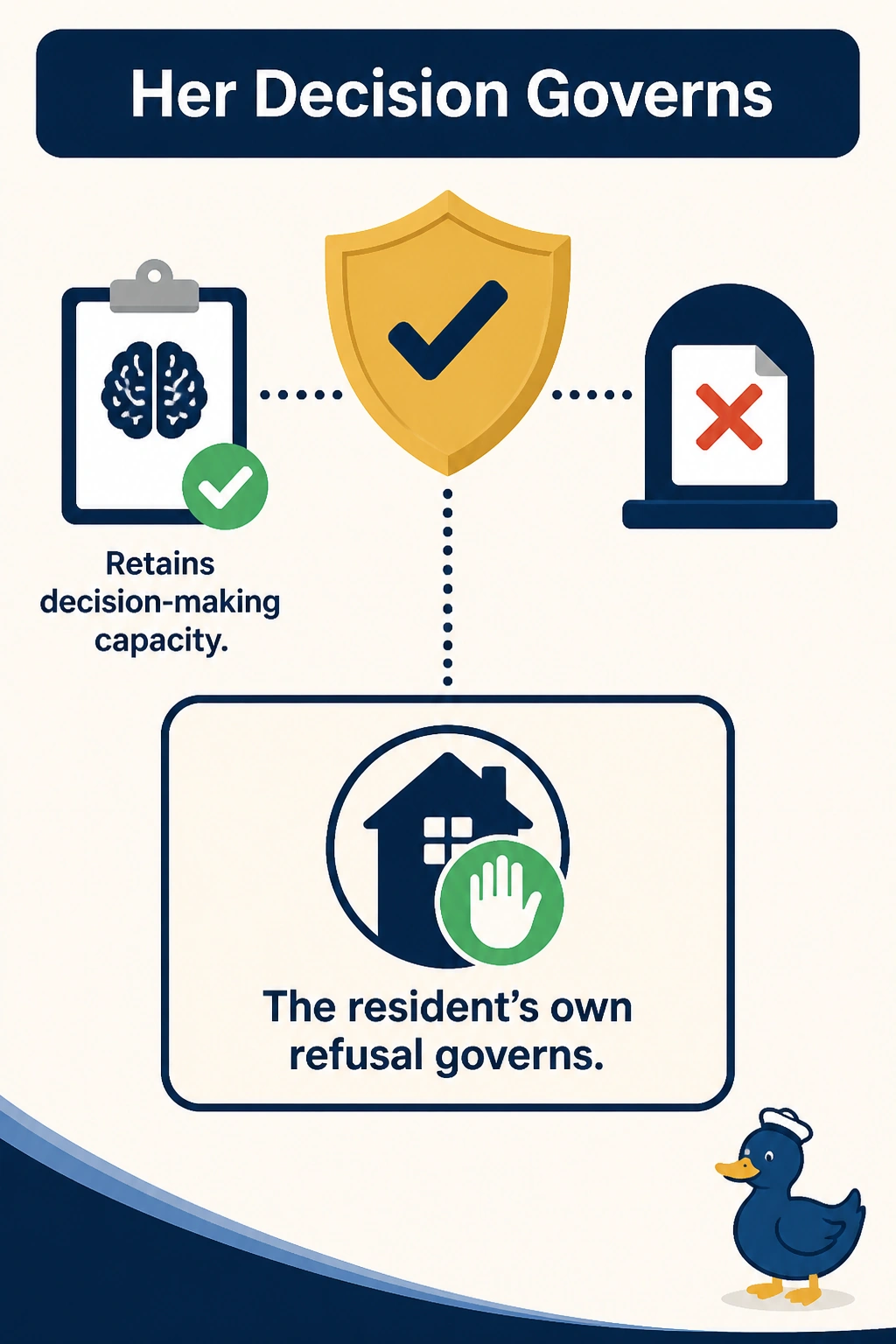
Having a healthcare proxy on file is like having a spare tire in the trunk—you only use it if the main tire goes flat. The trap is assuming a signed power of attorney lets a family agent overrule a resident who can still decide for herself. As long as the resident has decision-making capacity, your team must honor her own refusal.
Full Explanation
Under federal resident rights rules (42 CFR 483.10) and standard advance directive principles, The resident's own refusal, because she retains decision-making capacity, is the legally and clinically governing choice. Under 42 CFR 483.10(c)(6) and 42 CFR 489.100, the resident's own refusal controls while the resident has capacity; a health-care power of attorney addresses decisions when the resident is incapacitated. Who documents incapacity, and whether a given instrument is springing or immediately effective, follows the document and state law, but an agent cannot override a capacitated resident. Choosing The adult son's decision, because the signed durable power of attorney is already on file mistakenly treats a springing or standby proxy designation as active authority while the resident is still competent. Choosing The attending physician's clinical judgment, because the disagreement creates a care conflict overrides resident autonomy without a finding of incapacity. Choosing The ethics committee's majority vote after reviewing both the chart and the legal form unnecessarily transfers a clear-cut competent refusal to a committee instead of respecting the resident's voice. Caveat: if the resident's cognitive status fluctuates or acute illness impairs understanding, the physician should formally evaluate and document capacity before activating the proxy. Operational check: document the resident's capacity assessment, the physician's risk-benefit discussion, and the resident's refusal in the medical record and care plan.
Prefer to study offline? Printable PDF study book + test engine ($7.50, unofficial). These questions stay free here.