
During admission intake for a cognitively intact short-stay rehabilitation resident, an admissions coordinator states that she must sign a living will and healthcare proxy form before physical therapy can begin. How do federal resident rights rules govern this requirement?
Select an answer to reveal the explanation.
Short Explanation
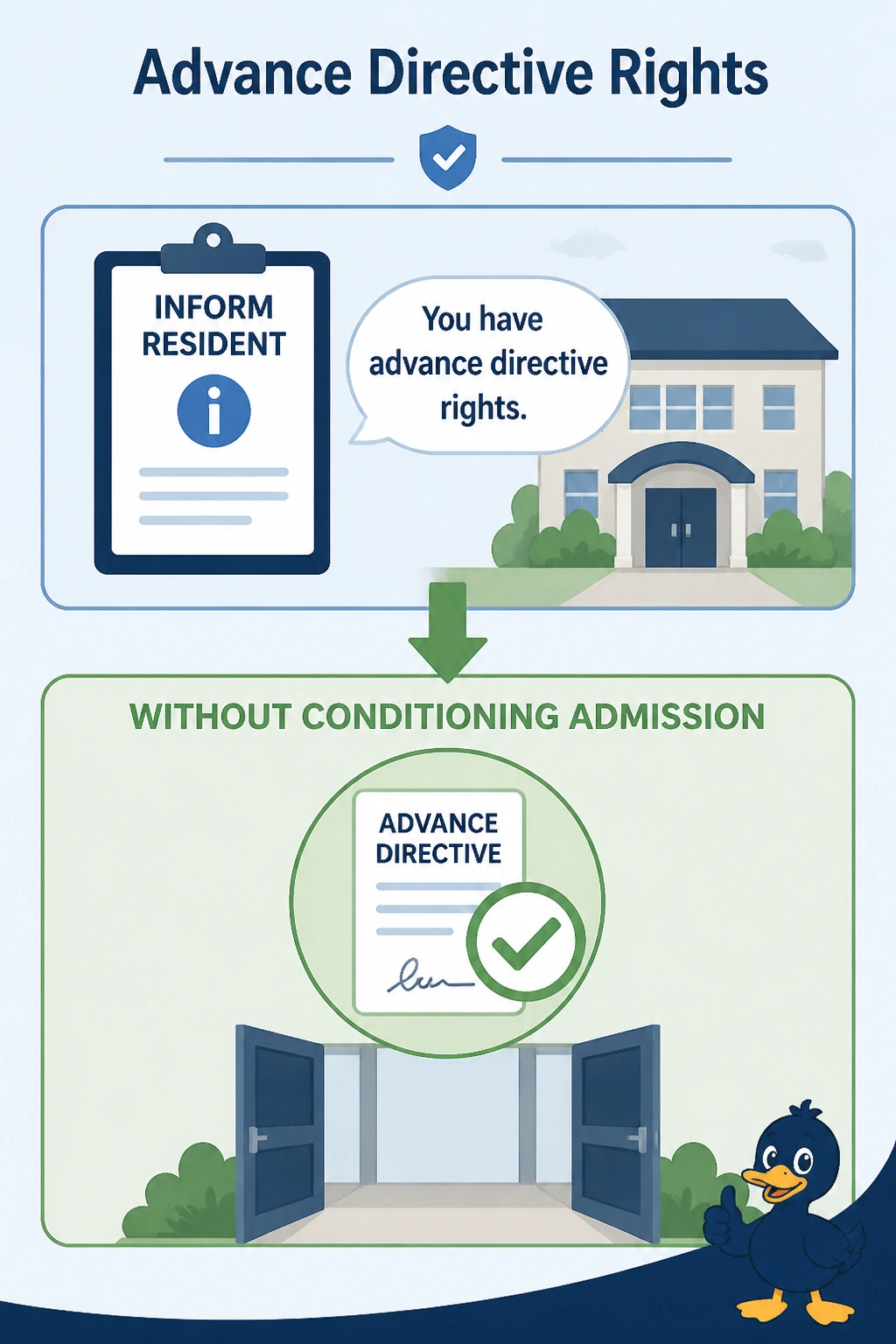
Advance directives exist to protect resident choice, so turning them into a forced admission ticket misses the entire point. Watch out for the trap of thinking a facility can hold therapy hostage until paperwork is signed—you must educate, never coerce.
Full Explanation
Under the federal Patient Self-Determination Act and 42 CFR 483.10(g)(12), the facility must inform the resident of advance directive rights without conditioning admission on execution. Residents have the right to formulate an advance directive and to decline to execute one, and staff may not discriminate or withhold care based on that choice. Suggesting that the facility may require a healthcare proxy form at admission for residents who have no local emergency contact violates federal anti-coercion protections. Claiming that the facility must wait until the 14-day comprehensive assessment is completed before discussing advance directives is incorrect because written information on advance directive rights must be provided at the time of admission. Asserting that the facility may delay initiating physical therapy until the attending physician records a formal code status unlawfully conditions clinical treatment on advance-care paperwork. As an exam caveat, facilities must still document in the medical record whether the resident has executed an advance directive and honor any valid directive presented. Operationally, audit admission packets quarterly to confirm all intake scripts and checklists separate advance directive education from mandatory admission signatures.
Prefer to study offline? Printable PDF study book + test engine ($7.50, unofficial). These questions stay free here.