
A cognitively intact long-stay resident prefers to stay up reading until midnight and sleep until 9:00 AM, but the morning nursing supervisor insists that all residents on the wing must be awakened and dressed by 7:00 AM for breakfast. How must the facility respond to uphold federal resident rights?
Select an answer to reveal the explanation.
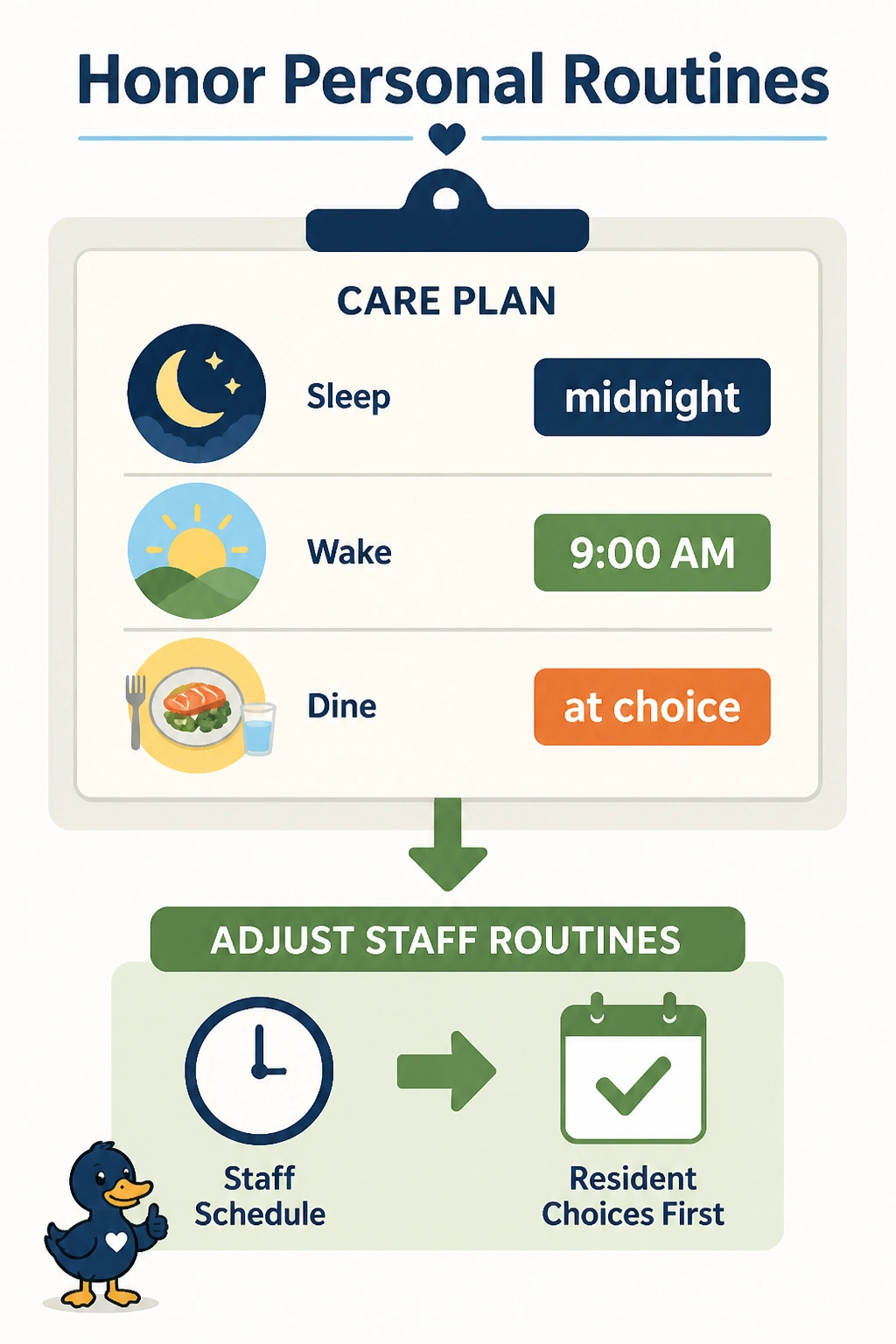
Short Explanation
A nursing home is the resident's home, not an army barracks where everyone wakes to the same bugle. The trap is letting institutional efficiency—like lining up breakfast trays and morning meds—override a resident's personal rhythm. You must build care routines around the resident's chosen schedule, not force the resident into a staff timetable.
Full Explanation
Under federal resident rights regulations at 42 CFR 483.10(f), residents have the explicit right to choose their own activities and daily schedules, including sleeping and waking times, so the facility must Honor the resident's preferred waking, sleeping, and dining schedule in the care plan and adjust staff routines to accommodate individual choices. Person-centered care requires adapting nursing, dietary, and housekeeping workflows—such as offering breakfast later or holding a warm meal—rather than enforcing rigid institutional routines for staff convenience. Choosing to Require the resident to wake by 7:00 AM on weekdays so morning medication passes and dining room meal service stay on schedule violates self-determination and treats operational convenience as superior to resident rights. Deciding to Allow the resident to sleep late only on weekends while maintaining standard facility waking hours Monday through Friday imposes an arbitrary restriction unsupported by any clinical need. Proposing to Transfer the resident to a private-pay wing where individualized morning and evening routines are offered for an extra fee is discriminatory and unlawful because schedule choice applies equally regardless of payer source. As a caveat, a schedule preference may only be modified if it poses a documented clinical or safety risk. Operationally, review morning care and breakfast delivery times during care conferences and spot-check early-morning wake-up practices on rounds.
Prefer to study offline? Printable PDF study book + test engine ($7.50, unofficial). These questions stay free here.