
A metro government wants predictable large-seat Microsoft 365 pricing under negotiated multi-year governance. Which channel best matches that use case?
Select an answer to reveal the explanation.
Short Explanation
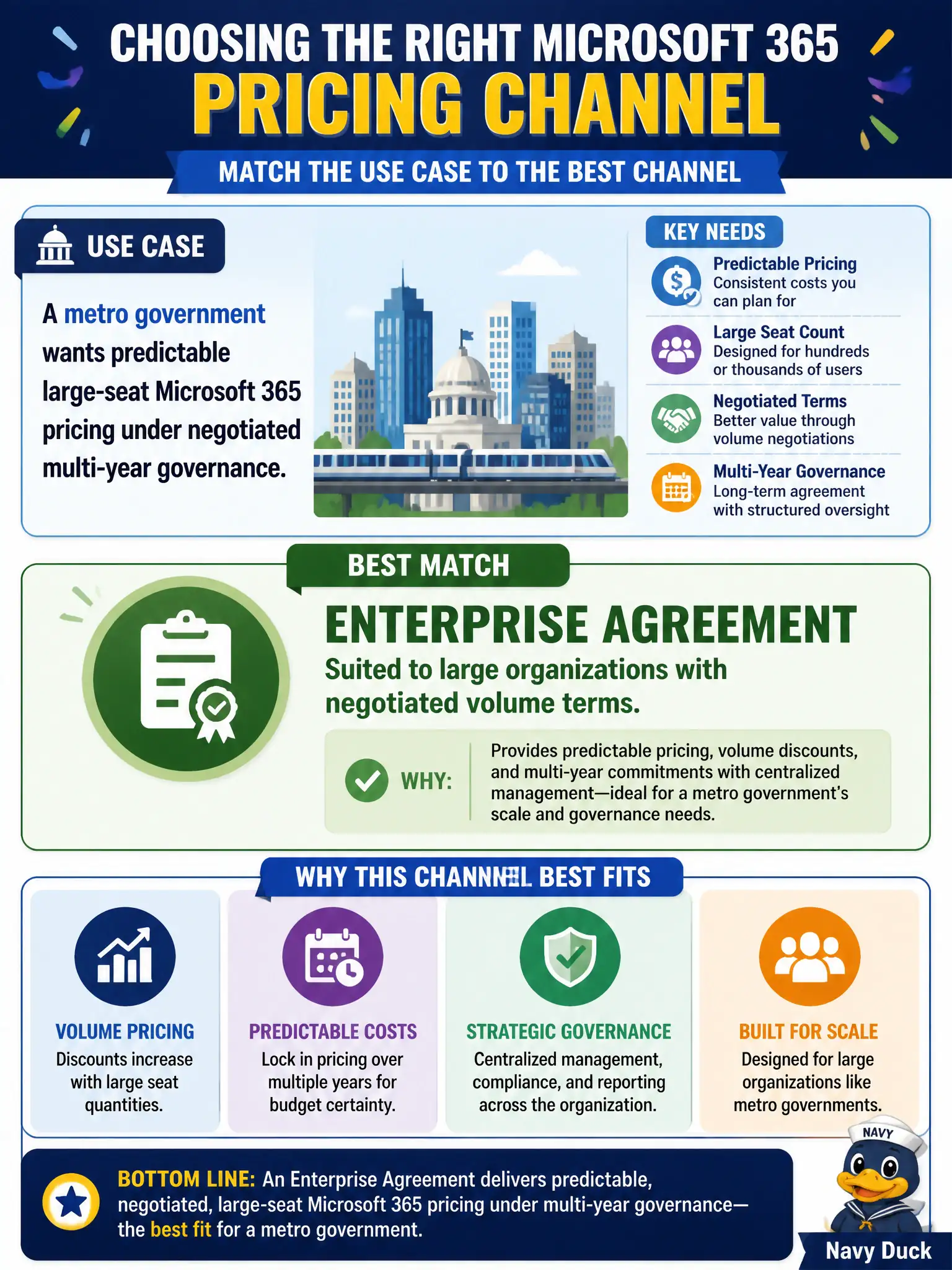
Huge seat counts and multi-year negotiated pricing usually point to an enterprise agreement. It is the big-org governance channel.
Full Explanation
Large organizations with negotiated volume terms typically use an enterprise agreement suited to that scale. When a major city needs organizational Microsoft 365 licensing under negotiated volume commercial terms, EA is the fundamentals answer—not a one-seat consumer trial or informal note.
A one-seat consumer trial bought on a personal tablet with no org terms is not an EA. An unsigned sticky note taped to a server rack is not a licensing agreement. Claims that enterprise agreements cannot cover Microsoft 365 under a CSP myth are incorrect; EA is a primary organizational volume vehicle for Microsoft 365.
Exam caveat: smaller municipalities may correctly choose CSP or direct instead of EA based on volume and procurement maturity. Operational check: review whether the city’s enrollment shows Microsoft 365 products under EA, note anniversary/true-up dates, and ensure IT and procurement share a seat-count forecast. In municipal Microsoft 365 fundamentals scenarios, map the business need to the named capability, reject distractors from a different pillar, and verify the control or commercial setting in the admin or billing experience before reporting risk closed to leadership. In municipal Microsoft 365 fundamentals scenarios, map the business need to the named capability, reject distractors from a different pillar, and verify the control or commercial setting in the admin or billing experience before reporting risk closed to leadership.