
A city Teams admin checks Teams usage activity reports to brief the hybrid-work committee. Where should those Teams-focused reports be reviewed?
Select an answer to reveal the explanation.
Short Explanation
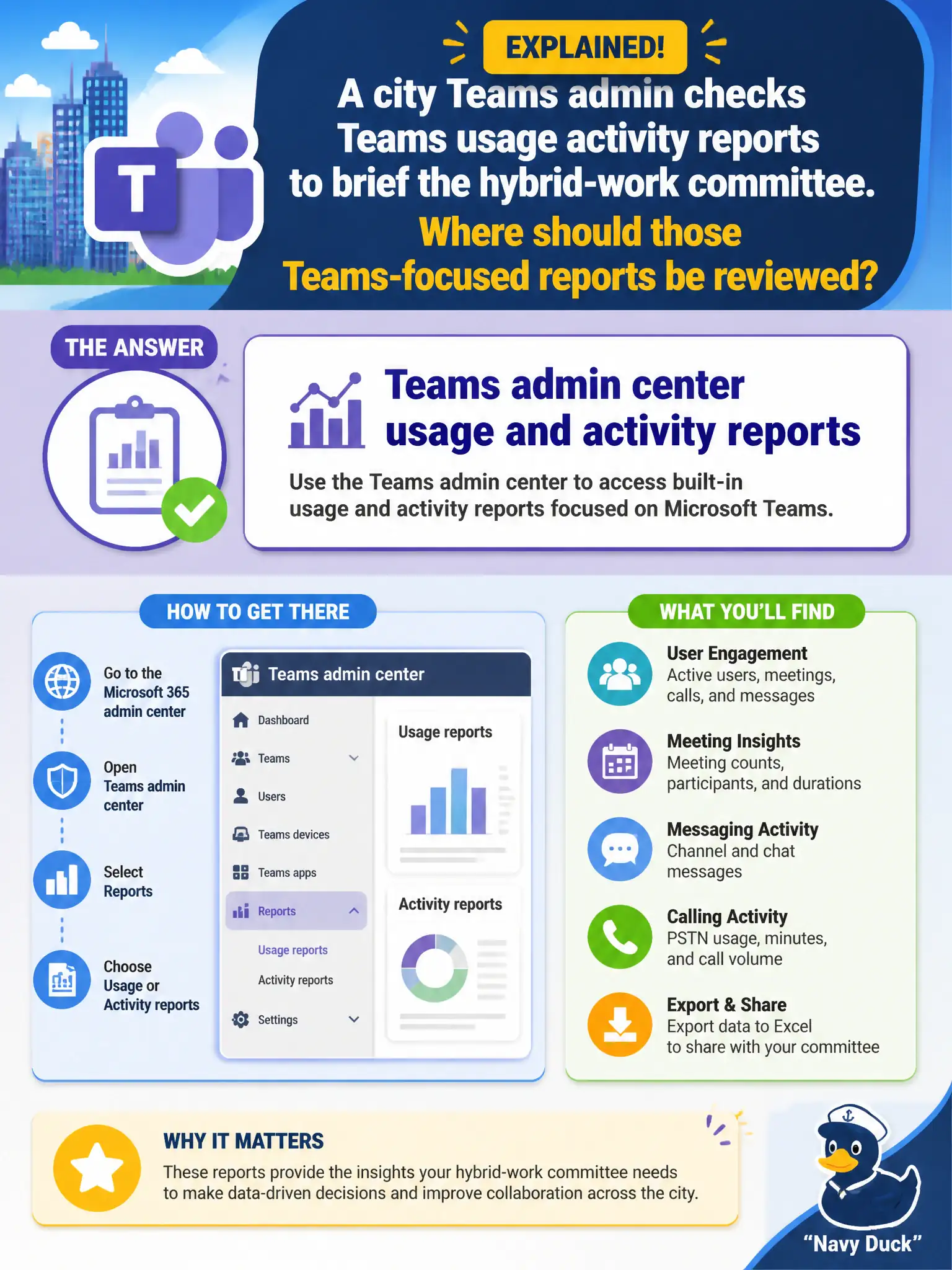
Teams has its own report room in the Teams admin center—great for chat, meetings, and activity trends. That’s where a Teams admin pulls usage activity for leadership. Forms and OneDrive settings won’t tell the Teams story.
Full Explanation
Teams admin center usage and activity reports are the correct place for a city Teams admin to gather Teams-focused metrics for a hybrid-work committee. Those reports cover Teams workload signals such as user activity, meetings, and collaboration patterns that matter when municipal leadership asks how chat and meetings are actually used across departments. Because the Teams admin center is purpose-built for the Teams product, it is the fundamentals answer whenever the scenario names Teams usage activity rather than a generic tenant rollup or an unrelated Office app.
Microsoft Forms response summaries only describe survey or form submissions; they do not replace Teams meeting and chat activity reporting for hybrid-work briefings. OneDrive personal recycle bin settings control file recovery for an individual user’s OneDrive and say nothing about organization Teams usage. Azure Virtual Desktop host pool metrics measure session-host capacity and desktop virtualization health, which is a different platform concern from Teams collaboration analytics.
An exam caveat is that Microsoft 365 Admin center reports can still show high-level Teams adoption alongside other workloads, while the Teams admin center goes deeper for Teams-specific operational and activity views. Candidates should match the reporting surface to the depth and product named in the stem. Operationally, open the Teams admin center with an appropriate Teams admin role, locate usage or activity reports for the reporting period the hybrid-work committee requested, export or capture the key charts, and cross-check that external-access or meeting trends match what city policy owners expect to discuss.